

You have a shelf. Maybe a physical one, maybe digital. On it, in some order, are the remains of every system that was going to fix your relationship with email.
Getting Things Done. You read the book. You set up the contexts (@email, @calls, @computer, @errands). You did the weekly review. It worked for three weeks. Then you missed a review, and the trusted system became an untrustworthy system, and the overhead of maintaining it became another source of anxiety on top of the inbox it was supposed to tame.
Inbox Zero. You cleared your inbox on a Sunday night. It felt transcendent. By Monday at noon, there were 47 new emails. By Tuesday morning, you were back to triple digits. You tried again the following Sunday. Same result. Eventually the Sundays stopped.
Time blocking. You carved out 9-11 AM for deep work. No email, no Slack, no interruptions. It lasted until 9:23 AM, when a client email arrived that could not wait until 11, and the block shattered, and the entire morning became reactive.
Pomodoro. Twenty-five minutes on, five minutes off. Except the five-minute break became an email check that became a 20-minute reply chain, and the next Pomodoro never started.
Batching. Check email three times a day. Except between check-ins, 40 emails accumulated, and the batch processing session became its own overwhelming event.
“I’ve tried every productivity system. GTD. Inbox Zero. Time blocking. None of it matters because the emails keep coming.”
None of them lasted. And the failure, which you have internalized as a personal failure, a character flaw, evidence that you lack discipline, was never about you at all.
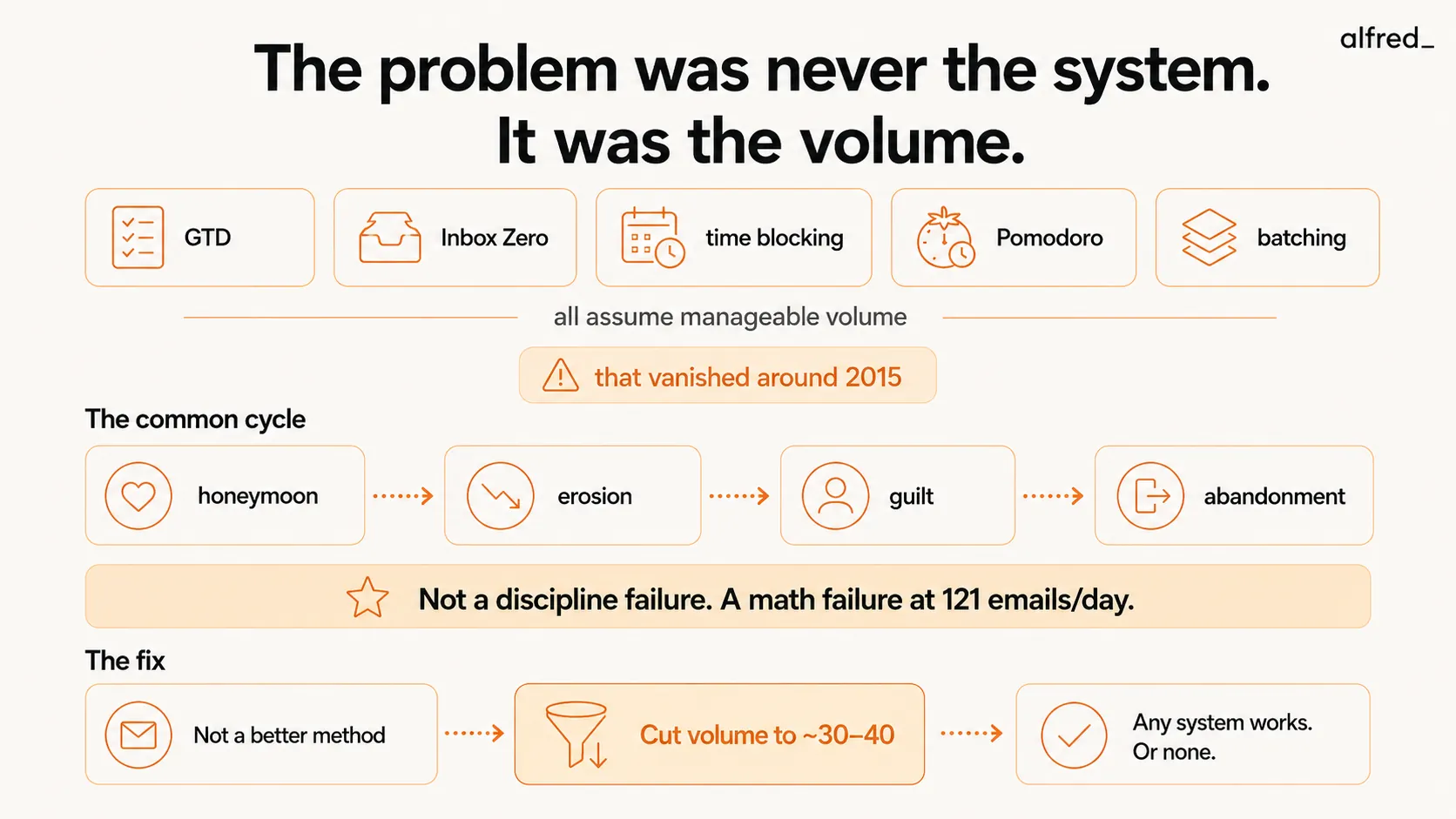
The Volume Problem Nobody Admits
Every major productivity system was designed in a different era.
Getting Things Done was published in 2001. The average knowledge worker received approximately 40 emails per day. David Allen’s core insight, capture every input, process it into a trusted system, review regularly, is elegant and correct. At 40 inputs per day, it is also achievable. You can capture and process 40 items. You can maintain a trusted system with 40 daily entries. The weekly review can handle a week’s worth of 200 items.
The Radicati Group now estimates the average knowledge worker receives 121 emails per day. Add Slack messages, Teams notifications, text messages, and meeting follow-ups, and the daily input count approaches 200-300. GTD’s processing loop was never designed for this volume. It is like using a hand pump to drain a swimming pool that is being refilled by a fire hose.
Inbox Zero was coined by Merlin Mann in 2006-2007. At the time, the concept was about spending zero unnecessary time in your inbox, a mindset, not a number. But the popular interpretation became literal: get to zero emails. At 40 emails per day, this was ambitious but possible. At 121, it is arithmetically absurd. If you spend an average of 3 minutes per email, reading, deciding, responding, processing 121 emails takes over 6 hours. That is not a productivity system. That is a full-time job.
Time blocking gained mainstream popularity through Cal Newport’s work, particularly Deep Work (2016). Newport’s argument is sound: deep work requires extended, uninterrupted focus. But the system assumes you can protect those blocks from intrusion. In 2016, email volume was already above 100 per day for most knowledge workers. By 2026, the combination of email, Slack, Teams, and AI-generated communication means that a 2-hour block will accumulate 20-40 messages that create psychological pressure even if you do not read them. A study by RescueTime found that the average knowledge worker gets only 1 hour and 12 minutes of uninterrupted work per day.
The systems are not wrong. They are outdated. They were designed for a communication volume that no longer exists.
The Pattern of Failure
If you have tried multiple systems, you have experienced the same cycle. It goes like this:
Week 1-2: Euphoria. The new system works. Your inbox is clean, or your blocks are holding, or your contexts are organized. You feel in control for the first time in months. You tell a friend about the system. You might buy the premium version of the app.
Week 3-4: Erosion. The volume reasserts itself. The inbox that was at zero creeps to 30, then 60. The time block that was sacred gets broken by a meeting that “can’t be moved.” The GTD review gets pushed from Sunday to Monday to “I’ll do it next week.” The system starts requiring more maintenance than it saves.
Week 5-8: Guilt. You know the system works. It worked for two weeks. So the failure must be yours. You lack discipline. You are not organized enough. You are not committed enough. You promise to restart on Monday. Monday comes. You do not restart.
Week 9+: Abandonment. The system joins the shelf. You go back to survival mode, triaging by urgency, responding to whatever is loudest, and carrying a background hum of anxiety about everything you are missing.
Industry surveys suggest that the vast majority of knowledge workers have tried multiple productivity methods and abandoned them all. The average professional cycles through 3-5 systems over a decade. Each cycle comes with a honeymoon, an erosion, and a guilt phase. Each abandonment deposits a layer of self-blame: I am the kind of person who cannot stick to a system.
You are not that kind of person. You are a person trying to use a hand pump on a fire hose.
Why the System Is Not the Problem
Here is the fundamental error in every productivity system designed for knowledge workers: they assume the incoming volume is manageable.
GTD assumes you can capture and process every input. This requires that the inputs be finite and predictable. They are not.
Inbox Zero assumes you can reach zero through processing. This requires that the processing rate exceeds the arrival rate. It does not. At 121 emails per day arriving over 8-10 hours, you receive a new email roughly every 4-5 minutes. You cannot process faster than they arrive and also do anything else.
Time blocking assumes that email can be contained to blocks. This requires that email respect boundaries. It does not. An urgent client email does not wait for your 4 PM email block.
Batching assumes that catching up is possible. This requires that the batch be clearable. At 40-50 emails per batch, the clearing process itself takes 90-120 minutes, during which 15-20 more emails arrive.
Every system shares the same blind spot: they ask you to do more with the volume, instead of reducing the volume. They are coping mechanisms for a structural problem. They help you survive the flood rather than stopping it.
This is why they all fail. Not because you lack discipline. Because the math is wrong.
“The problem isn’t my system. It’s that 121 emails come every day and no system can handle that.”
The Graveyard of Apps
The system failure extends to software. You have tried the apps, too.
Todoist, Asana, Things 3, task managers that organize what you need to do. But the task list grows faster than you can work it because every email spawns a task, and the emails keep coming. You have 47 tasks in your inbox and 83 in your task manager and the dual tracking creates more anxiety, not less.
SaneBox ($7-36/month), sorts your email into priority tiers. Fewer emails in your primary inbox, but the emails still exist in @SaneLater and @SaneBlackHole. You still check those folders (because what if something important got sorted wrong?). The volume is redistributed, not reduced.
Superhuman ($30-40/month), makes email faster. Keyboard shortcuts, split inbox, quick-reply templates. You process email in 45 minutes instead of 90. But 45 minutes is still 45 minutes of processing work that a human system was supposed to eliminate. Faster processing does not fix the volume problem any more than a faster bucket fixes a sinking boat.
Spark, Shortwave, AI-assisted email with summaries and bundles. The summaries are helpful. The bundles reduce visual noise. But you are still reading summaries, still opening bundles, still making decisions about every email. The decision volume has not changed. Just the packaging.
Each of these tools optimizes a part of the email experience. None of them addresses the root problem: you are the one doing the work. As long as you are personally processing every message, even faster, even sorted, even bundled, the volume exceeds your capacity and the system fails.
What Works Instead
The insight, once you see it, is almost embarrassingly simple:
The problem was never the system. The problem was the volume. Reduce the volume and any system works. Or no system at all.
At 30-40 emails per day, GTD works beautifully. Inbox Zero is achievable. Time blocking holds because the between-block accumulation is 5-10 emails, not 40. Batching is manageable. Even doing nothing, no system, just processing as things arrive, works fine at 30-40 emails.
The question is not “which system should I try next?” The question is: how do I get from 121 emails to 30?
Not by ignoring the other 91. Not by sorting them into folders you check later. Not by unsubscribing from newsletters (you already did that; the number barely moved). By having something else handle the 70% that does not require your expertise, your judgment, or your attention.
alfred_ reads every email. It understands context, who sent it, what it says, how it connects to your calendar, your commitments, your conversation history. It triages by genuine urgency. It drafts replies for routine messages, scheduling, acknowledgments, status updates, follow-ups, in your voice. It tracks commitments so you do not need a separate follow-up system. It assembles a daily briefing that tells you what matters before you open your inbox.
The 121 emails still arrive. You see 30-40 of them. The rest are handled, replied to, archived, categorized, tracked, without your involvement. Not because they were unimportant, but because they did not require you.
At 30-40 emails, you do not need GTD. You do not need Inbox Zero. You do not need time blocks or Pomodoros or batching schedules. You open your briefing, handle the items that need you, and get on with your day. The system problem disappears because the volume problem disappeared.
The Morning After the Last System
You will know it is different because of what you do not do.
You do not open your inbox at 7 AM. You open your briefing. Seven items. Two have draft replies that need your review. You read them, approve one, adjust a word in the other. Three are flagged for your input: a project question, a scheduling conflict, a client proposal that needs your thinking. Two are informational: a contract that arrived, a payment that cleared.
You handle all seven in 18 minutes. Not because you rushed. Because there were only seven.
Then you do your work. And at no point during the day do you think about the system. You do not think about processing, or capturing, or reviewing, or batching. The system is not the thing that works. The volume reduction is the thing that works. The system is irrelevant because the problem the system was supposed to solve no longer exists.
That shelf of abandoned productivity systems? It is not evidence of your failure. It is evidence that you were trying to solve the wrong problem. The problem was never your discipline, your habits, or your commitment. The problem was 121 emails a day. And no human, with any system, can process 121 emails and also do their actual job.
alfred_ does not ask you to adopt a new system. It makes systems unnecessary by reducing the volume to a level where your natural judgment is enough.
You have tried everything else. Try less.