

If you feel permanently behind at work, the fix is three steps:
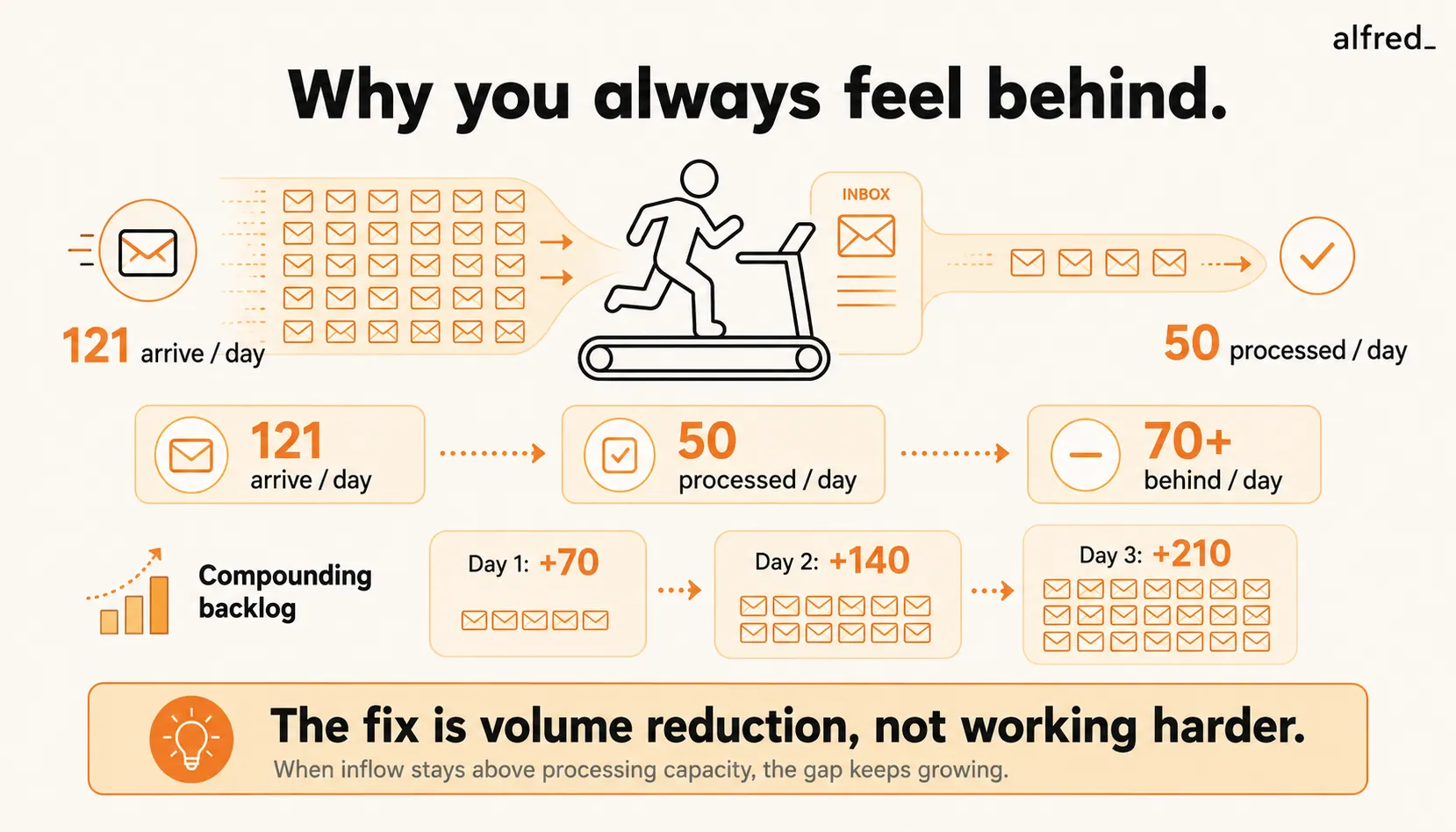
- Stop trying to process everything yourself. The average knowledge worker receives 121 emails/day and can meaningfully process ~50, the gap compounds daily. Volume reduction, not time management, is the move.
- Start every day from a morning brief, not a cold inbox. Instead of opening 121 messages, act on a structured summary of what actually needs you today. alfred_ reads your inbox overnight, triages by urgency, drafts replies, and surfaces the 3-5 items that matter, so you begin the day caught up instead of behind.
- Protect one 2-hour block daily for proactive work. The feeling of being behind is driven by never doing the work that prevents being behind. Reactive work fills 57% of the workday by default, the only way out is explicit time for proactive work, ahead of the inflow.
That’s the whole system. The rest of this piece is why it works and why everything else you’ve tried didn’t.
You are working. You have been working all day. You skipped lunch. You stayed late. You responded to 73 emails, sat through 4 meetings, and updated 2 project trackers. By any observable measure, you were productive.
And yet, as you close your laptop at 6:47 PM, you feel behind.
Not a little behind. Behind in a way that has become so familiar it feels like a personality trait. The to-do list is longer than it was this morning, because every task you completed spawned two new ones. The inbox is higher than when you started, because while you answered 73 emails, 121 arrived. The Slack threads you meant to catch up on multiplied while you were in meetings.
You were Sisyphean. The boulder went up. The boulder came down. Tomorrow it starts again.
“I don’t need zero inbox. I need to not feel like I’m always behind.”
If that feeling has become your baseline, if you cannot remember the last time you felt caught up. This is for you.
The Math That Breaks Everyone
Here is why you feel behind. Not a theory. Not a mindset problem. Math.
The Radicati Group estimates that the average knowledge worker receives 121 emails per day. A McKinsey Global Institute study found that workers spend 28% of their workweek on email, roughly 11 hours. At that pace, you can process about 15 emails per hour, or approximately 50-60 per day if email is your only task.
But email is not your only task. You have meetings. A study by Atlassian found that the average worker attends 62 meetings per month. You have actual work, the deliverables, the projects, the thinking that constitutes your actual job description. Email is a tax on that work, not the work itself.
So you have 121 emails arriving and the capacity to meaningfully process perhaps 40-50 of them. Every single day, you fall 70-80 emails behind. Some of those are noise, newsletters, automated notifications, CC threads. But some are not. Some are from clients, colleagues, and stakeholders who are waiting for responses.
Those responses arrive late. Or they do not arrive at all. Things slip. Follow-ups are forgotten. Balls are dropped. And you, who worked all day, who skipped lunch, who stayed late, feel like you failed.
You did not fail. The math failed you. The system generates more incoming communication than any individual can process. Feeling behind is not a sign of poor performance. It is the inevitable outcome of a structural imbalance.
The Treadmill You Cannot Outrun
The cruelest part of chronic behindness is the acceleration.
When you are behind, you triage. You respond to the loudest, most urgent, most visible emails first. The important-but-not-urgent ones get deferred. Client check-ins you should send proactively, deferred. Follow-ups on conversations that are slowly going cold, deferred. The thoughtful response that would strengthen a relationship, deferred.
This creates what researchers call reactive work, a state where your entire day is spent responding to incoming demands rather than proactively creating value. A RescueTime analysis found that knowledge workers spend only 2 hours and 48 minutes per day on productive work. The rest is communication, context-switching, and catch-up.
“Even when I’m not checking email I’m thinking about what might be in there.”
When you are stuck in reactive mode, the proactive work does not happen. It accumulates. It becomes another source of behindness. You are behind on email and behind on the work email is supposed to support. Two deficits growing simultaneously.
80% of workers report “productivity anxiety”, the chronic sense that they are not doing enough, not keeping up, not performing at the level expected of them. The American Institute of Stress reports that 83% of American workers suffer from work-related stress, with workload being the number one cited cause.
But it is not the workload itself. It is the gap between the workload and the capacity to address it. The workload is 121 emails. The capacity is 50. The gap is 71 emails per day. That gap compounds. It never shrinks. And the feeling of being behind grows in proportion to the gap.
The Lie of Productivity Advice
You have tried the systems. Everyone has tried the systems.
Inbox Zero, Process every email the moment it arrives. Respond, delegate, defer, or delete. The theory is beautiful. The practice requires that you treat email as your primary job. For anyone whose job is not “answering email,” this is impossible. You cannot process every message as it arrives if you are also supposed to be in meetings, writing reports, managing projects, and doing the work you were hired for. Inbox Zero is a full-time job. You already have a full-time job.
Getting Things Done (GTD), Capture everything, process it into a trusted system, review weekly. GTD works brilliantly for self-generated tasks. It collapses under the weight of externally-generated demands. Your inbox does not respect your processing schedule. Clients do not wait for your weekly review. The system requires a level of maintenance that itself becomes a source of behindness.
Time blocking, Dedicate specific hours to email, specific hours to deep work. This assumes that email can be contained to specific hours. It cannot. An urgent client email at 2 PM during your “deep work block” does not wait until your 4 PM email block. Either you break the block and lose the deep work, or you hold the block and risk missing something critical. The block creates an impossible choice, not a solution.
Batching email, Check three times a day. This works for people with low email volume and low-urgency roles. For anyone in a client-facing, leadership, or cross-functional role, three checks per day means 40+ emails accumulating between each check. The batch processing session becomes its own form of overwhelm, a concentrated dose of behindness rather than a continuous drip.
The structural problem with all of these systems: they assume the incoming volume is manageable. It is not. No personal productivity system can overcome the fundamental imbalance between 121 daily emails and a human brain that can meaningfully process 50.
The Comparison Trap
There is an additional cruelty. You look around the office, or the Zoom grid, and other people seem fine. They seem on top of things. They respond promptly. They appear calm. They do not have the hunted look of someone who is drowning.
Two things are true about this.
First, they are behind too. The math applies to everyone. A study by Adobe found that workers spend an average of 3.1 hours per day on work email, and that over half of workers say they are unable to fully clear their inbox. The people who appear on top of it are either hiding it better, have different role demands, or have support systems (human assistants, team structures, or smaller inboxes) that are invisible to you.
Second, the comparison itself is draining you. Social comparison in the workplace has been linked to decreased job satisfaction, increased stress, and imposter syndrome. When you feel behind and believe everyone else is caught up, the gap between your experience and your perception of their experience creates a secondary stress response. You are not just behind. You are uniquely behind. There is something wrong with you specifically.
There is not. The math is the same for everyone. Some people just have better systems, or better facades.
What Changes When You Stop Trying to Process Everything
The shift is not about working harder, working smarter, or developing better habits. The shift is about accepting a fundamental truth: you cannot process 121 emails per day and do your actual job. No one can. The people who appear to manage it either have smaller volumes, different roles, or help.
You need help.
Not a sorting rule. Not a keyboard shortcut. Not a new method for touching each email exactly once. You need something that reads the emails, understands them, makes the initial judgment calls, and presents you with the 15-20 items that actually need your brain, instead of the 121 items that arrived.
SaneBox ($7-$36/month) reduces visual noise by sorting unimportant email into @SaneLater. This helps. Fewer emails in your primary inbox means fewer loops to open. But SaneBox sorts by headers, sender reputation, CC patterns, not by content. It does not know that the email from a new address is actually a referral from your biggest client. It cannot tell the difference between a routine vendor invoice and a pricing dispute that needs immediate attention. You still have to review. You are still processing, just a smaller pile.
Superhuman ($30-$40/month) makes you faster. Keyboard shortcuts, split inbox, AI-assisted triage. You get through email in 45 minutes instead of 90 minutes. This is genuinely helpful. But faster processing of 121 emails still requires processing 121 emails. You saved 45 minutes. You did not eliminate the behindness. You shortened it temporarily, until tomorrow’s 121 arrive.
Shortwave ($30-$120/seat/mo) uses AI to bundle related emails and provide summaries. The visual experience is less overwhelming. But the bundles still contain the same emails. The summaries still require review. The decisions still fall on you. The bundle labeled “Client Projects” still has 14 emails in it, and you still need to decide which ones matter.
alfred_ does not sort, speed up, or bundle your email. It reads every message. It understands who sent it, what it says, what it references, and how it connects to your calendar, your prior conversations, and your commitments. It triages by genuine urgency, not by sender reputation but by content and context. It drafts replies in your voice for messages that need responses. It tracks follow-ups and surfaces items at the right time.
The result: you open your day not to 121 undifferentiated messages, but to a briefing. Here are the 8 things that need your attention. Here is why each one matters. Here are draft replies for 5 of them. The other 113 messages have been categorized, archived, or handled.
You are no longer processing 121 emails. You are reviewing 8 decisions. The math changes. The feeling changes. The behindness evaporates, not because you caught up, but because the gap between incoming and capacity closed.
The Morning You Wake Up Even
There is a morning. It might be a Tuesday, it might be a Thursday, when you open your laptop and feel something unfamiliar. Not dread. Not the bracing tension of “what did I miss.” Something lighter.
You look at your briefing. Four items need attention. Two have draft replies that just need your review. One is a calendar conflict that alfred_ flagged with a suggested resolution. One is a new request that actually requires your thinking.
You handle all four in 20 minutes. Then you start your actual work. The project you have been meaning to dive into. The strategic thinking you keep deferring. The creative work that constitutes the reason you were hired.
At 10:30 AM, you realize you are ahead. Not caught up, ahead. You addressed today’s priorities and you have capacity left over. The to-do list is shorter than it was yesterday. The inbox count is a number that no longer triggers the Zeigarnik effect because the items behind it are handled.
“It’s this constant low-level anxiety. Always there. Even on weekends.”
That constant low-level anxiety was the gap. The gap between what arrived and what you could process. The gap that compounded every day, every week, every month until it felt like a permanent feature of your professional life. Something you just lived with. Something you assumed everyone lived with.
The gap is gone. Not because you outran the treadmill. Because something else started running it.
alfred_ costs a fraction of what the feeling of being permanently behind has already been costing you.




