

There is a hum.
Not a sound. A feeling. A low-level background anxiety that follows you everywhere, to dinner, to the couch, to bed, to the weekend. Even when you are not looking at your inbox, part of your brain is half-monitoring it. Wondering. What came in? What slipped? Who is waiting for a response you forgot to send?
“It’s this constant low-level anxiety. Always there. Even on weekends.”
If you recognize that hum, this page is for you. Not because there is a quick fix. But because the hum has a name, it has a cause, and the cause is not you.
The Hum Has a Name
Researchers call it workplace telepressure, the preoccupation and urge to respond quickly to work messages. It is not a personality flaw. It is not being “too Type A.” It is a documented psychological phenomenon with measurable consequences.
A study by Barber and Santuzzi tracked 234 workers and found that telepressure predicts:
- Lower psychological detachment from work (you cannot mentally switch off)
- Higher physical and cognitive exhaustion (not just tiredness, depletion)
- More sleep problems (the hum follows you to bed)
- Increased burnout and absenteeism (the long-term cost of never disconnecting)
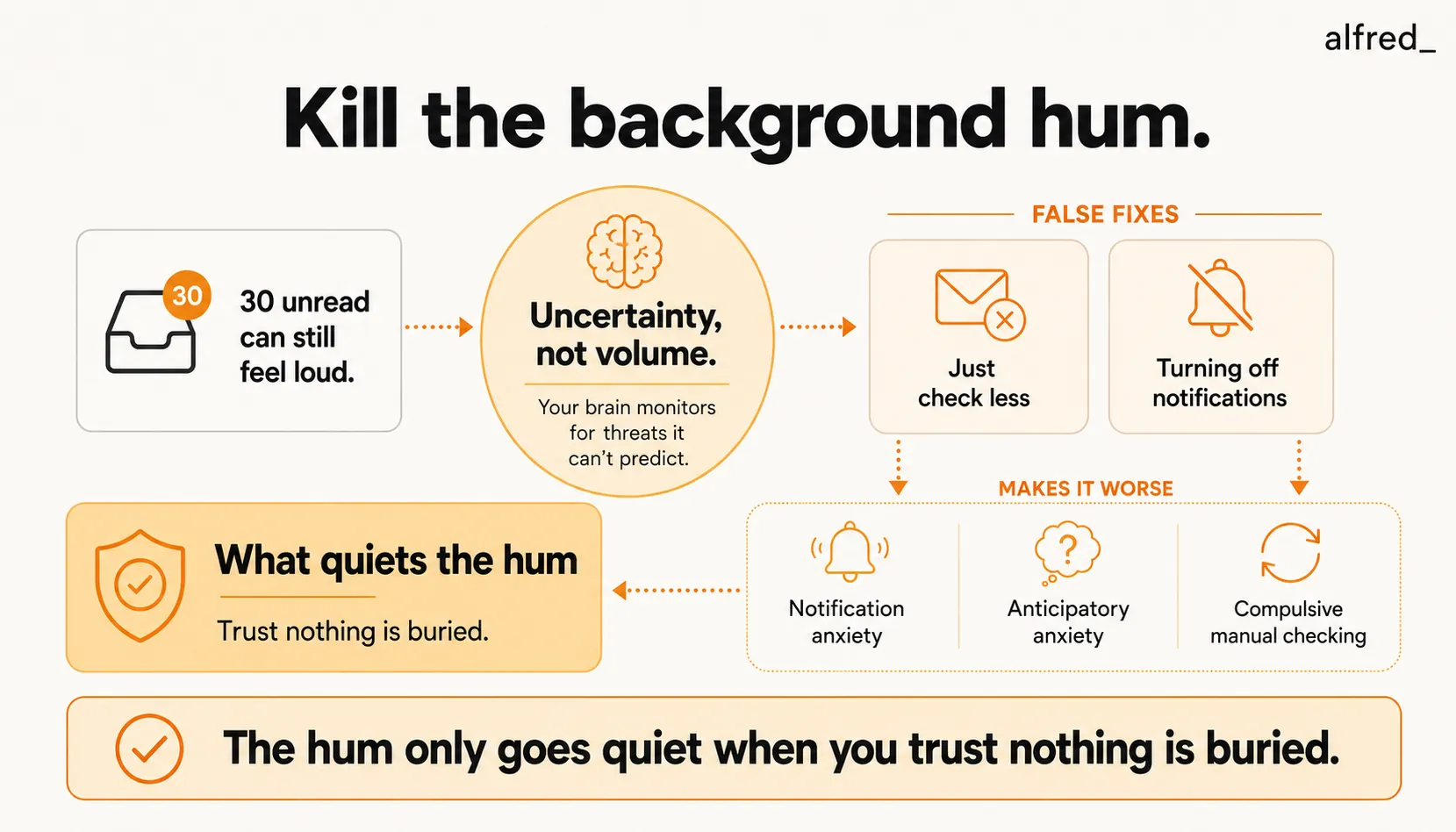
The cruel part: telepressure operates independently of actual workload. You can have zero urgent emails and still feel the pull. The anxiety is about what might be in there, not what actually is. It is anticipatory. It is about uncertainty.
And it is everywhere. 80% of workers report “productivity anxiety”, the constant feeling of being behind. 66% of Americans say email is a source of stress. Workers expected to be available for email outside work hours have measurably higher cortisol than those who are not, according to a University of Hamburg study of 132 people across 13 workplaces.
You are not imagining this. Your body is physiologically responding to a threat it cannot resolve, because the threat is not a specific email. The threat is the unknown.
Why “Just Check Less” Is the Worst Advice You Will Hear
Every productivity article says the same thing: limit email to three times a day. Batch your checking. Set designated email hours. Turn off notifications.
This advice works for people who do not have email anxiety.
For people who do, it is gasoline on a fire.
“I turned off notifications and it somehow got worse, now I compulsively check manually.”
Here is the paradox. The anxiety is about not knowing. When you check email, you briefly resolve the uncertainty. The hum quiets for a few minutes. Then it builds again. Checking less does not reduce the number of anxiety cycles. It extends them. Instead of 30 small spikes of “let me check” throughout the day, you get 3 massive waves of dread separated by hours of wondering.
Kushlev and Dunn at UBC ran a study where 124 participants limited email to three checks per day. Stress went down. But in our view, there is a critical caveat worth considering: this only works if something else provides the certainty your brain is seeking.
Without that certainty, here is what happens when you turn off notifications:
- You remove the external trigger (the ping, the badge, the vibration)
- The internal trigger remains (the worry, the wondering, the hum)
- Without external information, the internal anxiety escalates
- You check manually, more often than the notifications would have prompted
- Each manual check is now a conscious act of giving in, which adds guilt to the anxiety
- The guilt creates a secondary layer of stress on top of the email stress
You traded notification anxiety for anticipatory anxiety. And anticipatory anxiety is worse because it has no resolution point. At least a notification tells you something. Silence tells you nothing.
The dopamine-reward cycle makes it harder still. Email checking follows a compulsive, habitual pattern driven by intermittent reinforcement, the same mechanism behind slot machines. Occasionally, checking reveals something good (a deal closed, a positive response, a problem resolved). That occasional reward trains your brain to keep checking. Turning off notifications does not retrain the dopamine cycle. It just removes the external cue, leaving the craving intact.
The Part Nobody Talks About: Anticipatory Stress
There is a phenomenon in stress research called the cortisol awakening response. Your cortisol levels spike in the first 30-45 minutes after waking, a natural part of your body preparing for the day.
But when you anticipate a stressor, that spike is amplified. A small pilot study published in PubMed in 2024 found that anticipatory stress, dreading something that has not happened yet, triggers measurable physiological stress responses. Your body reacts to the expectation of threat the same way it reacts to actual threat.
“Sunday nights are ruined because I’m mentally pre-triaging Monday’s inbox.”
That is anticipatory cortisol. Your body is mounting a stress response to Monday’s inbox on Sunday night. The emails have not arrived yet. The problems may not exist. But your body does not care about the distinction between real and imagined threats. It floods you with cortisol either way.
70% of Americans report physical or emotional symptoms from ongoing stress. Sunday night dread. Morning stomach drops. The inability to be fully present at dinner because part of your brain is rehearsing tomorrow’s inbox.
“I can’t be fully present anywhere because part of my brain is always half-monitoring what I might be missing.”
This is the insidious nature of email anxiety. It is invisible. People who experience it often do not realize it is happening. They just feel vaguely stressed all the time. Cannot enjoy weekends fully. Cannot be completely present with family. The hum is so constant it becomes the baseline.
What Does Not Work (And What Does)
Here is an honest comparison of approaches, evaluated specifically for email anxiety, not email overload, not email speed, but the background hum:
| Approach | Effect on the Hum |
|---|---|
| Turn off notifications | Makes it worse, trades notification anxiety for anticipatory anxiety |
| "Check 3x/day" rule | Creates 3 windows of dread and 21 hours of wondering |
| Inbox Zero methods | Require you to face every email, the anxiety is about facing it |
| SaneBox ($7–$36/mo) | Some relief, noise is filtered. But you still do not know if something important was miscategorized |
| Superhuman ($30–$40/mo) | Read receipts and follow-up reminders actually increase monitoring behavior |
| Reclaim.ai ($12–$18/mo, annual billing) | Protects calendar time, but does not touch email anxiety at all |
| alfred_ | Eliminates the uncertainty that causes the hum, nothing is buried, ever |
SaneBox offers partial relief. Knowing that noise was filtered means less visual overwhelm when you do open your inbox. The Daily Digest provides a safety net of sorts. Here is what was filtered, so you can check if anything was miscategorized. But “checking if anything was miscategorized” is itself a monitoring behavior. The uncertainty just moves from your inbox to the @SaneLater folder. The hum shifts locations but does not stop.
Superhuman is worth calling out specifically because some of its features actively make email anxiety worse. Read receipts tell you when someone has read your email, which means now you are anxious about email and about whether they read it. Follow-up reminders track unanswered threads, which means you are now monitoring response times on top of everything else. Superhuman is built for people who want to be faster at email, not for people who want to stop thinking about it.
alfred_ addresses the root cause. It continuously triages your inbox, not once a day, not when you check, but continuously. At any moment, you can know: nothing important is buried. Everything urgent has been surfaced. Replies are drafted. Follow-ups are tracked. The thing that lets you stop monitoring is not willpower or discipline. It is trust. Trust that the system caught what matters.
What Trust Feels Like
There is a moment, usually about a week in, when something shifts.
You are at dinner. Your phone is in your pocket. The usual half-thought appears: I should check email. But instead of the familiar tug, there is something else. A quieter voice: It’s handled. If something needed me, it would have been flagged.
You do not check. Not because you are disciplining yourself. Not because you set a boundary. Because there is genuinely nothing to check for. The system is watching. It caught the urgent email from your client at 4:47 PM and flagged it. It drafted a reply. It will be there when you sit down tomorrow morning. Nothing is slipping. Nothing is buried.
The hum goes quiet.
“The mental overhead of ‘I need to respond to that’ is worse than actually responding.”
That mental overhead, the invisible weight of unresolved email, is what drains you. Not the 3 minutes it takes to write the reply. The 3 hours of carrying the awareness that you need to. alfred_ removes the overhead by removing the uncertainty. Replies are drafted. Follow-ups are tracked. The weight lifts because there is nothing left to carry.
This is not about checking email less. It is about needing to check less. The distinction matters. “Checking less” through discipline creates a new source of anxiety (am I missing something?). Needing to check less because you trust the system. That is actual relief.
The Cost of the Hum (And the Cost of Ending It)
Telepressure predicts burnout. Burnout predicts absenteeism. Absenteeism predicts turnover. Surveys suggest roughly one in five companies have formal policies limiting after-hours email. And the research shows that formal policies alone do not help, only environments where the implicit expectation of constant availability is actually removed.
You cannot change your company’s culture by yourself. You cannot make clients stop emailing at 9 PM. You cannot make your manager stop sending weekend messages.
But you can eliminate the reason those emails create anxiety. The anxiety is not about the emails themselves. It is about not knowing whether they are sitting in your inbox, unread, potentially urgent, possibly slipping through.
alfred_ connects to your Gmail or Outlook. It does not change your email client. It watches your inbox, understands context, surfaces what matters, drafts replies, and tracks follow-ups. Continuously.
The hum stops when you trust that nothing is buried. Not when you check less. Not when you turn off notifications. Not when you batch your email into time blocks. It stops when you know, actually know, not hope. That if something important came in, it was caught. Triaged. Flagged. Drafted.
That is what alfred_ buys. Not a faster inbox. Not a cleaner inbox. A quieter mind.