

You just left a 2-hour meeting. It went well. Important things were discussed. Decisions were made. You feel productive.
Then you open your laptop.
52 new emails. 34 Slack messages across 7 channels. 3 threads where someone @mentioned you. A Google Doc with 6 comments awaiting your response. Two calendar invitations for tomorrow that conflict with each other.
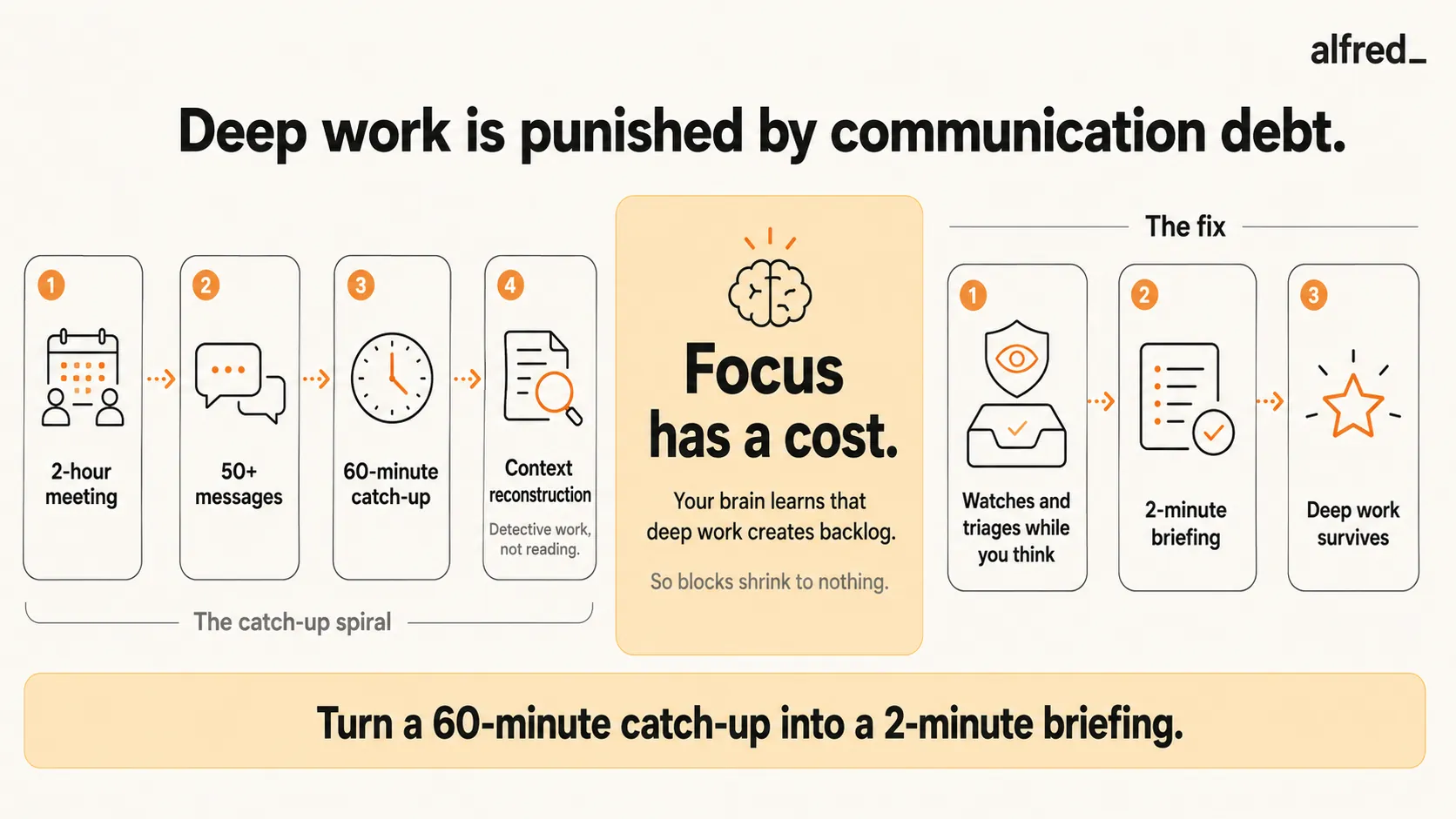
The productive feeling evaporates. In its place: the familiar sinking sensation of being behind. Not behind on work you chose to postpone. Behind on work that accumulated while you were doing other work. The meeting was productive. The cost of attending it was an hour of catch-up.
“I dread leaving my inbox for more than 30 minutes because I know what’s waiting when I come back.”
This is the catch-up spiral. And it is systematically punishing your ability to do the work that actually matters.
The Math of Communication Debt
The average knowledge worker sends and receives 121 emails per day (Radicati Group). Over an 8-hour workday, that’s a steady stream of incoming messages. Add Slack messages, the average user sends around 90 per day, and you’re looking at a constant stream of incoming communications across channels.
Step away for 2 hours and you return to roughly 50 new messages.
But the number understates the problem. Because those 50 messages aren’t 50 isolated items. They’re fragments of conversations that have been moving without you:
- A decision thread where 4 people debated and reached a conclusion you weren’t part of
- A client email that arrived, was responded to by a colleague (CC’d you), then the client replied with a follow-up question directed at you
- A Slack thread where someone asked a question, three people answered with conflicting information, and now someone is asking you to clarify
- A calendar invitation that references a meeting you weren’t in, about a project you are responsible for
To catch up, you can’t just read the messages. You need to reconstruct what happened. This means reading threads from the bottom up, inferring context from incomplete information, determining which threads still need your input and which resolved without you, and figuring out whether the decisions made in your absence are ones you agree with.
Context reconstruction is cognitively expensive. It’s not reading. It’s detective work.
“I spend the first hour after every meeting just figuring out what happened while I was in the meeting. It’s Sisyphean.”
Why Deep Work Gets Punished
Here’s the cruelest dynamic in modern knowledge work: the activities that produce the most value also create the most communication debt.
Deep work, the focused, uninterrupted thinking that produces strategy, analysis, creative output, and breakthrough insights, requires extended periods without checking messages. Cal Newport’s research on deep work consistently shows that the most valuable cognitive output comes from sustained focus blocks of 90 minutes or more.
But every minute of deep work is a minute of accumulating communication debt. Two hours of focused writing means two hours of messages piling up. When you surface from the deep work, the catch-up spiral is waiting.
Over time, your brain learns this association. Focus = debt. Depth = punishment. The longer you concentrate, the worse the pile when you come back. So your brain starts shortening the focus blocks. Instead of 90 minutes, you check after 45. Then 30. Then 15. Eventually, you’re checking continuously, never building any communication debt, never doing any deep work, always reactive, always responsive, never producing anything that requires sustained thought.
Research by Gloria Mark at the University of California, Irvine found that the average attention span on any screen had dropped to just 47 seconds (with a median of 40 seconds) in communication-heavy environments. Forty-seven seconds. That’s not a focus block. That’s barely enough time to read a paragraph.
“I know I should do 2-hour focus blocks. But every time I do, I come back to chaos. Eventually I just stopped trying.”
This is how the catch-up spiral kills deep work. Not by preventing it directly, but by making the cost of it feel unbearable. The punishment isn’t in the focus block. It’s in the 60 minutes after the focus block that you spend catching up on everything that happened while you were thinking.
The Context-Switching Tax on Top of the Catch-Up
The catch-up isn’t just time. It’s cognitive quality.
When you return from a meeting or a focus block and begin processing 50 accumulated messages, you’re performing rapid context switches, jumping from the client contract to the team scheduling thread to the budget question to the design review comment. Each switch costs cognitive resources. Research on task switching (Monsell, 2003) consistently shows that switching between contexts imposes a measurable performance cost: slower processing, more errors, reduced comprehension.
After 45 minutes of rapid context-switching through your catch-up pile, your cognitive function is degraded. You’ve spent your best mental energy on triage, leaving your worst mental energy for the actual work that the messages require. The important client email that deserves a thoughtful, strategic response gets whatever’s left of your brain after processing 49 other messages.
The result: your responses during catch-up are worse than they would be if you’d seen the messages in real time. The irony is sharp. You stepped away to do deep work, but the catch-up process degraded the quality of the work that comes after.
“By the time I figure out what happened, I’m too fried to actually do anything about it.”
Why “Just Check More Often” Is Not the Answer
The obvious solution is to check more frequently. If 2 hours creates a 50-message catch-up spiral, check every 30 minutes and face only 12 messages.
This is what most people do. And it’s exactly why most people never do deep work.
Checking every 30 minutes means you never reach the cognitive depth required for complex thinking. Your brain never fully disengages from the monitoring function. You’re always half-aware that a check is coming, which research from the University of British Columbia shows increases inattention and hyperactivity symptoms even when the phone isn’t actively used.
You’ve traded the catch-up spiral for continuous partial attention. The messages don’t pile up, but neither does your ability to think deeply about anything. You spend the day in reactive mode, responding, triaging, coordinating, and the work that requires actual thinking gets pushed to evenings and weekends.
Neither extreme works. Stepping away creates communication debt. Staying connected prevents depth. The problem isn’t your behavior. The problem is that nothing is watching while you’re away.
What Actually Works: A System That Watches While You Think
The catch-up spiral has a structural solution. Not checking more. Not checking less. Having something that monitors, triages, and prepares a brief while you’re focused on something else.
This is what executive assistants do. You go into a meeting, and when you come out, your EA says: “Three things while you were gone. The Acme contract came back signed, I forwarded it to legal. Sarah needs your input on the Q2 budget by end of day, here’s the relevant email. And the team meeting tomorrow was moved to 2 PM, I already confirmed your availability.”
Two minutes. Not sixty. Two. Because someone with judgment processed the incoming flow, identified what mattered, handled what they could, and prepared you for what they couldn’t.
SaneBox ($7-$36/month) reduces the volume by sorting noise into @SaneLater. This means your catch-up pile after a 2-hour meeting is smaller, maybe 30 messages instead of 50. That’s helpful but doesn’t change the fundamental dynamic. You’re still doing context reconstruction manually on the messages that remain.
Superhuman ($30-$40/month) helps you process the catch-up pile faster. AI summaries let you skim threads without reading every message. Split inbox separates human messages from automated ones. If the catch-up used to take 60 minutes, Superhuman might compress it to 35. But 35 minutes of catch-up after a 2-hour focus block is still a 35-minute tax on deep work.
Shortwave ($30-$120/seat/mo) bundles email threads and provides AI summaries, which helps with context reconstruction. But it’s still inbox-first. You open it, you scroll, you process. The judgment about what matters relative to your specific priorities and calendar is still yours to make.
alfred_ eliminates the catch-up spiral by doing the context-reconstruction for you. While you’re in a meeting or a focus block, alfred_ watches your inbox. When you come back, instead of 52 raw messages, you get a brief: “Here’s what happened. Three things need your attention. Two drafts are ready for your review. Everything else is categorized.” The 60-minute catch-up becomes a 2-minute scan.
The deep work isn’t punished because the communication debt doesn’t accumulate. It’s processed in real time by a system that understands what matters.
What Changes When the Spiral Breaks
People describe the same shift. The moment they realize they can step away, really step away, and come back without the dread.
You leave for a 2-hour focus block. You close your email. You close Slack. You work on the thing that needs your full brain. The strategy document. The code review. The creative brief. Whatever it is, you give it everything, because you’re not counting down to the catch-up.
When you surface, there’s a brief waiting. Not 52 messages. A brief. The Acme contract arrived, draft response ready. Two FYI threads, no action needed. Sarah’s question about the timeline, here’s context and a suggested reply. The meeting tomorrow was confirmed.
Ninety seconds. You’re caught up. You approve two drafts, adjust one, and move to the next thing.
The focus block didn’t cost you an hour of catch-up. It cost you 90 seconds of reviewing a brief. The deep work is no longer punished. The Sisyphean cycle is broken.
“I used to think focus time was a luxury I couldn’t afford. Now I realize the catch-up spiral was the luxury, the most expensive one in my workday.”
The Economics of the Spiral
Do the math on a typical week.
If you step away from your inbox 4 times per day (2 meetings + 2 focus blocks), and each return creates a 45-minute catch-up spiral, you’re spending 3 hours per day catching up. Fifteen hours per week. 780 hours per year, spent not on work, but on reconstructing the context of work that happened while you were doing other work.
At a loaded cost of $75/hour, that’s $58,500 per year in catch-up time. For a senior employee at $150/hour, it’s $117,000.
alfred_ eliminates the catch-up spiral entirely.
The return isn’t abstract. It’s the 3 hours per day you get back. The deep work that stops being punished. The cognitive energy that stops being wasted on detective work. The evening hours you stop using to do the thinking work that the catch-up spiral pushed out of your day.
The spiral was always optional. You just didn’t have anything watching while you were away.
Now you do.