
You sit down to do the one piece of work that actually requires your brain, and within ten minutes a message pulls you out. You answer it, return, and spend the next stretch trying to remember where you were. Most knowledge workers spend their best cognitive hours in exactly this state: busy, responsive, and never quite producing the work only they can do. Cal Newport’s Deep Work is the argument that this is not a personal failing but a structural one, and that the ability to focus without distraction is becoming both rarer and more valuable. Here are the four philosophies he lays out, the research underneath them, and the one role the framework struggles to serve.
The Definition and the Hypothesis
Cal Newport’s Deep Work (Grand Central Publishing, 2016) opens with two definitions that anchor everything that follows.
Deep work:
“Professional activity performed in a state of distraction-free concentration that pushes your cognitive capabilities to their limit. These efforts create new value, improve your skill, and are hard to replicate.”
Shallow work:
“Non-cognitively demanding, logistical-style tasks, often performed while distracted. These efforts tend to not create much new value in the world and are easy to replicate.”
Newport’s central economic argument:
“The Deep Work Hypothesis: The ability to quickly master hard things and the ability to produce at an elite level, in terms of both speed and quality, are two core abilities for thriving in the new economy. Deep work helps you quickly learn hard things and helps you produce at an elite level. If you don’t cultivate this ability, you’re likely to fall behind as the world spins deeper into complexity.”
Newport is a computer science professor at Georgetown University. The book draws on his own experience producing academic research at a high rate while teaching, and on case studies of practitioners who have structured their professional lives around extended, uninterrupted focus.
The Four Philosophies of Deep Work
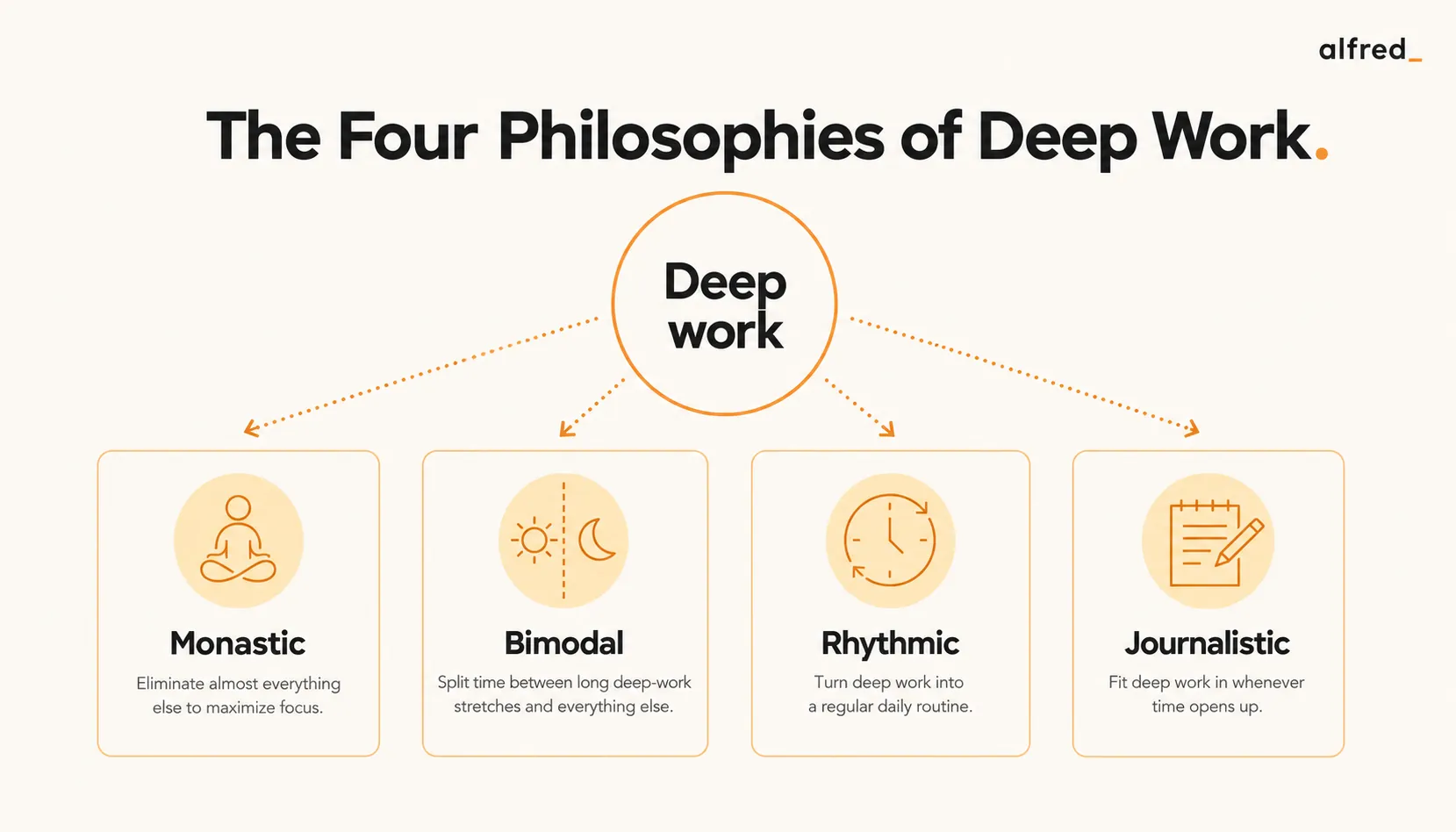
Newport’s most practically useful contribution is his taxonomy of four distinct approaches to incorporating deep work into a professional life. The distinction matters because a single prescription (“just focus more”) ignores the structural constraints of different roles and careers.
1. Monastic Philosophy
Eliminate or radically minimize all shallow obligations to maximize deep work hours. Best suited to people with a single clearly defined professional mission who can opt out of normal communication expectations.
Canonical example: Donald Knuth
Knuth, author of The Art of Computer Programming and creator of TeX, has had no email address since January 1, 1990. From his Stanford webpage:
“I have been a happy man ever since January 1, 1990, when I no longer had an email address. I’d used email since about 1975, and it seems to me that 15 years of email is plenty for one lifetime.”
“Email is a wonderful thing for people whose role in life is to be on top of things. But not for me.”
“My role is to be on the bottom of things. What I do takes long hours of studying and uninterruptible concentration.”
Knuth maintains a postal address; his secretary prints physical copies of emails he might want to respond to. He reviews them a few times per year.
2. Bimodal Philosophy
Divide time into extended deep work periods (hermetically sealed, typically weeks or months) and “everything else” periods (fully available). Neither mode is abandoned. They alternate.
Canonical example: Carl Jung
In 1922, Jung purchased land at Bollingen on Lake Zurich and built a stone tower complex (worked on with his own hands over decades) where he retreated for months at a time to do his deepest theoretical writing. From Memories, Dreams, Reflections:
“At Bollingen I am in the midst of my true life, I am most deeply myself.”
Jung maintained an active Zurich clinical and lecturing practice (the shallow periods) while retreating to Bollingen (the deep periods). Newport’s key observation: he did not abandon professional life. He partitioned it.
Secondary example: Adam Grant. Wharton professor Grant stacks his teaching into fall semester, freeing spring and summer for research. During isolation periods he activates an out-of-office email responder. In 2012 alone, Grant published seven peer-reviewed articles in major journals. Newport describes this as “an absurdly high rate for his field.”
3. Rhythmic Philosophy
Schedule deep work in consistent daily blocks at the same time, removing the decision of when to do it. The ritual recurrence is the mechanism: deep work becomes a default rather than a daily decision.
Newport himself uses this approach: writing before his first meeting, every day, without exception. The value is that the decision cost is eliminated by routine. Brian Chappell, a graduate student Newport profiles in the book, used this method: 5:30–7:30 AM daily, every day, no exceptions. He completed his dissertation while holding a full-time job.
This is the most broadly accessible philosophy because it does not require controlling large blocks of calendar time. It only requires protecting a consistent daily window.
4. Journalistic Philosophy
Switch into deep work mode on demand, fitting it into gaps in an unpredictable schedule. Named for journalists’ professional culture of writing on deadline without extended warm-up time.
Example: Walter Isaacson, biographer of Einstein, Steve Jobs, and Benjamin Franklin, reportedly fitted deep writing sessions into any available gap, including working on manuscripts during crowded social events by finding a quiet corner.
Newport’s caveat: The journalistic philosophy is not recommended for people who haven’t already developed deep work as a practiced skill. Switching cognitive modes on demand requires training. Beginners who attempt it typically produce shallow work because the transition cost is too high without practice.
The Research Foundation: Attention Residue
Newport’s framework is grounded in research by Sophie Leroy (University of Washington Bothell), published in Organizational Behavior and Human Decision Processes (Vol. 109, Issue 2, July 2009).
Leroy’s finding: “thoughts about one task persist while performing another.” When people switch from Task A to Task B, attention continues to be divided. Task A generates cognitive “residue” that impairs Task B performance. The effect is measurable (via lexical decision tasks) and dose-dependent: the stronger the residue, the worse the subsequent performance.
Two additional findings are critical: incomplete Task A generates more residue than completed Task A (confirming the Zeigarnik Effect in professional settings), and the degradation is proportional to the cognitive demand of Task B. For simple tasks, switching cost is small. For cognitively demanding work such as writing, coding, and complex analysis, the cost is significant.
Newport’s application: every email check, every Slack message, every brief meeting interlude generates attention residue that impairs the next task. A fragmented workday is not just annoying. It is measurably cognitively expensive, even when the fragments are brief.
2009
Sophie Leroy's attention residue research, showing that switching between tasks leaves measurable cognitive traces that impair subsequent performance, published the same year as Paul Graham's 'Maker's Schedule, Manager's Schedule'
Leroy, S. (2009). Organizational Behavior and Human Decision Processes, 109(2), 168–181The “Any Benefit” Mindset
Newport coins “any benefit” to describe the dominant professional logic for adopting tools and communication norms:
“You’re justified in using a network tool if you can identify any possible benefit to its use, or anything you might miss out on if you don’t use it.”
This logic drives universal email availability, constant Slack presence, social media, and open-door policies, because any conceivable benefit justifies adoption, regardless of cost. Newport’s alternative is what he calls the craftsman approach to tool selection: adopt a tool only if its benefits substantially outweigh its costs, evaluated against your core professional goals. Most tools don’t survive this test when the cost side of the ledger includes their full attention-fragmenting impact.
The Failure Mode: The Manager Problem
Newport’s framework assumes the practitioner controls their schedule. For people in coordination-intensive roles (managers, consultants, client-facing professionals) structural constraints make the monastic and bimodal philosophies unavailable. Newport acknowledges this without fully resolving it.
His prescription for managers: carve out protected blocks even within heavily scheduled weeks. Even 90 uninterrupted minutes three times per week accumulates meaningful deep work over time. The goal is not the optimal case but deliberate protection of some non-fragmented time.
The deeper critique from Newport’s critics: deep work may privilege a specific type of cognitive output (solo writing, programming, research) that doesn’t represent the full range of valuable knowledge work. Leadership, mentoring, and collaborative creative work are not shallow by Newport’s definition, but they resist the long-block structure he advocates. Newport acknowledges this tension but doesn’t offer a deep work philosophy specifically designed for high-coordination roles.
7 papers
published by Wharton professor Adam Grant in a single year (2012) using the bimodal philosophy, batching a full teaching semester into fall and dedicating spring and summer to isolated research
Cal Newport, Deep Work, Grand Central Publishing, 2016What Has to Happen to the Shallow Work
Every philosophy here has the same unspoken prerequisite. Newport tells you to close email and Slack and confine them to two or three windows a day. The catch is what the post above already names: most people cannot do that, because the shallow tier does not stop generating obligations just because you stopped looking at it. The reply someone needs, the meeting that has to move, the thread that turns urgent. The fear of missing one of those is what keeps the inbox open during the block, which is what kills the block. Knuth could disappear because a secretary printed his email a few times a year. Most people do not have a secretary.
That is the role alfred_ plays. It watches the shallow tier while you are heads-down, triages what comes in, drafts the routine replies, and holds the rest until your processing window, surfacing only the thing that genuinely cannot wait. This is also the most honest answer to the manager problem the framework leaves open: you protect the block not by pretending the coordination work disappears, but by handing the bulk of it to something that handles it for you. The deep work is yours. The shallow work that would otherwise fragment it does not have to be.
The Rhythmic Philosophy is most broadly accessible: protecting a consistent daily block doesn’t require controlling large stretches of calendar. The Bimodal Philosophy works well for roles with predictable seasonal variation. The Monastic Philosophy requires professional autonomy most people don’t have. The Journalistic Philosophy requires being already practiced at deep work. Most people should start with Rhythmic.