

Here is your day.
7:15 AM. Alarm. Phone. Email. 34 new messages since you closed your laptop at 10 PM last night. You scan the subjects. Nothing is on fire. Everything needs attention. You start triaging in bed.
8:00 AM. Laptop open. Coffee made. The plan was to spend the first two hours on the proposal you have been putting off for a week. Instead, you open your inbox. “I’ll just clear the urgent stuff.” There are 7 emails that feel urgent. Each one takes 5-8 minutes. That is 45 minutes. While you responded to those 7, 4 more arrived. You handle 2 of them.
9:00 AM. You have been responding for an hour. The proposal is still untouched. A meeting starts in 15 minutes. You use the 15 minutes to respond to three more emails.
9:15 AM - 10:15 AM. Meeting. You half-listen while catching up on Slack threads in another tab.
10:15 AM. The proposal. You open the document. You stare at it. Your phone buzzes, a text from a client. You answer. You check email. 11 new messages. You handle 4 of them. You look at the clock. It is 10:47 AM.
10:47 AM. The proposal. You write a sentence. An email arrives from your manager, she needs a status update by noon. You write the status update. It takes 20 minutes because you have to check three other threads to compile the information.
11:07 AM. The proposal. Another meeting starts at 11:30.
11:30 AM - 12:30 PM. Meeting. Notes to take. Action items to capture. Follow-up emails to send afterward.
12:30 PM. Lunch at your desk. Email while eating. You respond to 6 messages. Three more arrive.
1:00 PM - 5:00 PM. Three more meetings. Gaps between them that are too short for deep work and too long to waste. You fill them with email. You respond to 31 messages in the afternoon. You attend to 4 Slack conversations. You update a project tracker.
5:00 PM. You look at your to-do list. The proposal you were going to write. The strategy document you were going to review. The client deck you were going to refine. The one-on-one agenda you were going to prepare.
None of it happened. You were busy all day. You did not accomplish a single thing that was on your list when the day started.
“By the time I actually sit down to do the work I was hired for, half my day is gone.”
Not half. All of it. The entire day was reactions.
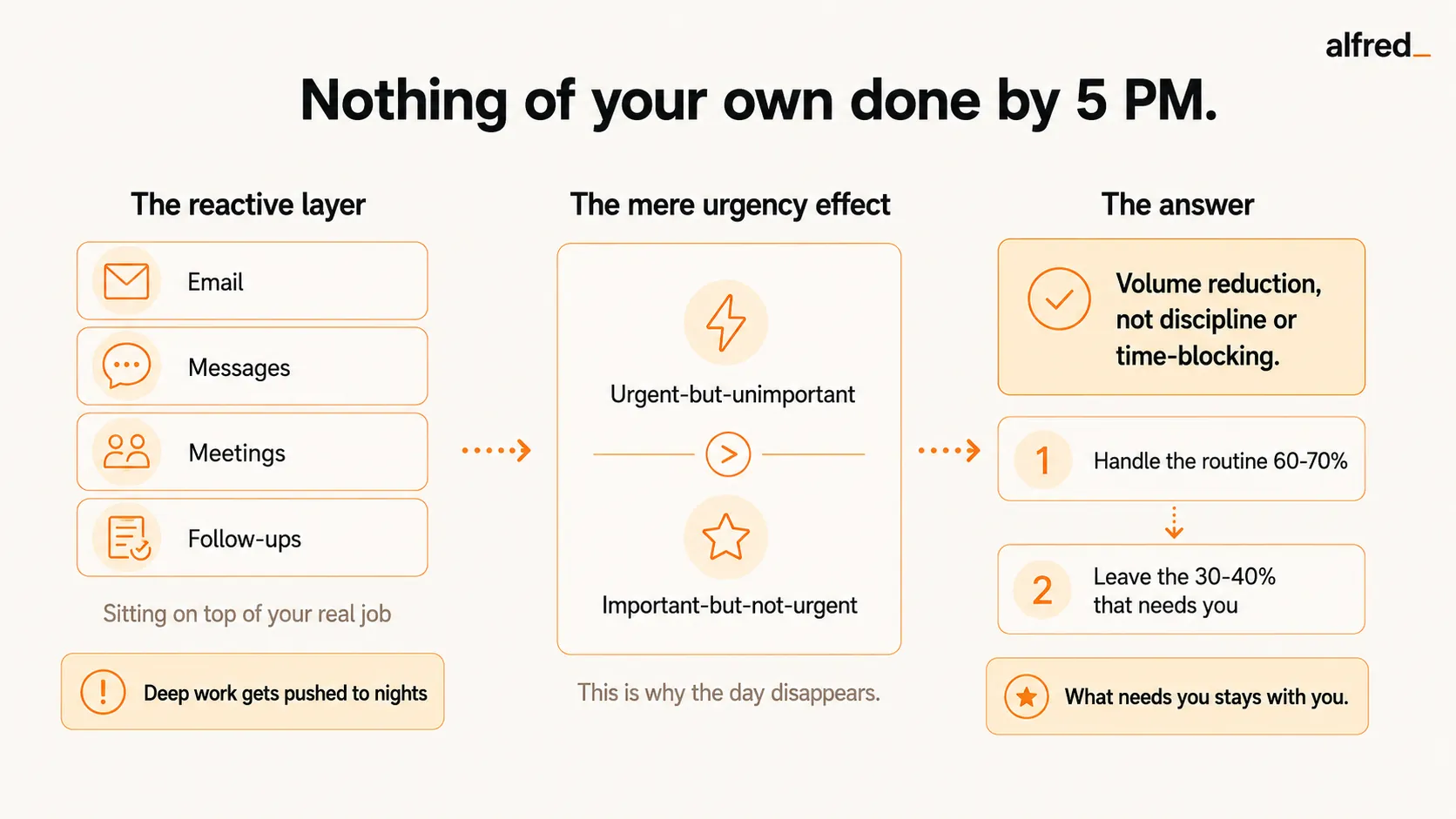
The Reactive Layer
There is a layer on top of your actual job. It consists of email, messages, meetings, follow-ups, status updates, scheduling, coordination, and the endless chain of responses that each trigger further responses. This layer is reactive. You do not initiate it, you respond to it. It arrives unbidden, demands attention, and does not stop.
Your actual job lives beneath this layer. The thinking, the creating, the building, the deciding, the writing, the designing, the leading. This is the work you were hired for. The work that appears in your job description. The work that, if you did it well, would advance your career, satisfy your clients, grow your business, and fulfill you professionally.
The reactive layer eats the real work. Every day.
RescueTime, which tracks how millions of workers spend their time, found that the average knowledge worker has only 2 hours and 48 minutes of productive work per day. Not 2 hours and 48 minutes of free time, 2 hours and 48 minutes of time spent on the work that actually constitutes their job. The remaining 5-6 hours are consumed by communication, coordination, and context-switching.
A McKinsey Global Institute study confirmed: knowledge workers spend 28% of their workweek, roughly 11 hours, on email alone. An Atlassian survey found that workers attend 62 meetings per month, with 50% of those meetings considered unnecessary by attendees.
The math does not leave room for your priorities. If you have 8 working hours and 5-6 are consumed by reactive work, you have 2-3 hours for everything else. But those 2-3 hours are not contiguous. They are scattered in 15-30 minute fragments between meetings, interrupted by notifications, contaminated by the attention residue of the last email you read.
Attention Residue and the Quality Problem
It is not just a time problem. It is a quality problem.
Research by Sophie Leroy at the University of Washington identified a phenomenon called attention residue. When you switch from one task to another, from writing a proposal to answering an email, for instance. Your attention does not switch cleanly. Part of your mind remains on the previous task. The email you just read lingers. The decision you just made echoes. The context you just inhabited persists.
Leroy’s research found that people who experience attention residue perform significantly worse on subsequent tasks. The deep work you manage to squeeze between reactive tasks is not just shorter than it should be. It is lower quality. Your best thinking requires sustained, uninterrupted focus. The reactive layer ensures you almost never have it.
Gloria Mark at the University of California, Irvine found that it takes an average of 23 minutes and 15 seconds to return to the original task after an interruption. If you check email 10 times during a deep work session, and research suggests most people check far more frequently. You lose over 3 hours just to recovery time. Not to the email itself. To the recovery from the email.
“Even when I’m not checking email I’m thinking about what might be in there.”
This is the cruelest mechanism of reactive work. It does not just steal the time when you are doing it. It degrades the time when you are not. The awareness that emails are accumulating, that messages are waiting, that people are expecting responses. This awareness is itself a cognitive load that reduces the depth and quality of whatever else you are trying to do.
Researchers call this continuous partial attention, the state of never being fully present in any one task because part of your mind is always monitoring other channels. It is the default state of the modern knowledge worker. And it is incompatible with deep work.
The Priorities That Never Happen
Look at your to-do list from last Monday. The items that were there at 8 AM. How many did you complete that day?
For most knowledge workers, the answer is discouraging. The urgent-but-not-important displaces the important-but-not-urgent, every single day. The proposal gets written on Thursday night instead of Monday morning. The strategy review happens in a rushed 30-minute window instead of the focused 3-hour session it deserves. The client deck gets the B+ treatment instead of the A+ work you are capable of.
This is the Eisenhower Matrix in action, except in reverse. The quadrant that contains your highest-value work (important but not urgent) is systematically starved by the quadrant that contains reactive work (urgent but not important). Email feels urgent because it is immediate, visible, and often accompanied by social pressure (someone is waiting). Your strategic priorities feel less urgent because no one is standing at your desk demanding you work on them right now.
A study published in the Journal of Consumer Research by Meng Zhu found that people consistently choose to complete urgent tasks over important tasks, even when they know the important tasks have greater value. The researchers called this the “mere urgency effect”, urgency creates a psychological pull that overrides rational prioritization.
Reactive work is inherently urgent. Your priorities are inherently important. The urgency wins, every day, until your priorities become the thing you “never get around to.”
Why Discipline Is Not the Answer
You have tried discipline. You set the alarm earlier. You committed to “no email before 10 AM.” You blocked your calendar. You put your phone in a drawer. You downloaded a website blocker.
Each attempt failed for the same reason the productivity systems failed: the volume does not respect your discipline. While you are being disciplined, while you are in your deep work block, phone in the drawer, inbox closed, the reactive volume accumulates. And when the block ends, the accumulated volume hits you like a wave. The 40 emails that arrived in 2 hours require an hour of catch-up that eats into the next block, or the next meeting, or your lunch, or your evening.
Discipline can defer reactive work. It cannot eliminate it. As long as the total volume exceeds your processing capacity, the reactive layer will consume your day, either during the day or after hours.
This is why the “just be more disciplined” advice feels so hollow. The people giving it either have dramatically lower email volume, have assistants handling their communication, or are just as buried as you and hiding it better.
Removing the Layer
The shift is not about managing the reactive layer better. It is about making it smaller.
If 60-70% of your email is routine, scheduling, acknowledgments, status updates, FYIs, follow-ups, then removing that 60-70% from your direct attention gives you back 7-8 hours per week. Not theoretical hours. Actual hours that were being spent on emails that did not need your expertise, your creativity, or your strategic thinking. Emails that needed a reply, not your reply.
alfred_ handles the reactive layer. It reads every email. It understands context, who sent it, what it references, your calendar, your commitments, the history of the conversation. It triages by genuine urgency. For the 60-70% that is routine, it drafts replies in your voice and queues them for your approval (or sends them automatically for categories you pre-approve). For the 30-40% that needs you, it assembles full context and surfaces them in your daily briefing.
The reactive layer shrinks from 121 emails to 30-40 items. The catch-up pressure disappears. The time blocks hold because the between-block accumulation is manageable. The deep work happens because the attention residue is reduced. You are not wondering what is piling up because you know alfred_ is handling it.
This is not productivity advice. This is volume reduction. The most effective intervention for reactive work is not a better system for handling it. It is less of it.
The 5 PM You Deserve
Here is the day, redesigned.
8:00 AM. You open your briefing. Not your inbox. Your briefing. Seven items need your attention. Three have draft replies. Two need your decision. Two are informational. You handle all seven in 20 minutes.
8:20 AM. You open the proposal. The one you have been putting off. You write for 90 minutes without interruption. Not because you are being disciplined. Because there is nothing to interrupt you. The reactive volume is being handled. Your phone is not buzzing with emails because the emails that would have buzzed are already triaged.
9:50 AM. You check your briefing. Two new items surfaced. You handle them in 6 minutes.
10:00 AM. Meeting. After the meeting, you spend 10 minutes on follow-up because you texted alfred_ the action items and it drafted the follow-up emails for you to approve.
11:00 AM - 12:30 PM. The strategy document. Deep, focused thinking. The kind of work that made you good at your job. The kind you have not done properly in weeks because the reactive layer kept eating the time.
12:30 PM. Lunch. Away from your desk. Without checking email.
1:30 PM - 4:30 PM. Two meetings. Between them, focused work, not email catch-up, because there is nothing to catch up on. The reactive volume is at 30-40 items, not 121.
5:00 PM. You look at your to-do list. The proposal, done. The strategy document, drafted. The client deck, reviewed and refined. The one-on-one agenda, prepared.
Everything that was on your list this morning is crossed off. Not because you worked harder. Because the 5-6 hours that reactive work used to consume were returned to you.
“I just want to do my actual job.”
You can. The reactive layer that has been eating your days is not an immovable feature of modern work. It is a volume problem. And volume problems have a clear answer: reduce the volume.
The hours alfred_ returns are worth everything you were going to do with them but never got the chance.