

The Working Memory Constraint
Working memory, the cognitive system that holds and actively processes information, has a hard capacity limit. The well-known “7 plus or minus 2” figure from George Miller (1956) describes short-term storage capacity: roughly 7 items can be held in short-term memory at once for simple retention.
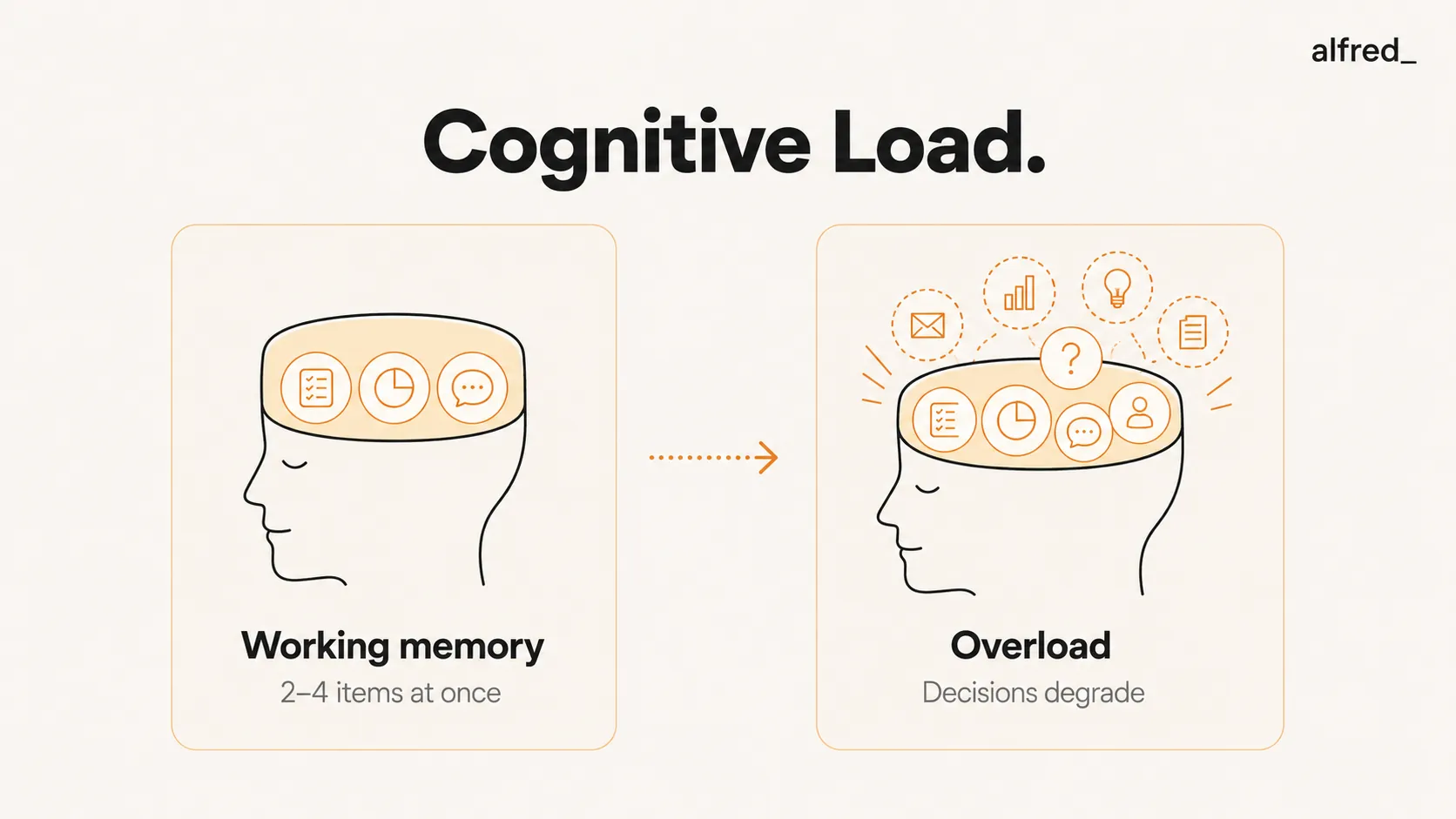
The limit that matters for complex cognitive work is narrower. Research by Nelson Cowan and others established that the capacity for active processing (holding multiple items in mind while simultaneously reasoning about relationships between them) is approximately 2 to 4 chunks. Once this limit is exceeded, processing quality degrades regardless of intelligence, motivation, or experience.
2–4 chunks
the working memory capacity for active processing (not storage), the cognitive limit that governs reasoning quality in complex decisions
Cowan (2001), updating Miller (1956); cited in Sweller's Cognitive Load TheoryA “chunk” is not a single piece of information. It is a meaningful unit, the size of which depends on expertise. An expert chess player chunks board positions into meaningful patterns; a novice sees individual pieces. The same constraint applies to both, but the expert’s chunks are larger. This is why expertise improves performance under cognitive load: not by expanding the limit but by making each unit of capacity more information-dense.
Three Types of Cognitive Load
Sweller distinguishes three types of cognitive load that compete for working memory capacity:
Intrinsic load
The inherent complexity of the task itself. Some problems are genuinely complex and require holding many interacting elements in mind simultaneously. This load is unavoidable for complex work. It is the reason the work is hard.
Extraneous load
Load imposed by poor information design, irrelevant inputs, or unclear communication. This load consumes working memory without contributing to the actual problem being solved. A confusing meeting agenda that requires participants to track which topic they are on generates extraneous load. So does an email that buries the action item in the fourth paragraph. So does any environment that generates unprocessed interruptions requiring cognitive evaluation.
Extraneous load is the target for organizational and communication design. It is not inherent to the work; it is imposed by how the work is presented or structured. Reducing extraneous load directly increases the working memory capacity available for intrinsic load, for the actual problem.
Germane load
Effort devoted to building mental schemas (the integrated knowledge structures that allow future processing to happen more efficiently). This is the productive cognitive load that results in learning and expertise development. It is only possible when extraneous load is low enough to leave capacity for it.
Applied to Knowledge Work
Cognitive Load Theory was developed for classroom instruction, but its implications extend directly to how knowledge workers and executives operate:
Meeting design
A meeting agenda with six agenda items requires participants to track which item is active, what has been decided, what remains open, and what their contribution to the current item should be, all simultaneously. The extraneous load of this tracking directly reduces the capacity available for reasoning about any individual agenda item. Single-topic meetings consistently produce better decisions on that topic than multi-topic meetings, not because attendees are smarter but because working memory is freed for the problem.
Email and communication
An email that asks three questions in one message requires the reader to hold all three in working memory while reading, decide which to answer first, and then remember the others while composing a response. Extraneous load. An email with one clear question and a stated action item reduces load to near-zero and produces faster, more accurate responses, not because the reader is more capable but because the communication design removes unnecessary processing demand.
Context switching
Every context switch requires clearing working memory and loading a new set of task-relevant information. The time cost of switching is real and measurable; the cognitive load cost of incomplete loading after each switch is why performance on complex tasks degrades so significantly in interrupted environments.
Open-plan offices
Open-plan environments generate continuous, unpredictable extraneous load: conversations within earshot require cognitive evaluation to determine whether they are relevant, physical movement in peripheral vision consumes attentional resources, and the absence of clear environmental cues for “this person is deeply focused” means interruptions arrive without friction. The extraneous load is not offset by any collaborative benefit for cognitively demanding individual work.
Extraneous cognitive load is the only type you can actually control as a designer, manager, or communicator. Three changes with the largest impact: single-topic meetings with written pre-reads; one-question emails with explicit action items; batched email processing rather than continuous monitoring.