

What Reactive Work Actually Is
Reactive work is any task triggered by an external request or interruption that pulls you away from planned, high-leverage work.
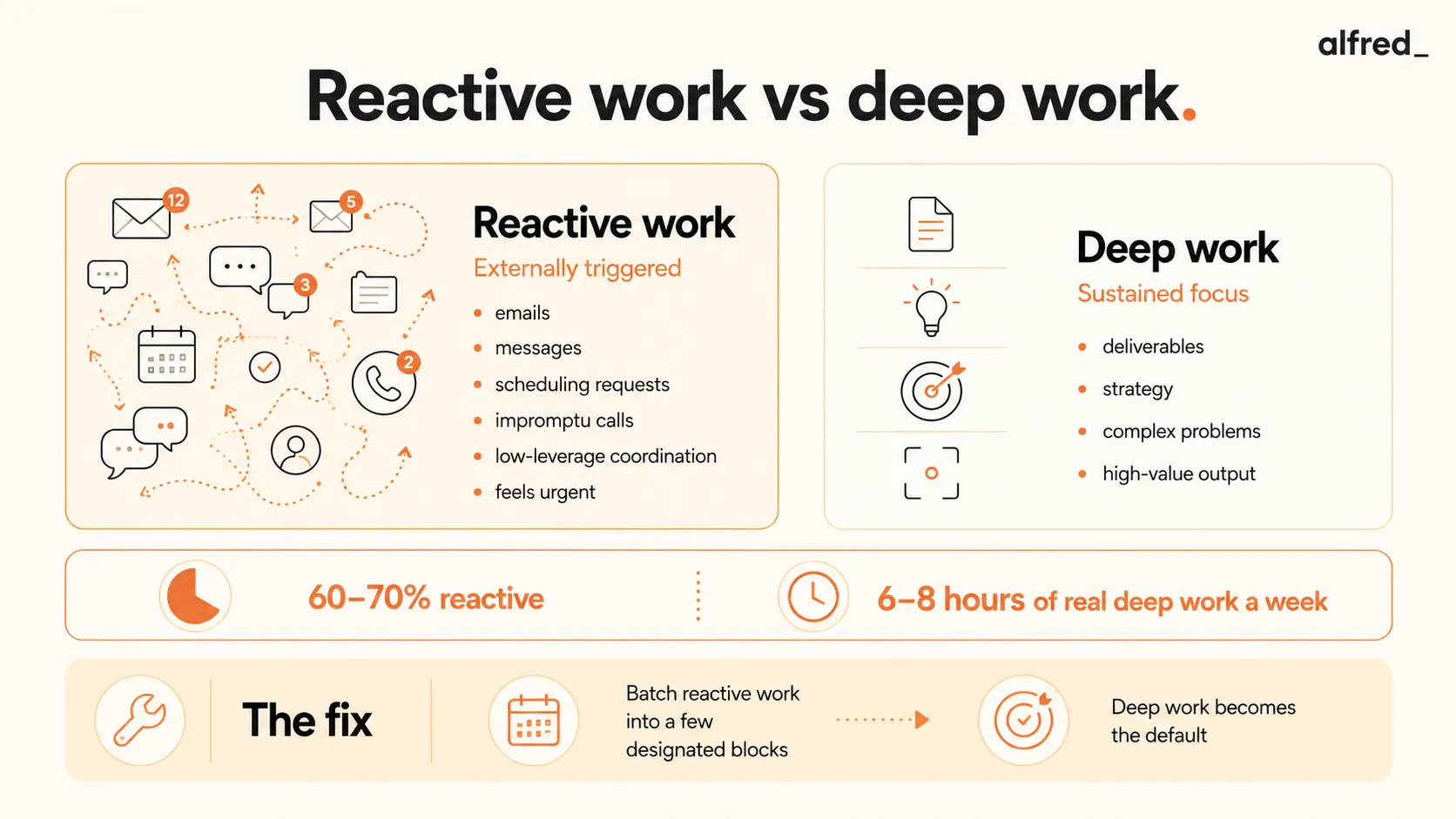
Examples include:
Reactive work is not necessarily low-value. Some reactive tasks (responding to a key client, handling a deal-critical question) are revenue-generating. But most reactive work is low-leverage coordination that feels urgent in the moment but does not move revenue-critical work forward.
What Deep Work Actually Is
Deep work is cognitively demanding work that requires sustained focus and produces high-value output.
For consultants, founders, and high-value professionals, deep work includes:
Deep work is what generates revenue, closes deals, and builds leverage over time. It is the work that separates professionals earning $200K from those earning $500K+. The problem: deep work requires 2 to 4 hour blocks of uninterrupted focus. Reactive work fragments the day into 15 to 30 minute chunks where deep work is impossible. Understanding the true cost of context switching makes this even more alarming.
The Math: How Reactive Work Kills Revenue
Research shows that knowledge workers spend 60 to 70% of their time on reactive work: responding to email, attending meetings, answering messages, and coordinating schedules.
A Typical Consultant’s Day (Reactive-Dominated):
- 40-hour work week
- 25 hours on reactive work (email, Slack, coordination)
- 15 hours available for deep work
- But: fragmentation destroys those 15 hours
- Result: only 6 to 8 hours of actual deep work per week
The Revenue Impact (at $300/hr):
- Deep work hours per week: 8 (should be 25 to 30)
- Lost deep work hours: 17 to 22 hours/week
- Weekly lost capacity: 20 hours × $300 = $6,000
- Annual lost capacity: $312,000
Reactive work does not just consume time. It destroys the conditions necessary for revenue-generating work to happen.
Why “Just Ignore It” Does Not Work
The standard advice for protecting deep work is: turn off notifications, close email, ignore Slack. But this advice fails for high-value professionals because some reactive work is revenue-critical:
The 4-Part Framework: Protect Deep Work Without Missing What Matters
Part 1: Triage Reactive Work Automatically
Not all reactive work is equal. Some requests are urgent and revenue-critical. Most are not. The goal: automatically separate urgent from noise.
Manual Triage (The Old Way):
- Check email every 30 minutes
- Read every message to determine urgency
- Interrupted 10+ times per day
- Deep work becomes impossible
Automatic Triage (The Leverage Way):
- AI reads incoming email and messages
- Urgent, revenue-critical requests flagged immediately
- Routine requests deferred or handled
- You are interrupted only for what actually matters
Part 2: Batch Reactive Work Into Time Blocks
Instead of handling reactive work as it arrives (constant interruptions), batch it into designated time blocks.
Common Batching Pattern:
- 8:00 to 8:30 AM: Reactive work block
- 8:30 AM to 12:00 PM: Deep work block (protected)
- 12:00 to 1:00 PM: Reactive work + lunch
- 1:00 to 5:00 PM: Deep work block (protected)
- 5:00 to 6:00 PM: Final reactive work block
By batching reactive work, you reduce context switches from 10 to 15 per day down to 3. This alone reclaims 4 to 6 hours per week for deep work.
Part 3: Automate Routine Reactive Work
Most reactive work is routine and pattern-based. A personal AI assistant can handle 70 to 80% of it: scheduling meeting requests, confirming receipt of deliverables, sending status updates, answering FAQs, rescheduling conflicts. You approve what requires judgment. The rest gets handled without pulling you out of deep work.
Part 4: Protect Deep Work Blocks With Calendar Rules
Deep work requires calendar protection. Block 3 to 4 hour chunks and enforce strict rules. If you need a practical framework, read about the right way to schedule deep work:
Real-World Example: Before and After
Julia, independent marketing consultant at $350/hour.
Before (Reactive-Dominated):
- Interrupted 12 to 15 times per day
- Deep work attempted in 45-minute gaps
- 8 hours of actual deep work per week
- Billable output: $2,800/week
Felt constantly behind and stressed
After (Deep Work Protected):
- AI triages email: only urgent interrupts
- Reactive batched into 3 one-hour windows
- 28 hours of deep work per week
- Billable output: $9,800/week
Annual increase: $364,000
The Psychology: Why Reactive Work Feels More Important
Reactive work is addictive. It triggers dopamine hits with every email response, every message sent, every task completed. Deep work, by contrast, is cognitively demanding and produces results slowly.
How to Measure Success: Deep Work Hours
The metric for success is not inbox zero or all messages answered. It is deep work hours per week.
Deep Work Hour Targets:
- Minimum viable: 15 hours/week (3 hours/day)
- Good: 20 hours/week (4 hours/day)
- Excellent: 25 to 30 hours/week (5 to 6 hours/day)
Track this weekly. If you are below 15 hours, reactive work is killing your earning capacity.
What a Personal AI Assistant Handles
Personal AI assistants change the equation. They handle reactive work so you get the best of both worlds: reactive work gets handled (nothing slips, no deals lost), deep work stays protected (no interruptions unless revenue-critical).
The goal is 25 to 30 hours of deep work per week. That is where revenue gets generated. That is where leverage gets built.




