

There was a version of you. It might have been two years ago, it might have been five, who did the work you were hired to do.
If you are a designer, you designed. You opened Figma in the morning and closed it in the evening and the hours between were spent making things. If you are a strategist, you strategized. You sat with problems, turned them over, found angles nobody else saw. If you are an engineer, you built. If you are a writer, you wrote. If you lead a team, you led, not by answering emails about leading, but by actually thinking about where the team should go and how to get there.
That version of you did not check email 74 times a day. That version did not spend the first 90 minutes of every morning triaging an inbox. That version did not end the day wondering where the hours went, because the hours went to the work.
Something changed. Not overnight. Slowly, like a tide coming in while you were looking at your phone.
“I got into consulting to use my expertise. I spend most of my day proving I read emails.”
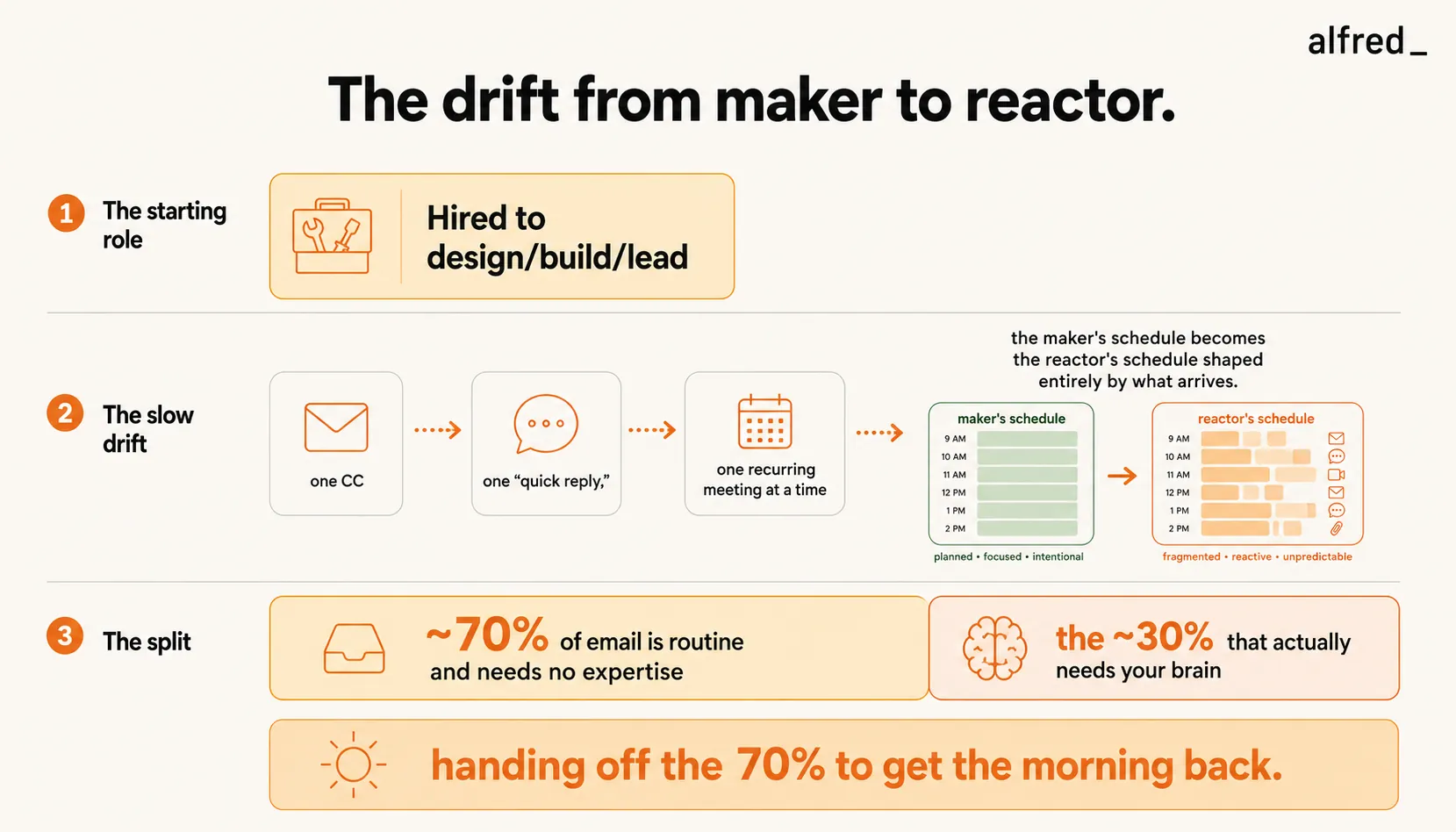
The Drift
Nobody announces the transition. There is no meeting where your manager says, “We are officially changing your role from Designer to Person Who Answers Emails.” It happens one thread at a time.
First, you get CC’d on a project thread. Then you get added to a Slack channel “just to keep you in the loop.” Then someone asks if you can “just quickly respond” to a client question. Then the client starts emailing you directly. Then the client’s colleague starts emailing you. Then someone creates a recurring meeting to discuss the emails.
At each step, the ask was small. “Just 5 minutes.” “Just a quick reply.” “Just loop in on this.” But the asks accumulated. And because each one felt reasonable in isolation, you never said no. You never drew a line. And slowly, imperceptibly, the work that once defined your days was displaced by the work of managing communication about the work.
A McKinsey Global Institute study found that knowledge workers spend 28% of their workweek on email, roughly 11 hours. An Atlassian study found that the average worker attends 62 meetings per month. A RescueTime analysis found that the average knowledge worker has only 2 hours and 48 minutes of productive work per day.
Two hours and forty-eight minutes. The rest is communication, coordination, and context-switching. The rest is email.
The Identity Problem
This is not just a time management issue. It is an identity crisis.
You define yourself by your craft. You are a designer who designs. An engineer who builds. A consultant who advises. A leader who leads. These identities are not just job titles. They are core to how you understand your professional worth, your contribution, the reason you spent years developing expertise.
When email consumes 60-70% of your day, something breaks. Not your schedule. Your sense of self. Because the person staring at an inbox for 6 hours is not a designer. They are not an engineer or a strategist. They are an email processor. A message relay. A human router who receives inputs, applies minimal judgment, and sends outputs.
“Half my day is just proving to people that I read their messages.”
A Gallup poll found that only 33% of American workers report feeling engaged at work. One of the primary drivers of disengagement is the gap between what people believe their job should be and what it actually is. When you were hired to think and create but spend your days reacting and replying, that gap becomes a chasm.
This is the part that productivity advice never addresses. Nobody tells you how to recover the version of yourself that was a maker. They tell you how to process email faster. As if the problem is speed. As if being a more efficient email answerer somehow solves the fact that you are an email answerer at all.
The Maker’s Schedule vs. The Reactor’s Schedule
Paul Graham wrote about the maker’s schedule versus the manager’s schedule in 2009. Makers need long, uninterrupted blocks, 3-4 hours minimum, to do their best work. Managers operate in 30-60 minute increments, moving from meeting to meeting, decision to decision.
But there is a third schedule that Graham did not name, because in 2009 it did not yet dominate. The reactor’s schedule. This is neither making nor managing. This is purely responding. Inbox, Slack, inbox, meeting about what was discussed in Slack, inbox, follow-up email about the meeting, inbox.
The reactor’s schedule has no blocks. It has no structure. It is entirely shaped by what arrives. You do not decide what to work on. Your inbox decides. You do not prioritize, the loudest, most recent, most visible message gets your attention. You do not create. You acknowledge, confirm, forward, and reply.
Most knowledge workers are on the reactor’s schedule and do not realize it. They believe they are managing. They believe the emails are “part of the job.” They believe that answering 80 emails is work. It is work, but it is not their work.
The Slow Death of Expertise
Here is what happens to expertise when it is not exercised.
Cognitive science research has consistently found that skills atrophy measurably when not practiced, even in experts. The concept of “use it or lose it” applies to cognitive skills just as it applies to physical ones. Strategic thinking, creative problem-solving, design intuition, technical depth. These are muscles. They require exercise. They require sustained engagement.
When your day is consumed by email, those muscles do not get exercised. The strategic thinking you were hired for gets compressed into 45-minute windows between meetings. The design work gets pushed to evenings and weekends, the lowest-energy, lowest-quality hours. The deep analysis happens in fragments between inbox checks.
You start to feel it. Not immediately, but over months and years. The ideas come slower. The creative leaps feel harder. The strategic clarity that once came naturally now requires effort you do not have, because the effort was spent on email.
You are not losing your edge because you are getting older or losing talent. You are losing your edge because you stopped doing the work that sharpens it. Email did not just take your time. It is taking your expertise.
“I used to be good at this. Now I’m just good at responding to emails about it.”
Why Faster Email Does Not Fix This
You have tried the tools. Superhuman ($30-40/month) makes email faster. The keyboard shortcuts are genuinely elegant. The split inbox is well designed. You process email in 45 minutes instead of 90. But faster email processing is not the point. You did not lose your identity because email was slow. You lost it because email was there, omnipresent, constant, demanding, and it displaced the work that mattered.
SaneBox ($7-36/month) sorts email into priority tiers. Fewer emails in your primary inbox. This helps with visual overwhelm. But the emails are still there, in other folders, requiring review. You are still the one processing. You are still the reactor.
Notion, Todoist, Asana. These are task management systems. They organize the work you need to do. But they do not reduce the communication volume that prevents you from doing it. Adding a to-do list on top of an unmanageable inbox is like organizing deck chairs on the Titanic. The ship is still sinking.
The problem is not that email is slow, or unsorted, or disorganized. The problem is that you are the one doing it. Any solution that still requires you to personally process every message, even faster, even sorted, even organized, leaves the fundamental problem intact. You are still the reactor. You are still not doing your actual job.
Getting Your Job Back
The shift is not about doing email better. It is about doing less of it. Dramatically less.
alfred_ does not make you faster at email. It removes you from the 60-70% of email that never needed you in the first place. It reads every message. It understands context, who sent it, what it references, how it connects to your calendar and your commitments and your prior conversations. It drafts replies in your voice for the routine messages. It triages the rest by genuine urgency.
What reaches you is the 30-40% that actually requires your brain. The client who needs your strategic input. The team member who needs your creative direction. The negotiation that hinges on your judgment. These are the emails that constitute your actual job. These are the ones where being a designer or a strategist or a leader actually matters.
The other 70%? Handled. The scheduling is coordinated. The acknowledgments are sent. The status updates are processed. The FYIs are filed. The follow-ups are tracked. You did not have to see them. You did not have to triage them. They did not consume your morning, fragment your afternoon, or bleed into your evening.
The Morning You Were Hired For
Here is what the first morning looks like.
You open your laptop at 8:30 AM. Not to an inbox. To a briefing. Six items need your attention. Three have draft replies. You scan them, approve two, edit one. Two are flagged for your decision: a project scope question and a client concern that needs your expertise. One is informational: a contract is arriving today.
By 8:50 AM, you are done with email. For the day. Not because you are ignoring it, alfred_ is monitoring continuously and will surface anything urgent, but because the volume that required you was 6 items, not 121.
At 9:00 AM, you open Figma. Or your strategy doc. Or your development environment. Or the blank page where the writing happens. And you work. For three hours, uninterrupted, doing the thing you were hired to do. The thing you are good at. The thing that, until email buried it, was the reason you got up in the morning.
At noon, you check your briefing again. Two new items surfaced. You handle them in 8 minutes. You go back to work.
At 5:15 PM, you close your laptop. You did 6 hours of real work today. Not 2 hours and 48 minutes. Six hours. The kind of day you used to have. The kind of day that made you good at this.
“I just want to do the job I was hired for.”
You can. The emails that turned you into a reactor are not inevitable. They are a layer, a reactive, repetitive, context-free layer. That can be handled by something other than you. Something that has the judgment to know which messages need a designer and which ones just need a reply.
Your identity as a maker is worth far more than what alfred_ costs. So are the skills you are losing while you spend your days proving you read emails.




