

You answer a Slack message in the middle of writing a document, and it costs you far more than the thirty seconds it took to reply. The real price is the slow climb back into the document afterward, the re-reading, the where-was-I, the minutes before your mind is fully back on the task. Multiply that by the dozens of small switches in a normal day and the loss is enormous, almost all of it invisible. Context switching is the silent productivity killer, and willpower will not fix it. Here is what the research says and how to actually stop it.
The Attention Residue Research
In 2009, business school professor Sophie Leroy published “Why Is It So Hard to Do My Work?”, a study that identified and measured what she called attention residue. The finding: when you switch from Task A to Task B, part of your attention remains on Task A, degrading your performance on Task B. The residue doesn’t clear when you make the switch. It persists.
Cal Newport built on Leroy’s work in Deep Work: “When you switch from Task A to Task B, part of your attention remains on Task A, creating a residue that degrades performance on Task B. Even if a shift in attention is brief, think twenty seconds in an inbox. It’s enough to leave behind a residue that reduces your cognitive capacity for a non-trivial amount of time.”
“Even if a shift in attention is brief, think twenty seconds in an inbox. It’s enough to leave behind a residue that reduces your cognitive capacity for a non-trivial amount of time.” Cal Newport, Deep Work
Gloria Mark’s research at UC Irvine adds the recovery dimension: it takes an average of 23 minutes and 15 seconds to fully return to a task after an interruption. In a day with just 25 task switches, a conservative floor given that Mark’s data implies far more, the total recovery time alone exceeds the actual workday. The math produces a conclusion most people resist: frequent task-switching doesn’t just waste the switching time, it consumes most of the surrounding work time as well.
3 min
average time knowledge workers spend on a task before switching
Drucker: Concentration as the Only Sustainable Advantage
Peter Drucker identified concentration as the defining characteristic of effective executive performance: “If there is any one ‘secret’ of effectiveness, it is concentration. Effective executives do first things first and they do one thing at a time.”
“If there is any one ‘secret’ of effectiveness, it is concentration. Effective executives do first things first and they do one thing at a time.” Peter Drucker, The Effective Executive
Drucker’s rule was operational, not aspirational: decide what is “first” and what is “second.” Do not touch “second” until “first” is complete. This sounds simple. It is not, because the modern work environment is designed to prevent it, with notification systems, messaging platforms, and open-plan offices all optimized for interruption rather than concentration.
Drucker’s deeper point: “Concentration is the only hope of becoming the master of time and events instead of their whipping boy.” The person who is constantly context-switching is being governed by events. The person who decides their order of work and executes it is governing events.
Why We Context-Switch Even When We Know We Shouldn’t
Understanding the mechanism of context-switching is necessary for stopping it. Three causes dominate:
Open Loop Anxiety
David Allen’s Getting Things Done identifies this as the primary driver: uncaptured tasks and commitments create persistent mental “reminder” signals. The brain, trying to prevent you from forgetting things, interrupts you with them. The interruptions manifest as impulses to check email, message a colleague, or open a different document.
Allen’s fix: externalize all open loops into a trusted system. “Your mind is for having ideas, not holding them.” When everything is captured in a comprehensive, current, clear, accessible system, the brain stops generating reminder interruptions, because it trusts the system to hold the items.
“Your mind is for having ideas, not holding them.” David Allen, Getting Things Done
Variable-Reward Novelty Seeking
Checking email and Slack has a behavioral conditioning quality: sometimes there’s something interesting, and that intermittent reward makes the checking behavior highly persistent. The solution here is not willpower; it’s structural. Remove the triggers (notification sounds, visible unread counts) and batch the reward into defined windows.
Urgency Culture
The expectation of immediate response to any message creates interrupt-driven behavior that makes focused work socially risky. People feel they’re failing their colleagues by being unreachable. Newport’s solution is the same one needed for email boundaries: redefine what “responsive” means. Reliable same-day response is responsive. Instant response to everything is compulsive.
Allen’s Trusted System as the Structural Fix
Allen’s five-step Getting Things Done methodology (Capture, Clarify, Organize, Reflect, Engage) is fundamentally a system for eliminating the open loops that drive context-switching anxiety. The trusted system must be four things: Comprehensive (everything goes in), Current (it’s kept up to date), Clear (each item has a defined next action), and Accessible (you can get to it immediately).
When these conditions are met, the system becomes the external brain that the actual brain can stop trying to be. Instead of fragmenting attention across dozens of remembered commitments, attention is available for the single task at hand.
Allen’s 2-minute rule supports single-tasking during inbox processing: if an item takes under 2 minutes to complete, do it immediately and close the loop. Don’t let it become a persistent open loop that generates context-switching anxiety later.
The weekly review, Allen’s non-negotiable 60-90 minute Friday session, closes all loops that have accumulated during the week. Projects without next actions, waiting-for items that haven’t resolved, captured items that need clarification. The weekly review is the maintenance that keeps the trusted system trusted.
Newport’s Time Blocking Anti-Switch Protocol
Newport’s time blocking is often misunderstood as a scheduling technique. It’s actually an anti-context-switching protocol. The principle: every hour of the workday has a named task before the day begins. This does two things.
First, it creates a specific task to return to when a distraction impulse hits. Without time blocking, when you feel the impulse to switch, there’s nothing pulling you back. The alternative to the distraction is an amorphous pile of “work.” With time blocking, the alternative to the distraction is a specific named commitment.
Second, it prevents the default behavior that fills unstructured time: Newport calls it “shallow work optimization.” When people don’t have a named block to work in, they drift toward the most immediately stimulating thing (email, Slack, a quick task) rather than the most important thing. Time blocking makes intentionality the default.
Newport’s distraction capture technique: during a focus block, keep a notepad or capture field open. When the impulse to switch hits (look up a fact, send a quick message, check something), write it down on the capture list and return to the block. This satisfies the “don’t forget” anxiety without actually switching. The captured item gets processed at the end of the block.
Collins’s 20 Mile March for Single-Tasking
Jim Collins’s 20 Mile March, consistent daily output regardless of conditions, applies directly to single-tasking discipline. Define your daily “one thing”: the primary output you will produce today. March toward it consistently, regardless of what else is happening.
“The 20 Mile March imposes order amidst disorder, discipline amidst chaos, and consistency amidst uncertainty.” Jim Collins, Great by Choice
On chaotic days, which are the days most likely to produce excessive context-switching, the single-task commitment is the anchor. The chaos hasn’t changed what’s most important. The march continues. Collins’s discipline is not about ignoring the chaos; it’s about not letting the chaos determine what you work on.
Step-by-Step: Stop Context Switching
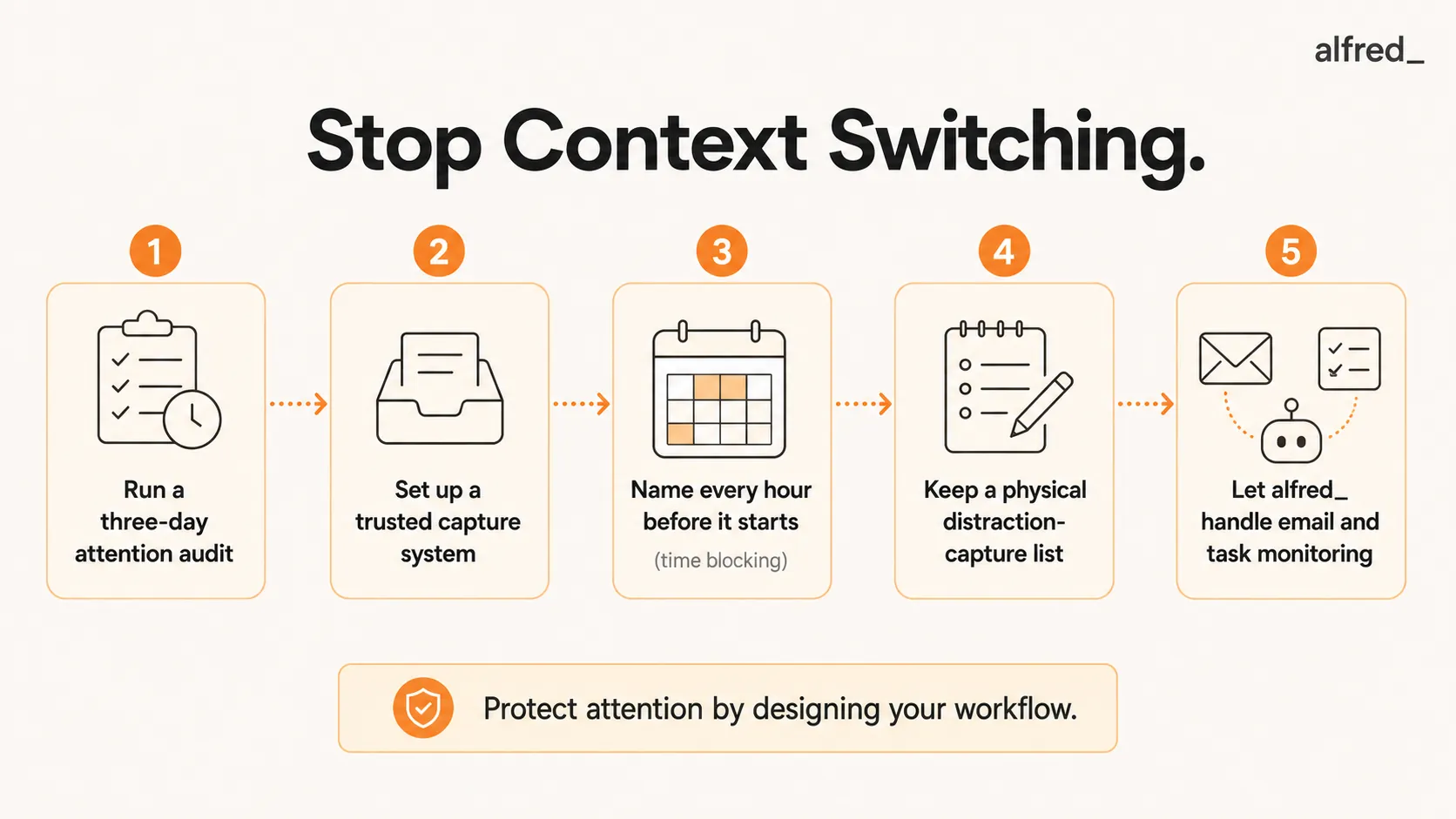
1. Run an Attention Audit for Three Days
Every time you switch tasks, deliberately or by impulse, note it in a log. Include what you were working on, what you switched to, and what triggered the switch (notification, anxiety, boredom, genuine need). After three days, review the log for patterns. Your context-switching sources are specific to your role and work environment. Identify them before designing solutions.
2. Set Up a Trusted Capture System
Following Allen’s GTD: every open loop (task, idea, commitment, thing you need to do later) goes into one trusted system immediately. Phone, notepad, task manager: the tool matters less than the discipline. When everything is captured, the brain stops generating reminder interruptions. Open loop anxiety, the most common driver of context switching, dissolves.
3. Use Newport’s Time Blocking: Name Every Hour Before It Starts
Each morning, assign a specific task to every hour of the workday. Include buffer time for email, interruptions, and the unexpected. The assignment gives you something to return to when distraction impulses hit. Instead of defaulting to whatever is most stimulating, you have a named commitment.
4. Create a Physical Distraction Capture List
Keep a notepad within reach during focus blocks. When a distraction impulse hits (the urge to check email, look up a fact, message someone), write it on the list and return to the block. Don’t act on it. The act of writing it down satisfies the don’t-forget anxiety without producing a context switch. Process the distraction list at the end of the block.
5. Use alfred_ to Handle Email and Task Monitoring
The “did I miss something?” loop is one of the most persistent drivers of compulsive email checking during focus blocks. alfred_ resolves this: it monitors your inbox continuously and surfaces genuinely urgent items in your morning brief. When you know that alfred_ is watching, the anxiety that drives inbox checking during focus time dissolves. You can be truly focused without the background fear of missing something important.
Before and After: What Stopping Context Switching Produces
Before: High Context-Switching Day
- 9am-12pm: Switch tasks 25 times between focused work, email, Slack, and tangential research
- Feel constantly busy and perpetually behind
- Complete zero substantial work, only fragments
- 4pm: still haven’t finished the thing that was your priority at 9am
After: Low Context-Switching Day
- 7:15-9am: 90-minute focused block, primary deliverable completed
- 9am-12pm: three focused 45-minute blocks on secondary work; distraction capture list fills but doesn’t pull you away
- 12pm: morning’s planned work done; afternoon is meetings and email
- Feeling of accomplishment versus feeling of motion
40%
of productive time estimated lost to cumulative context switching and attention residue
What to Do About Meetings as Context Switches
Every meeting is a context switch. By definition, you stop what you’re working on and engage with a different topic, people, and cognitive mode. Paul Graham’s maker’s schedule observation applies here: “A single meeting can blow a whole afternoon, by breaking it into two pieces each too small to do anything hard in.”
The anti-context-switching move for meetings: batch them together rather than scattering them. One cluster of three meetings from 1-4pm is dramatically less damaging to focused work than three meetings scattered at 10am, 1pm, and 3pm. Each version involves the same total meeting time, but the scattered version produces three context switches plus three recovery windows, while the batched version produces one.
Apply Grove’s leverage test before accepting any meeting: “Is my presence worth the context switch cost?” If your contribution to the meeting is passive (receiving information you could get by email), decline and request a written update instead.




