

Open your browser right now and count the tabs.
Not the ones you are using. The ones you opened three hours ago because “you might need them later.” The article you started reading but did not finish. The Google Doc you were referencing but moved away from. The spreadsheet with numbers you need to double-check but have not gotten to yet.
Every one of those tabs is consuming a small amount of your computer’s memory. Individually, negligible. Collectively, the reason your machine is running hot and everything feels sluggish.
Now apply that to your brain.
Every unread email is a tab. Every unanswered message is a tab. Every thread you deferred to “later” is a tab. Every follow-up you need to send, every reply you owe, every message you saw the notification for but did not open, tab, tab, tab, tab.
Your brain is running hot. Everything feels sluggish. And the worst part is you cannot see the tabs. You just feel them.
The Weight You Cannot See
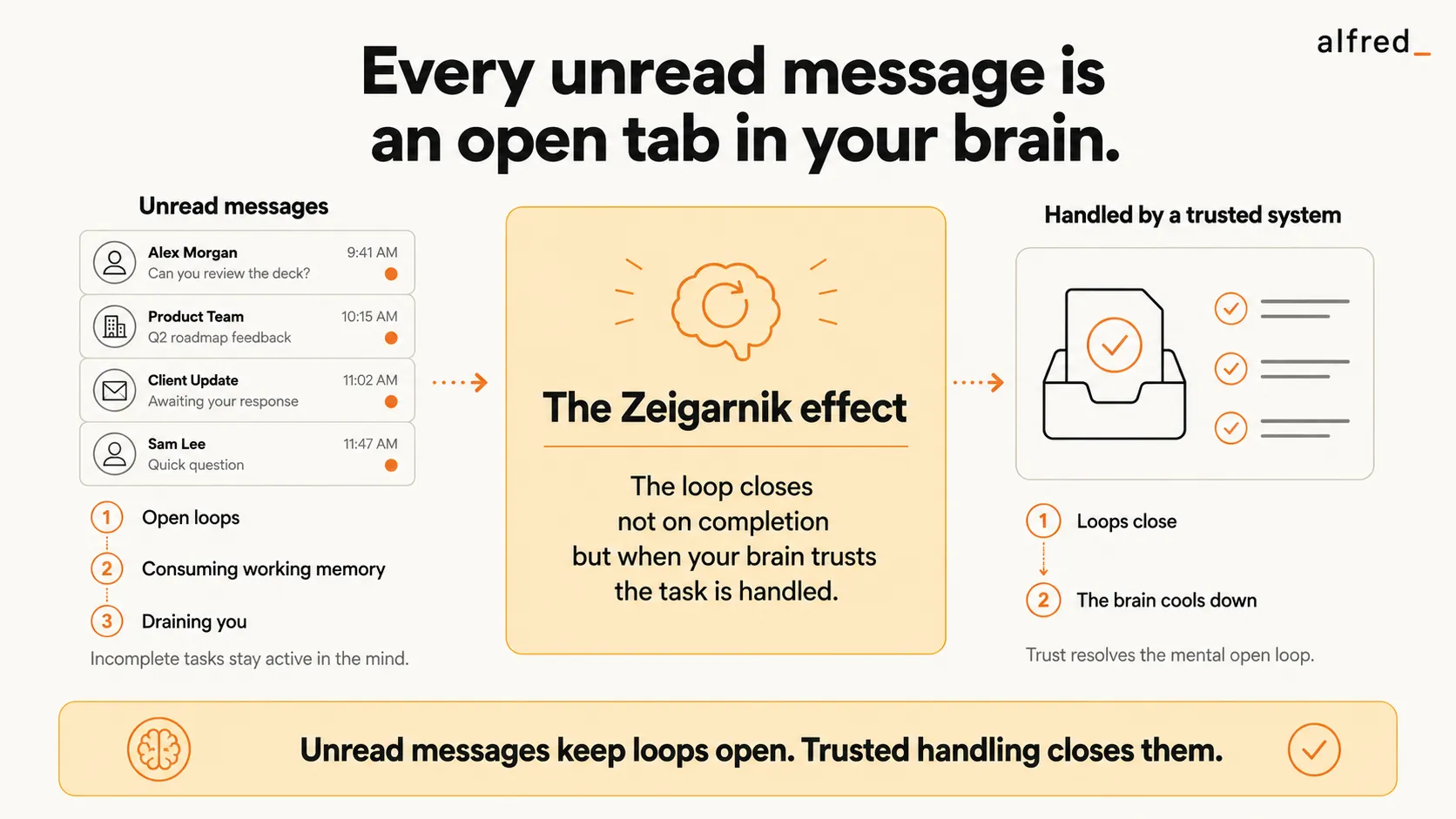
The Zeigarnik effect is one of the most replicated findings in cognitive psychology. Discovered by Soviet psychologist Bluma Zeigarnik in the 1920s, it describes a straightforward phenomenon: incomplete tasks occupy more mental space than completed ones. Your brain treats unfinished business as an open loop and allocates working memory to keeping that loop active until it resolves.
Zeigarnik discovered this in a restaurant. She noticed that waiters could remember complex orders with perfect accuracy, until the food was delivered. Once the task was complete, the order vanished from memory. The loop closed. The mental resources were freed.
Your inbox is a restaurant where the food never arrives.
Every email you receive creates a loop. What does this person want? Do I need to respond? When? What will I say? Is this urgent? The loop opens the moment you see the notification, even if you do not open the email. And the loop does not close until you have dealt with the message or made a clear plan to deal with it.
At 121 emails per day, the figure from a Radicati Group study. That is 121 loops opening every day. Some close quickly. Many do not. The ones that linger, the ambiguous request from your boss, the client email that needs a careful response, the meeting thread that is not quite resolved. Those loops accumulate.
“The mental overhead of ‘I need to respond to that’ is worse than actually responding.”
That quote captures the Zeigarnik effect perfectly. The response takes 3 minutes. The mental overhead of knowing you need to respond lasts hours. The loop is consuming resources regardless of whether you are actively thinking about it. It runs in the background, like a process you cannot see in task manager but that drains the battery all the same.
Your Brain’s Background Processes
In 2011, researchers Baumeister and Masicampo at Florida State University ran a study that clarified exactly how the Zeigarnik effect operates. Participants were given a task, then interrupted before completion and assigned a new task. The interrupted participants performed significantly worse on the second task. Their brains were still processing the first, incomplete task, even though they were told to move on.
The critical finding: making a specific plan to complete the first task eliminated the performance impairment. Participants who wrote down when and how they would finish the interrupted task performed just as well on the second task as those who were never interrupted.
The brain does not need the task to be done. It needs to trust that the task will be done. The loop closes not on completion, but on commitment to a trusted plan.
This is the key to understanding the mental load of unread messages. Your brain is not suffering because you have emails. It is suffering because you have emails that are unresolved, and it does not trust that they will be resolved. There is no plan. There is no system. There is only the vague awareness that things are piling up and some of them might matter.
Sophie Leroy at the University of Washington coined the term “attention residue” to describe a related phenomenon. When you switch from Task A to Task B, your brain leaves a residue of attention on Task A, a background process that continues to pull cognitive resources even as you try to focus on something new. Each unread email is a source of attention residue. You are never fully focused on anything because part of your brain is always monitoring the pile.
“I can’t be fully present anywhere because part of my brain is always half-monitoring what I might be missing.”
The Badge That Weighs 100 Pounds
There is a number on your email icon. Maybe it says 47. Maybe it says 347. Maybe you turned off badge counts because seeing the number made it worse.
That number, or the knowledge that the number exists, even unseen, is the physical representation of your open loops. Every digit is a message your brain has catalogued as “unresolved.” The number goes up throughout the day. It rarely goes down to zero. And even when you do not look at it, you know it is there, growing.
Research published in the Journal of the Association for Consumer Research found that the mere presence of a smartphone, even face-down, even silenced, reduces available cognitive capacity. The researchers, Ward et al. at the University of Texas at Austin, described this as “brain drain.” Your phone does not have to buzz. It does not have to light up. Its mere existence in your awareness reduces the cognitive resources available for whatever you are trying to do.
Now multiply that by 121 daily emails. Each one a potential task. Each one a potential obligation. Each one a potential problem. Your brain is running a background inventory of all of them, all the time.
This is why you feel exhausted at the end of a day where you “did not do much.” You did not produce visible output. But your brain burned through its cognitive budget maintaining awareness of dozens of open loops. The fatigue is real. The cause is invisible.
80% of workers report “productivity anxiety”, the constant feeling of being behind. That feeling is the Zeigarnik effect at scale. It is not about what you did or did not accomplish. It is about the open loops that never close.
Why Reading Your Email Does Not Help
Here is the counterintuitive part. You would think that opening and reading your emails would close the loops. You see the message. You know what it says. Loop closed, right?
Wrong. Reading an email without acting on it makes the mental load worse.
Before you open the email, the loop is: “There is a message from Sarah. I do not know what it says.”
After you open the email, the loop becomes: “Sarah is asking about the Q3 projections. I need to pull the numbers from the finance doc. I should probably check with Dave first. I should respond by end of day. I will do it after this meeting.”
The loop expanded. You now have more information to track, more sub-tasks to remember, and a self-imposed deadline to maintain. The mental load increased because the loop got more complex without getting resolved.
This is why inbox-zero methods often increase stress before they decrease it. They require you to touch every email, which means opening every loop to its fullest complexity. If you can then act on each one immediately, the loops close and you feel relief. But if you cannot, because you are in meetings, because the response requires research, because you need input from someone else. You have expanded every loop without closing any of them.
“Even when I’m not checking email I’m thinking about what might be in there.”
The mental load is not proportional to the number of emails. It is proportional to the number of unresolved, expanded loops your brain is tracking. Ten emails with clear, immediate actions may create less mental load than three emails with ambiguous, multi-step requirements.
The Tools That Add Tabs Instead of Closing Them
Gmail labels and filters. These move emails around but do not close loops. The email is in a different folder. Your brain still knows it is there. The loop persists, just with a new label on it.
Todoist and Notion, Task managers that record your open loops in a different location. Instead of an unread email creating the mental load, now an unchecked task item creates it. You have moved the loop from one system to another without resolving it. The Zeigarnik effect does not care where the loop lives. It cares whether the loop is closed.
SaneBox ($7-$36/month), Sorts email by importance headers. Low-priority email goes to @SaneLater. This genuinely reduces the number of loops that open, because you never see the unimportant ones. But for the emails that do reach your inbox, the ones from real people about real things, the loops open as usual. SaneBox reduces volume. It does not reduce the mental load of the messages that remain.
Superhuman ($30-$40/month), Makes processing faster. You can get through email in less time, which means you can close loops faster. But if your calendar is full of meetings and you cannot get to email until 4 PM, the loops are open all day regardless of how fast you can process them at 4 PM.
Shortwave ($30-$120/seat/mo), AI-powered bundles and summaries reduce visual overwhelm. Seeing 30 bundles instead of 200 emails feels lighter. But each bundle is itself a loop, “What is in this bundle? Do any of these need action?”, and opening the bundle expands the loops within.
None of these tools close loops. They sort them, move them, speed them up, or bundle them. The mental load persists because the underlying uncertainty, “Is this handled?”, remains unresolved.
Closing the Loops You Cannot Close Yourself
The Baumeister and Masicampo finding is the solution hidden in plain sight. The loop closes when your brain trusts that the task is handled. Not done, handled. A plan exists. A system has it. Someone is on it.
This is why executives with excellent human executive assistants do not carry the mental load of email. They generate just as many emails as everyone else. They have just as many open threads. But the loops close because they trust that their EA is watching, triaging, flagging, and handling. The executive’s brain does not need to track the loops because someone else is tracking them.
alfred_ provides this for everyone. It connects to your Gmail or Outlook and continuously reads your incoming email. It understands context, who the sender is, what the email references, how it connects to your calendar and prior threads. It triages by urgency. It drafts replies in your voice. It tracks follow-ups and surfaces items that need your attention.
The mental load drops because the loops close. Not because the emails are gone. They are still there, but because your brain receives the signal it needs: this is handled. Someone is watching. Nothing will slip.
The badge on your email icon can say 47 or 347. It does not matter. The number is noise. What matters is that every message behind that number has been read, understood, categorized, and, where appropriate, responded to in draft. The loops are closed. The background processes can stop. The tabs can close.
The Day Your Brain Feels Light
There is a moment, usually about three days in, when you notice something different. You are in a meeting. The meeting is about the thing you are supposed to be thinking about. And you are thinking about it. All of you. Not 80% of you while the other 20% runs a background process on whether Marcus replied to the contract email.
You know whether Marcus replied because alfred_ told you this morning. He did not, and a follow-up is scheduled for tomorrow. Loop closed. Brain freed.
The meeting ends. You walk to the kitchen. You make a cup of tea. You stand there for a moment and notice, with a kind of surprise that is hard to describe. That you are just standing there. Not mentally inventorying your inbox. Not rehearsing a reply. Not calculating how many unread messages have accumulated since you last checked. Just standing there, drinking tea.
“I don’t need zero inbox. I need to not feel like I’m always behind.”
That feeling of being behind is the mental load. It is the weight of open loops your brain has been carrying for months or years. The tabs you cannot see but always feel. The background processes that consume your cognitive RAM and leave you exhausted at the end of days where you cannot point to what you accomplished.
alfred_ does not give you inbox zero. It does not give you a productivity system. It gives you something much more valuable: the cognitive relief of knowing that every open loop in your inbox has been read, understood, and categorized by something that understands context and exercises judgment.
The tabs close. The brain cools down. The weight lifts.
Your mental clarity is worth far more than what alfred_ costs.




