

The Researcher and the Origin
Bluma Wulfovna Zeigarnik (1900 or 1901–1988) was a Soviet psychologist, one of the most significant figures in early Soviet psychology. She conducted the research that bears her name in 1927 in Berlin, under the supervision of Kurt Lewin, the founder of social psychology.
A widely repeated origin story holds that Lewin observed waiters at a café who remembered unpaid orders in detail but forgot them almost immediately once the bill was settled, and that this observation prompted Zeigarnik’s research. This story is apocryphal. The specific details are unverifiable in primary sources, the location is disputed (most academic literature says Berlin, some sources say Vienna), and careful historical investigation has found it to be legend rather than documented fact. Zeigarnik’s research was real and important; the café origin is a folk tale.
The 1927 Experiment
Zeigarnik’s study gave participants a series of tasks: puzzles, arithmetic problems, and construction tasks. Some tasks were completed; others were interrupted before completion. After all tasks were finished or interrupted, participants were asked to recall which tasks they had worked on.
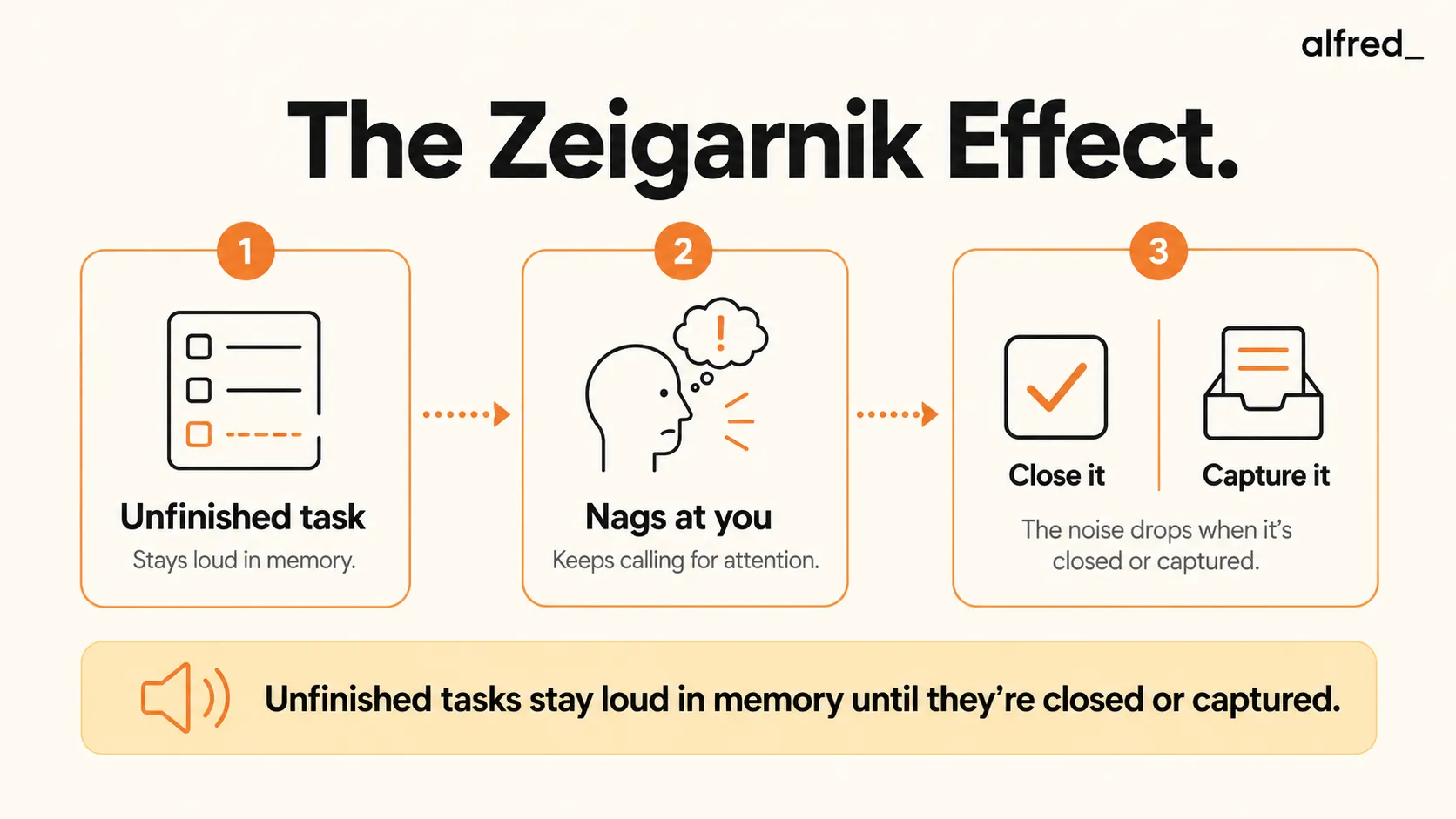
Finding: Participants recalled interrupted (incomplete) tasks significantly better than completed tasks. Incomplete tasks maintained an active cognitive “tension system” (in Lewin’s theoretical framework) that kept them available in memory. Completed tasks discharged this tension, and the associated memory representation faded.
The commonly cited figure is that incomplete tasks were recalled roughly 90% better than complete ones. This specific number should be treated as an approximation, as it varies across replications and is sensitive to experimental conditions.
Research context
The Zeigarnik effect has a complicated empirical history. Multiple early replications confirmed it; later research identified important boundary conditions. The effect is strongest when tasks are ego-relevant, when interruptions are externally imposed, and when participants have high intrinsic motivation. Under some conditions, particularly high cognitive load or low task engagement, the effect diminishes or reverses. It is a real and well-documented phenomenon, but not a simple universal law.
1927
Bluma Zeigarnik's original study on incomplete task memory, and the research foundation for David Allen's 'open loops' concept in Getting Things Done, published 74 years later
Zeigarnik, B. (1927). Psychologische Forschung, Vol. 9The GTD Connection: Open Loops and Psychic RAM
David Allen drew directly on the Zeigarnik mechanism in Getting Things Done (2001), though he did not cite the research by name. His “open loops” concept is a direct applied version of Zeigarnik’s “tension systems”:
“Your mind is for having ideas, not holding them.”
Every captured commitment that lacks a defined next action (every task known but not organized) occupies working memory as an open loop. Allen calls this “psychic RAM”: mental resources consumed by the act of tracking uncaptured commitments. The Zeigarnik mechanism is why those commitments don’t passively sit in the background. They actively compete for foreground attention.
Allen’s prescription to capture everything into a trusted external system with a defined next action is a behavioral implementation of Zeigarnik resolution. Once a commitment is captured and has a concrete next action, the tension system partially discharges. The brain can release it from active tracking because the external system holds it.
The Critical Finding: Plans Discharge the Tension
The most practically significant development in Zeigarnik research came in 2011.
Masicampo and Baumeister, “Consider it done! Plan making can eliminate the cognitive effects of unfulfilled goals,” Journal of Personality and Social Psychology, 101(4), 667–683.
Key finding: making a specific plan for an unfinished goal eliminated the goal’s intrusive effect on cognitive performance. Participants who wrote down a concrete plan for an unfinished task showed no performance impairment on a subsequent task, even though the original task remained unfinished. The plan substituted for completion in resolving the Zeigarnik tension.
This is the empirical validation of GTD’s capture-and-clarify workflow. You do not have to finish tasks to free your mind from them. You need:
A trusted external system
The brain must believe the task will not be lost. A vague intention (“I should deal with that”) does not discharge the tension. An entry in a system you actually trust does.
A concrete next action
“Deal with the Henderson project” does not discharge the tension. “Email Henderson to schedule a call on Thursday” does. The specificity is the mechanism.
Newport’s Shutdown Ritual
Cal Newport’s “shutdown complete” ritual is explicitly designed around the Zeigarnik effect. Newport writes about it in his blog and in Deep Work:
The problem: at the end of the workday, unfinished tasks generate Zeigarnik tension that intrudes on personal time. The brain continues attempting to “solve” the open loops even when the person is no longer at work, producing the experience of thinking about work in the shower, at dinner, or while trying to sleep.
Newport’s solution: a shutdown ritual that reviews all open items, confirms each has a home in the system (captured with a next action, scheduled, or delegated), and ends with a verbal declaration: “Shutdown complete.” The ritual provides psychological closure without completing the work. It discharges the tension through a trusted review rather than through task completion, precisely as Masicampo and Baumeister’s research would predict.
Newport argues that the ritual phrase itself becomes a conditioned signal: the brain learns that “shutdown complete” means the review is genuinely done and the open loops are properly captured, and stops generating intrusive thoughts in response.
The Hemingway Method: Useful Incompleteness
The Zeigarnik effect has a productive application in creative work. Ernest Hemingway described his writing practice:
“The best way is always to stop when you are going good and when you know what will happen next. If you do that every day when you are writing a novel you will never be stuck.”
Hemingway would stop mid-sentence or mid-paragraph when he was in full flow, deliberately leaving the work incomplete. The next day, the Zeigarnik-active incompleteness would draw him back into the work with momentum already established: he always knew the next sentence because he had already begun it.
Several other writers have described variations on this practice without using Zeigarnik’s vocabulary. The mechanism is the same: a deliberate open loop that draws you forward rather than draining you. The critical distinction from the harmful version is control: Hemingway chose when to stop and knew exactly where he would resume. An uncontrolled open loop (a task with no defined next action, a project without a plan) generates anxiety. A controlled open loop (a sentence half-written, a problem mid-solved) generates productive pull.
The Procrastination Relationship
For tasks being avoided
Zeigarnik tension increases as avoidance continues. The task intrudes on attention more as time passes, which is the subjective experience of procrastination anxiety. The thing you’re not doing mentally pursues you, consuming the attention you could be directing at other work.
For tasks being started
Beginning a task, even partially and with no commitment to finishing, creates Zeigarnik tension that makes continuation easier. This is the behavioral principle behind the “just start for five minutes” technique: once a task is started, the open loop creates motivational pull toward completion. The hardest part of any avoided task is the zero-to-one transition.
The applied finding: the most effective procrastination intervention may not be willpower or elaborate planning. It may be partial initiation. Beginning a task with no commitment to finishing it reduces the psychological barrier and immediately creates the forward momentum that completion requires.