

You left the office three hours ago. You are on the couch. The TV is on. Your partner is next to you. By every external measure, you are home.
But you are not here.
Part of your brain, maybe 30%, maybe 60%, you cannot tell anymore, is still at work. Running a background process. A quiet, persistent loop:
Did I reply to Sarah’s email? What if the client sent the revised scope tonight? I said I would send that deck by EOD. Did I? I think I did. Did I? What’s going to be in my inbox tomorrow morning?
“Even when I’m not checking email I’m thinking about what might be in there.”
You are physically present and mentally absent. And the worst part is that you cannot stop. It is not a choice. You have tried to stop. You have told yourself to be present. You have put the phone away, closed the laptop, done the deep breathing. The loop continues anyway, underneath everything, a hum that does not pause for your attempts at mindfulness.
This is work rumination. And it is not about dedication, or work ethic, or caring too much. It is about open loops.
Your Brain Cannot Let Go of Unfinished Things
In 1927, psychologist Bluma Zeigarnik noticed something at a restaurant in Vienna. The waiters could remember complex, unpaid orders in perfect detail. But the moment the bill was paid, the order vanished from memory. It was as if the brain allocated resources to track incomplete items and deallocated them the moment the task was resolved.
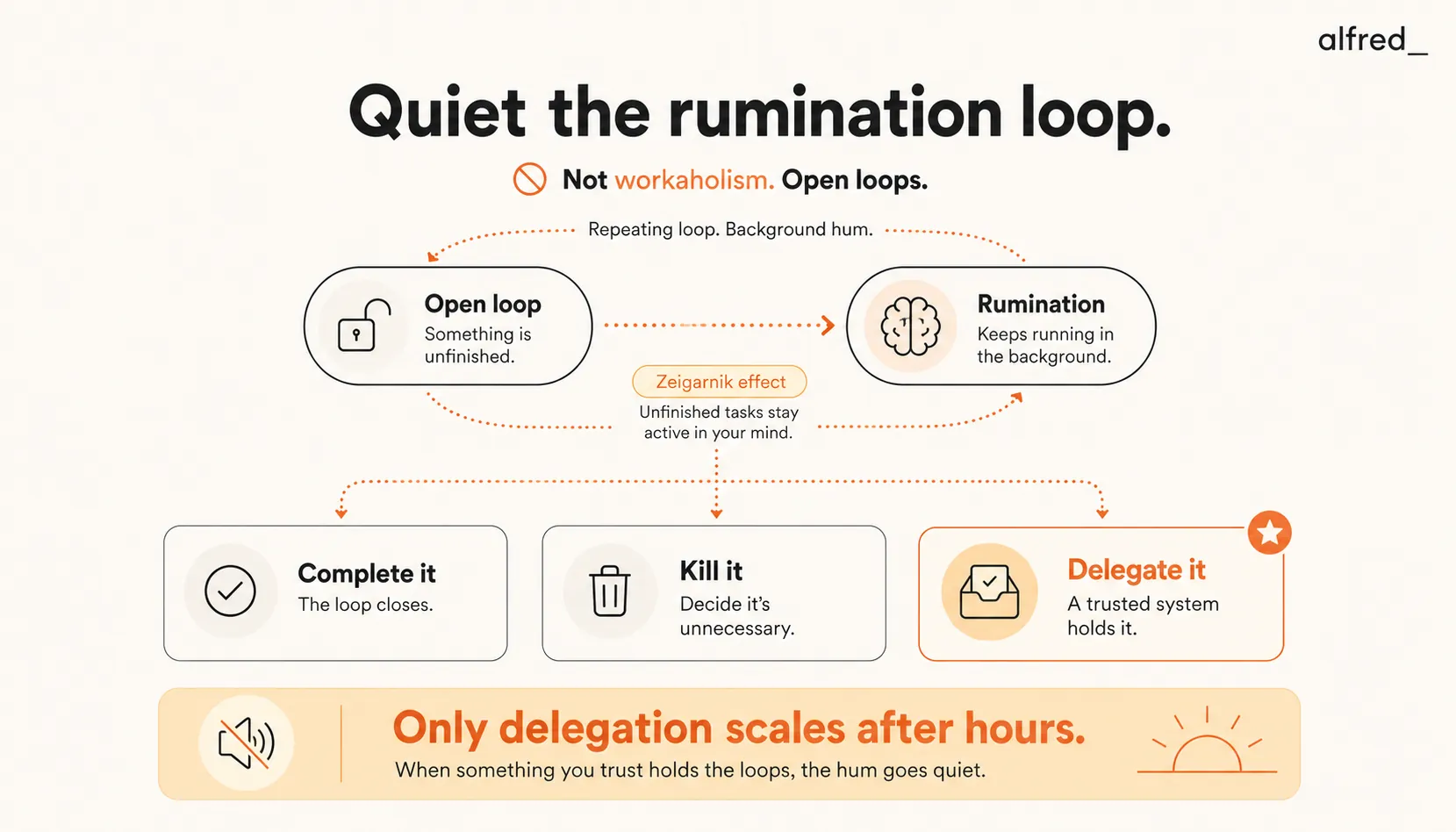
This became known as the Zeigarnik Effect: incomplete tasks occupy cognitive resources at a significantly higher rate than completed ones. Your brain treats every unfinished item as an active, running process, allocating background processing power to it until it is resolved.
Now consider your work life. At any given moment, you have:
- 15 unanswered emails
- 4 pending decisions
- 7 follow-ups you are waiting on
- A meeting tomorrow you have not prepared for
- A deliverable you promised last week that is not finished
- An unclear message from your boss that might mean nothing or might mean trouble
Each one of these is an open loop. Each one is consuming background cognitive resources. Together, they create the hum, the persistent, low-level processing that follows you to the couch, to dinner, to bed, to the weekend.
Research on psychological detachment, the ability to mentally disengage from work, consistently finds that it is one of the strongest predictors of recovery, well-being, and next-day performance. A meta-analysis by Sonnentag and Fritz published in the Journal of Occupational Health Psychology found that workers who achieve psychological detachment in the evening report lower fatigue, higher life satisfaction, and better sleep quality.
But here is the catch: psychological detachment requires that the open loops are closed. Or at minimum, that they are captured in a trusted system. You cannot mentally disengage from work if part of your brain believes there are unresolved threats sitting in your inbox.
The Hum Is Not a Character Flaw
There is a quiet shame that comes with work rumination. You tell yourself you should be able to turn it off. Other people seem to leave work at work. Why can you not? What is wrong with you?
Nothing is wrong with you. Your brain is doing exactly what it is designed to do.
The human brain evolved to monitor for unresolved threats. In an ancestral environment, that meant tracking predators, weather patterns, and social conflicts. In a modern work environment, it means tracking emails, deadlines, and implicit expectations. The monitoring function does not distinguish between a saber-toothed tiger and an unanswered email from a client. Both register as “unresolved, continue monitoring.”
“I can’t be fully present anywhere because part of my brain is always half-monitoring what I might be missing.”
Research on workplace telepressure, the preoccupation with and urge to quickly respond to work messages, found that telepressure predicts lower psychological detachment, higher exhaustion, and more sleep problems. Critically, telepressure operates independently of actual workload. You can have zero urgent items and still feel the pull. The monitoring is not about what IS happening. It is about what MIGHT be happening.
This is why telling yourself to “just relax” does not work. Relaxation requires the monitoring function to stand down. The monitoring function will not stand down until it believes the threats are resolved. And you cannot resolve the threats without checking, which restarts the entire cycle.
The Invisible Cost
Work rumination is invisible. It does not show up on a timesheet. It does not appear in a performance review. Nobody sees it happening. But the costs are real and they are significant.
Sleep disruption: A study published in the Journal of Occupational Health Psychology found that work-related rumination in the evening is a significant predictor of sleep disturbance. The brain’s continued processing of work items prevents the cognitive wind-down necessary for sleep onset. You lie in bed with your eyes closed and your brain running through tomorrow’s inbox.
Relationship erosion: Research from the University of Surrey found that work rumination during non-work hours is associated with lower relationship satisfaction. Partners report feeling that the ruminator is “not really there”, physically present but emotionally and cognitively absent. Over time, this creates a pattern of disconnection that erodes intimacy.
Reduced recovery: The entire point of evenings and weekends is recovery, the mental rest that restores the cognitive resources depleted during the workday. Rumination prevents recovery. You return to work on Monday with the same depleted cognitive resources you left with on Friday, because your brain never stopped working. This creates a downward spiral: inadequate recovery leads to worse performance, which creates more open loops, which creates more rumination, which prevents recovery.
Next-day performance: This is the irony. You ruminate because you care about work. But the rumination makes you worse at work. Research consistently shows that workers who achieve psychological detachment in the evening perform better the next day than those who continue to mentally process work. The rumination feels productive. You feel like you are staying on top of things, but it is actually degrading the performance it is trying to protect.
“I’m never fully at work and never fully at home. I’m in this in-between space all the time.”
Why Every Fix You Have Tried Falls Short
“I write everything down before I leave.” David Allen’s Getting Things Done method suggests capturing all open loops in a trusted external system. This is genuinely helpful, the Zeigarnik Effect diminishes when tasks are captured in a system your brain trusts. But here is the limitation: writing down “reply to Sarah’s email” does not resolve the loop. It transfers it from working memory to a to-do list. Your brain still knows the reply has not been sent. The loop does not close until the action is complete or someone else handles it.
“I do a shutdown ritual.” Cal Newport recommends a specific end-of-day shutdown ritual where you review all open items, make a plan for tomorrow, and say “shutdown complete.” This is better than nothing. But the ritual only works if you trust that the plan covers everything. If there is any uncertainty, what if something arrived after the shutdown? what if I forgot something?, the monitoring function reactivates.
“I try to be mindful.” Mindfulness meditation teaches you to observe thoughts without engaging with them. For clinical anxiety, this can be effective. For work rumination driven by actual unresolved items, it is asking you to observe the thought “I have not replied to Sarah’s email” without engaging with it. Your brain disagrees. The email is real. Sarah is real. The consequence of not replying is real. Observation without engagement requires that the threat is illusory. These threats are not illusory. They are just unresolved.
“I exercise after work.” Exercise temporarily redirects cognitive resources to physical demands and triggers endorphin release. Research consistently shows benefits for mood and anxiety. But the open loops are still there when you finish the run. The shower after the workout is often when the rumination returns, because the physical distraction has ended and the brain returns to its unresolved queue.
| Strategy | Why It Helps | Why It Is Not Enough |
|---|---|---|
| To-do list capture | Externalizes open loops from working memory | Does not close the loops, the work is still undone |
| Shutdown ritual | Creates a psychological boundary | Only works if nothing arrives after shutdown |
| Mindfulness | Teaches non-engagement with thoughts | The thoughts are about real, unresolved items |
| Exercise | Temporary cognitive redirect | Open loops return when physical distraction ends |
| Phone away | Removes the checking mechanism | Does not remove the uncertainty driving the rumination |
| alfred_ | Closes the loops: triages, drafts, tracks | Nothing is unresolved, nothing to ruminate about |
What It Takes to Quiet the Hum
The hum stops when the open loops close. Not when you try to ignore them. Not when you write them down. Not when you meditate about them. When they actually close.
An open loop closes in one of three ways:
- You complete the action. You reply to the email. The loop closes.
- You decide the action is unnecessary. You realize the email does not need a response. The loop closes.
- You delegate the action to a trusted system. Someone, or something. You trust handles it. The loop closes.
Option 1 is not sustainable after hours. You cannot reply to every email before you leave, more arrive after you go. Option 2 requires judgment you may not have the energy for at 7 PM. Option 3 is the only scalable solution.
But “trusted” is the operative word. You have to actually trust the system. A to-do app is a system but your brain does not fully trust it because the app does not do the work. It just reminds you to do it. A junior assistant might help but introduces new loops: did they handle it correctly? Did they miss the nuance?
alfred_ closes the loops by doing the work. It reads your email. It understands context. It drafts replies in your voice. It finds who owes you a response, and since when, whenever you ask. It surfaces anything that genuinely needs your attention and handles everything that does not.
When you leave the office at 6 PM, you know: nothing is sitting in your inbox that should not be. Nothing is slipping. If something urgent arrives at 7:30 PM, it will be caught, flagged, and ready for you in the morning, not buried under 47 other messages.
The monitoring function in your brain receives the signal it needs: the perimeter is secure. Nothing is unresolved. And for the first time in a long time, it stands down.
“The first evening I didn’t think about work, I almost didn’t know what to do with myself. I just sat there and watched the show. The whole show.”
alfred_ does not teach you to meditate. It does not coach you on work-life balance. It does not send you reminders to breathe. It closes the open loops that your brain cannot let go of. The ones that follow you to the couch, to dinner, to bed. The ones that create the hum.
The hum goes quiet when the loops close. And the loops close when something you trust is handling them.
That is not a mindset shift. That is a structural fix.