

You told yourself you would not check. It is 11 PM and you are in bed, thumb hovering over the mail icon. You know it is probably nothing. You know checking will not help. You know your partner has noticed. But the anxiety of NOT knowing what is in there. That is worse than checking.
So you check. It is nothing. You feel relief for about ten minutes. Then the hum starts again. What if something came in since you checked? What if something slipped through?
You are not weak. You are not undisciplined. You are caught in a loop that 85% of workers are caught in, and “just stop checking” is advice from people who have never felt the weight of an unmonitored inbox.
The Numbers You Are Living
This is not a quirk. This is a documented pattern:
- 85% of workers receive work emails outside business hours at least several times monthly (Speakwise)
- Of workers online by 6 AM, 40% are reviewing email, the workday now starts before the alarm (Microsoft Work Trend Index)
- 58% check email first thing in the morning, before breakfast, before coffee, before anything (Marketo)
- Surveys suggest 57% check while still in bed, not at a desk, not “working,” just lying in bed, staring at a phone
- Nearly half check email while on vacation (Speakwise)
- 29% return to their inbox by 10 PM (Microsoft)
- 84% keep email open in the background throughout the entire day (Speakwise)
- The average knowledge worker checks communication tools every 6 minutes. 35.5% check every 3 minutes or less (Speakwise)
You are not imagining the problem. You are living inside a statistic.
What the Research Actually Says
Virginia Tech studied this. Twice.
In 2016, researchers surveyed 297 working adults and found that organizational expectations of off-hour emailing negatively impact emotional states, leading to burnout and diminished work-family balance. Their conclusion: “Even during the times when there are no actual emails to act upon, the mere norm of availability and the actual anticipation of work create a constant stressor.”
In 2018, Professor William Becker’s team went further: “Flexible work boundaries often turn into work without boundaries, compromising an employee’s and their family’s health and well-being.” The study found that the mere EXPECTATION of after-hours monitoring creates anxiety and harms the health of employees AND their families, even when no actual work is done during personal time.
Read that again. Even when you are not doing any work. Even when you open your inbox and there is nothing urgent. The expectation that you MIGHT need to check is enough to create chronic stress, and that stress radiates to the people around you.
Your partner who noticed you checking during dinner. Your kid who sees you on your phone during bedtime stories. They are not just observing the behavior. They are absorbing the stress. The research says so.
70% of workers cite email as their top source of workplace stress (Speakwise). Surveys suggest fewer than half feel comfortable fully disconnecting after work or on vacation. People who check email before bed report higher levels of anxiety, racing thoughts, insomnia, and damaged personal relationships (Sleep Advisor).
Email interruptions are a documented cortisol trigger. Workers with elevated cortisol from email-related stress report depression and anxiety at higher rates. This is not a time-management issue. This is a health issue.
Why “Just Stop Checking” Does Not Work
You already know this. But here is why.
The anxiety of not knowing is worse than checking. Telling someone to “just stop checking” is like telling someone with insomnia to “just sleep.” The underlying anxiety needs to be addressed, not suppressed. You are not checking because you enjoy it. You are checking because the uncertainty of what might be in there creates a low-grade dread that does not go away until you look.
Turning off notifications makes it worse. This is the paradox nobody talks about. Without notifications, you lose passive awareness of your inbox. You used to see a preview pop up and think “not urgent, I can ignore that.” Now you see nothing, which means the urgent email MIGHT be sitting there, and you have no way to know without opening the app. The result? More frequent manual checking, not less.
Batching does not solve the anxiety. Apps like Mailman ($8/month, Gmail only) hold your email and deliver it at set times. Clever idea. But during the batch window, the hours when email is being held, the anxiety remains: “What if something urgent came in? What if a client needs me? What if my boss sent something critical and I will not see it until morning?”
“Email-free evenings” require organizational buy-in. You cannot unilaterally decide to stop checking if your boss, clients, or team expect responses after hours. The expectation is the stressor, and you do not control the expectation.
The compulsion is dopamine-driven. Psychology Today identifies seven reasons people check email compulsively: dread of falling behind, the fact that email is easier than deep work, desire to appear conscientious, FOMO, habitual behavior, anxiety avoidance, and underestimating the cumulative cognitive drain. Opening email triggers a small dopamine hit. This is not a willpower problem. It is a neuroscience problem. The answer needs to remove the NEED to check, not just the ability.
What People Try (And Why It Falls Short)
| What You Try | Monthly Cost | The Approach | Why It Does Not Work |
|---|---|---|---|
| Turning off notifications | Free | Remove the prompt to check | Increases uncertainty. Manual checking goes up. Anxiety gets worse. |
| Mailman | ~$8 | Batches email delivery at set times | Gmail only. Anxiety during batch windows. No judgment on urgency. |
| SaneBox Do Not Disturb | $7–36 | Holds non-urgent email during set hours | Rules-based, not intelligent. No way to trust it caught the truly urgent ones. |
| Hey (Basecamp) | $99/year | Screener blocks unknown senders | Requires a new @hey.com address. You cannot use your existing email. Opinionated. |
| Freedom | $3.33–8.99/month | Blocks access to email apps entirely | Does not solve the anxiety. The worry remains. You just cannot act on it. |
| Cold Turkey | $39 one-time | Blocks access to email apps entirely | Same, blocks the behavior, not the anxiety. |
| Superhuman | $30–40 | Fast email processing, split inbox | No after-hours mode. No urgency detection. No calendar. |
| alfred_ | $29.99 | AI triage 24/7. Urgent = you know. Rest = morning. | Requires trusting AI judgment. Trust builds over time. |
The Core Insight
The anxiety is not about email. It is about uncertainty.
“What if something urgent is in there?” That single question is what pulls you out of the movie, out of the conversation, out of bed at 11 PM. Not the email itself, the not knowing.
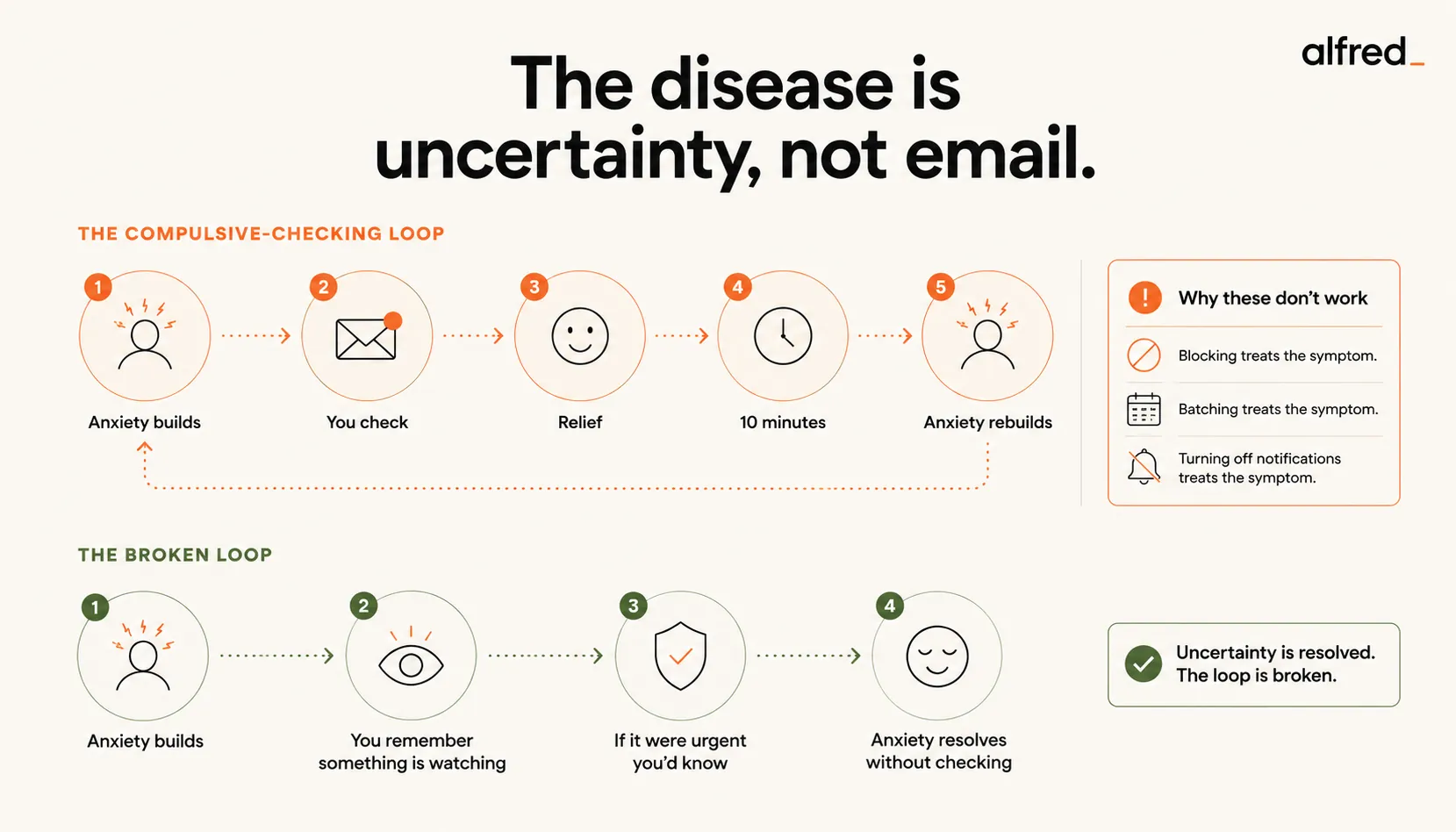
Every approach that blocks, batches, or hides your email treats the symptom. The symptom is checking. The disease is uncertainty. And uncertainty cannot be cured by removing access. It can only be cured by someone, or something. That watches your inbox and tells you: nothing is buried. If something urgent comes in, you will know.
That is a fundamentally different approach from every other app on the market. Not “we’ll hide your email.” Not “we’ll batch your email.” Not “we’ll block your email.” Instead: “We’ll watch your email. And if something actually matters, we’ll tell you. Everything else can wait.”
How alfred_ Becomes the Safety Net
alfred_ connects to your Gmail or Outlook and triages your inbox around the clock. Here is what that means for your evenings, your weekends, and your sleep.
Intelligent urgency detection. Not rules-based batching. Not header-only filtering. AI that understands the difference between “your CEO needs a decision by tomorrow morning” and “marketing sent a newsletter.” If the CEO emails at 10 PM, you know. If it is noise, you sleep. The judgment is real. It considers sender, content, tone, and your relationship history.
The certainty that nothing is missed. This is the crucial part. The reason you check is because you do not trust that nothing urgent is sitting unread. alfred_ gives you that trust. It is watching. If something matters, it surfaces it. If nothing matters, silence means safety, not uncertainty.
Auto-drafts for morning. The non-urgent emails that came in overnight? By the time you wake up, drafts are waiting. Not 50 undifferentiated messages requiring 50 decisions. A triaged inbox with replies already written in your voice. Review, adjust, send. Your morning is 20 minutes instead of 90.
Calendar management included. Tomorrow’s first meeting prep. Scheduling conflicts that appeared overnight. Agenda updates. All handled before you start your day. You open your laptop in the morning and know what actually matters today, without having checked at 11 PM, midnight, and 6 AM to piece it together.
Trust through transparency. alfred_ shows you exactly what it handled, what it flagged, and what it drafted. This is important because trust is earned, not demanded. In the first week, you will probably still check. That is fine. Check, and see that alfred_ caught what mattered and handled the rest. By week three, the checking slows. By month two, you stop. Not because you are forcing yourself, because the anxiety has been replaced by confidence.
Less than the cost of the sleep problems, the relationship friction, and the cortisol spikes that compulsive checking creates.
What Actually Changes
The compulsive checking loop works like this: anxiety builds -> you check -> relief -> 10 minutes -> anxiety rebuilds -> you check again.
alfred_ breaks it here: anxiety starts to build -> you remember that alfred_ is watching -> if something urgent had come in, you would know -> the anxiety resolves without checking.
That is it. That is the entire mechanism. You do not need more willpower. You do not need a blocker app. You do not need your company to change its culture. You need one thing: the certainty that if something truly urgent arrives, you will know about it without opening your inbox.
You can go to dinner. You can read your kid a bedtime story. You can watch a movie with your partner, the whole movie, without reaching for your phone at the halfway point. And if something truly urgent comes in, you will know. Not because you checked. Because alfred_ told you.
Sunday nights stop being ruined by mentally pre-triaging Monday’s inbox. Because Monday’s inbox is already triaged.