

It’s 9 PM on a Sunday and you’re already thinking about Monday’s inbox.
The weekend was good. Maybe even great. You went somewhere. You did something that wasn’t work. For a few hours, you forgot about the backlog, the client who emailed Friday afternoon, the thread you didn’t close before you left.
And then it started. That low hum. The tightening in your chest. Not a specific worry, just a general sense of something is waiting. You don’t know what. That’s the problem.
“Sunday nights are ruined because I’m mentally pre-triaging Monday’s inbox.”
You start running scenarios. Did the client reply to the proposal? Did the vendor send the revised quote? Is there something sitting in your inbox right now that’s urgent and unanswered? You don’t know. You can’t know without checking. And checking means the weekend is over.
So you sit with it. The hum. The not-knowing. The Sunday night feeling that has a name: the Sunday Scaries.
You’re Not Imagining It: 75% of Workers Feel This
The Sunday Scaries aren’t a personality flaw. They’re not a sign that you’re “too stressed” or “need better boundaries.” They’re a documented psychological phenomenon that affects the majority of the working population.
75% of working Americans experience the Sunday Scaries (LinkedIn/Harris Poll, 2018). 36% experience them every single week, not occasionally, not sometimes, every week (Kickresume survey). And the impact isn’t just feeling bad on Sunday night.
Among Gen Z workers, 45.9% have considered quitting their job because of Sunday anxiety, and 20.2% have actually done it, walked away from a job because the anticipatory dread became unbearable (Resume.io survey). 9% experience panic attacks and 39% have called in sick because the Sunday Scaries carried into Monday morning and they couldn’t face it (Kickresume survey).
The number one trigger? Incoming workload (60%). Not a bad boss. Not office politics. The sheer weight of what’s waiting in the inbox.
“Even when I’m not checking email I’m thinking about what might be in there.”
The Anticipatory Anxiety Trap
Here’s what most advice about the Sunday Scaries gets wrong: they treat it as a behavioral problem. Stop checking email. Set boundaries. Practice mindfulness. Separate work from life.
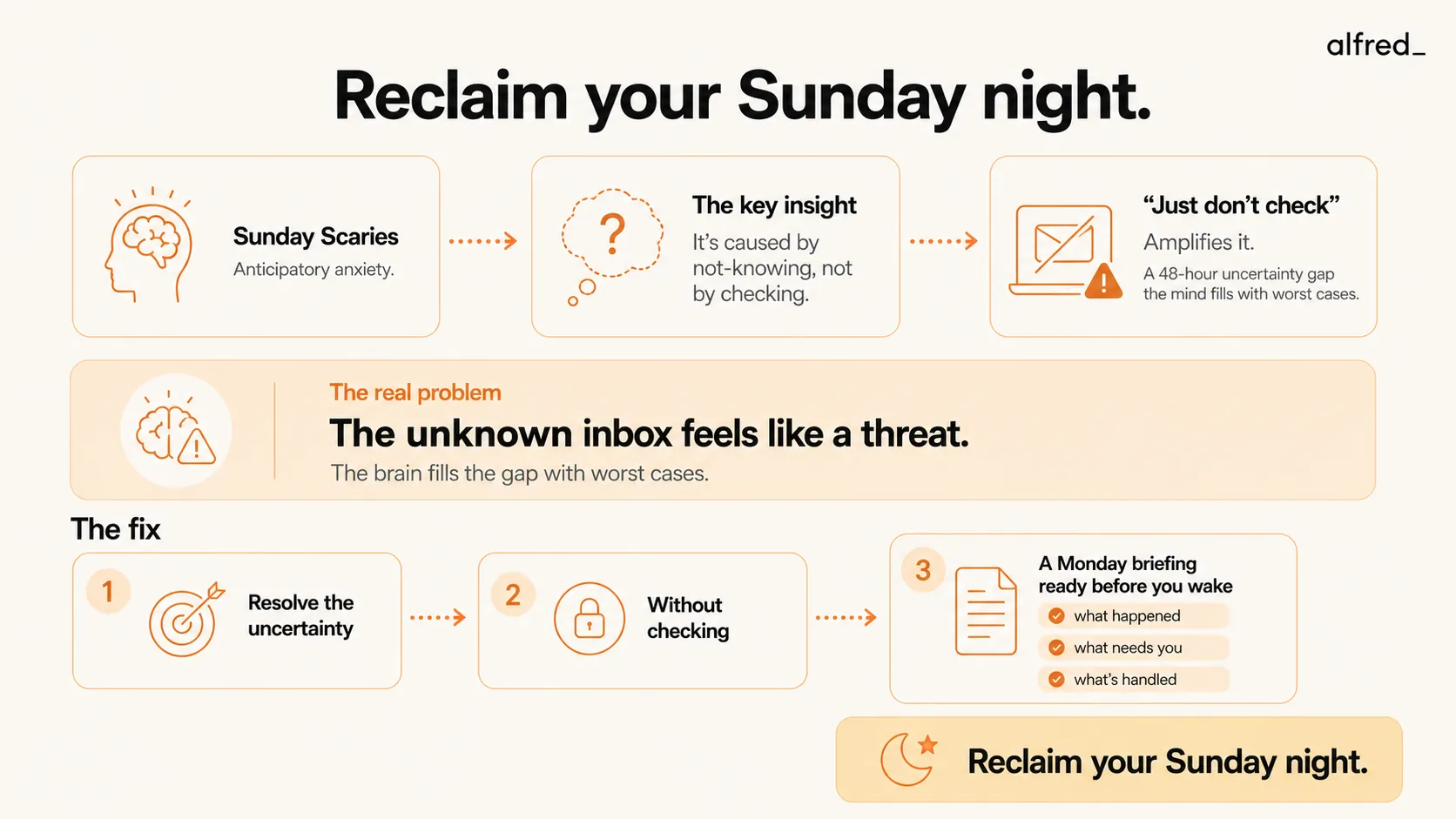
The Sunday Scaries aren’t a behavioral problem. They’re a cognitive one. Specifically, they’re anticipatory anxiety. Your brain’s threat-detection system responding to uncertainty as if it were danger.
Your nervous system doesn’t distinguish between “a tiger might be behind that bush” and “there might be an angry client email in my inbox.” Both are unknowns. Both trigger the same cortisol response. Your heart rate rises. Your muscles tense. Your mind starts running worst-case scenarios, not because the worst case is likely, but because your brain is wired to prepare for threats it can’t see.
The cortisol awakening response, the spike of stress hormones that happens when you wake up, is measurably elevated on Monday mornings for people with anticipatory work anxiety. Your body starts dreading Monday before your conscious mind does. The alarm goes off and the stress is already there, before you’ve opened a single app.
“I check my email before I get out of bed. I don’t want to. I just can’t not.”
That compulsive check isn’t a discipline failure. It’s a neurological response to uncertainty. Your brain is seeking resolution. Email provides it, briefly. You check, you see what’s there, the uncertainty dissolves for a moment. Then five new emails arrive. The cycle restarts.
70% of Americans report adverse symptoms from ongoing anticipatory stressors. Workers who are expected to be available for email outside of work hours show measurably higher cortisol levels. It’s not in your head. It’s in your bloodstream.
Why “Don’t Check on Weekends” Makes It Worse
This is the advice in every article about Sunday Scaries. Don’t check email on weekends. Set boundaries. Disconnect.
For people with email anxiety, this advice does the opposite of what it intends.
“Don’t check email on weekends” creates a 48-hour uncertainty gap. By Sunday night, the unknown contents of your inbox have become a looming, formless threat. Your brain fills the void with worst-case scenarios because that’s what brains do when they lack information. The dread on Sunday night is directly proportional to the length of time since you last checked.
“Just check Sunday night so you’re prepared” works, technically. You check at 8 PM, see 15 emails that need responses, and now you know what’s waiting. The uncertainty dissolves. But your weekend just ended at 8 PM on Sunday. You traded anticipatory anxiety for active stress. The emails are now in your head. Some of them are problems. You can’t do anything about most of them until Monday morning, but your brain has already started working on them. Sleep suffers. Monday starts exhausted.
“Set boundaries” assumes the anxiety is caused by the behavior of checking. But the anxiety is caused by the uncertainty of not knowing. Behavioral boundaries don’t address cognitive uncertainty. Telling an anxious person to sit with the unknown without giving them an alternative source of certainty is like telling someone who’s drowning to relax.
“Plan your Monday on Friday” helps for known tasks but does nothing for email, which is by definition unpredictable. You can’t plan for what arrives after you leave. The email that dropped in at 6 PM Friday, the one that’s now sitting unread, maybe urgent, maybe not, wasn’t part of your plan.
“It’s this constant low-level anxiety. Always there. Even on weekends.”
The paradox is real: the standard advice creates the exact condition it’s trying to prevent. You avoid checking to protect your weekend, and the avoidance generates the anxiety that ruins your weekend.
What Actually Helps: Reducing Uncertainty Without Checking
The research points to something specific: the Sunday Scaries dissolve when the uncertainty dissolves. Not when you “relax more.” Not when you “set better boundaries.” When you know what’s waiting without having to wade through it yourself.
The question is how to get that certainty without sacrificing your evening to email triage.
How 5 Approaches Handle the Sunday Gap
| Approach | Price | Resolves Sunday Uncertainty? | Preserves Your Weekend? | Prepares Monday Morning? | Key Limitation |
|---|---|---|---|---|---|
| "Just don't check" | Free | No, amplifies it | Technically, but with dread | No | Trades behavior change for cognitive suffering |
| Sunday night batch check | Free | Yes, but at a cost | No, weekend ends Sunday 8pm | Partially | You traded anxiety for active stress |
| SaneBox Daily Digest | $7–$36/mo | Partial, list of sorted items | Mostly | Summary, not a brief | A list of what was filtered, not what matters |
| Google CC experimental | Free | Partial, next-day briefing | Mostly | Closest to what's needed | Experimental; Google Workspace only; no drafts |
| alfred_ | $29.99/mo | Yes, fully | Yes, fully | Yes, with draft replies | Requires Gmail or Outlook |
“Just don’t check” (free)
The default recommendation in every self-help article about work-life separation. Works perfectly for people who don’t have email anxiety. For people who do, it creates a 48-hour void that the mind fills with worst-case scenarios. The dread isn’t about discipline. It’s about the brain’s response to uncertainty. Telling someone with email anxiety not to check email is like telling someone with a fear of heights not to look down. Technically correct. Practically useless.
Sunday night batch check (free)
You open email at 8 PM. You scan everything. You make a mental list. Now you know what’s waiting. The uncertainty dissolves, and your Sunday evening becomes Monday prep. You see the client’s frustrated follow-up. You see the scheduling conflict. You see the 12 threads that need responses. The dread converts from anticipatory to active. You traded one type of stress for another, and your weekend lost its last few hours.
SaneBox Daily Digest
SaneBox sends a daily summary of what it filtered, emails that landed in @SaneLater, newsletters it caught, senders it sorted. This is a list of what was sorted, not a brief of what matters. Getting a SaneBox digest on Monday morning still means opening your inbox cold and figuring out what actually needs your attention. The sorting happened. The understanding didn’t.
Google CC (experimental)
Google’s experimental AI agent sends a “Your Day Ahead” briefing. This is the closest existing product to what Sunday Scaries sufferers actually need, proactive delivery of “here’s what your day looks like.” But it’s experimental, requires Google Workspace, doesn’t work with Outlook, doesn’t draft replies, and doesn’t cover the specific weekend gap. Promising direction, not there yet.
alfred_
The Monday morning briefing is ready before you wake up. Not a list of emails. Not a digest of what was filtered. A brief: here’s what happened over the weekend. Three things need your attention. Two have draft replies ready. The rest is handled. Low-priority items are archived. Follow-ups that were due are flagged.
You go from “I don’t know what’s waiting” to “I know exactly what’s waiting, and most of it is already handled.”
What Sunday Night Feels Like When the Uncertainty Is Gone
“I can’t be fully present anywhere because part of my brain is always half-monitoring what I might be missing.”
That half-monitoring happens because there’s a genuine information gap. Your inbox is a black box between Friday evening and Monday morning, 60+ hours of incoming email that you haven’t seen. Your brain does what brains do with gaps: it fills them with threat.
alfred_ watches your inbox all weekend. It doesn’t need you to check. It doesn’t need you to open email. It processes what arrives, identifies what matters, and prepares the briefing. When you go to bed Sunday night, you’re not wondering what’s in there. You know that something is watching, and that Monday morning will start with clarity instead of chaos.
The hum stops. Not because you meditated harder or set a better boundary. Because the uncertainty, the actual cause of the dread, is gone.
Research from Baylor University found that writing a to-do list before bed helped participants fall asleep about 9 minutes faster, researchers believe the act of planning offloads worry. alfred_’s Monday briefing is that plan, made for you, waiting before you wake up.
It works with both Gmail and Outlook. No new email client. No complicated setup. It connects, it watches, it briefs.
Monday morning is already handled. Sunday night is yours again.