

You close the laptop, but you do not actually stop. The unfinished task follows you to dinner, the unanswered email surfaces at 10pm, and tomorrow’s worry has already started before tonight is over. Most knowledge workers do not end their workday; they just pause it, and the work keeps running in the background, taxing the recovery that was supposed to make tomorrow good. The fix is not working less. It is ending deliberately, with a ritual that tells your brain the day is genuinely closed. Here is how to build one.
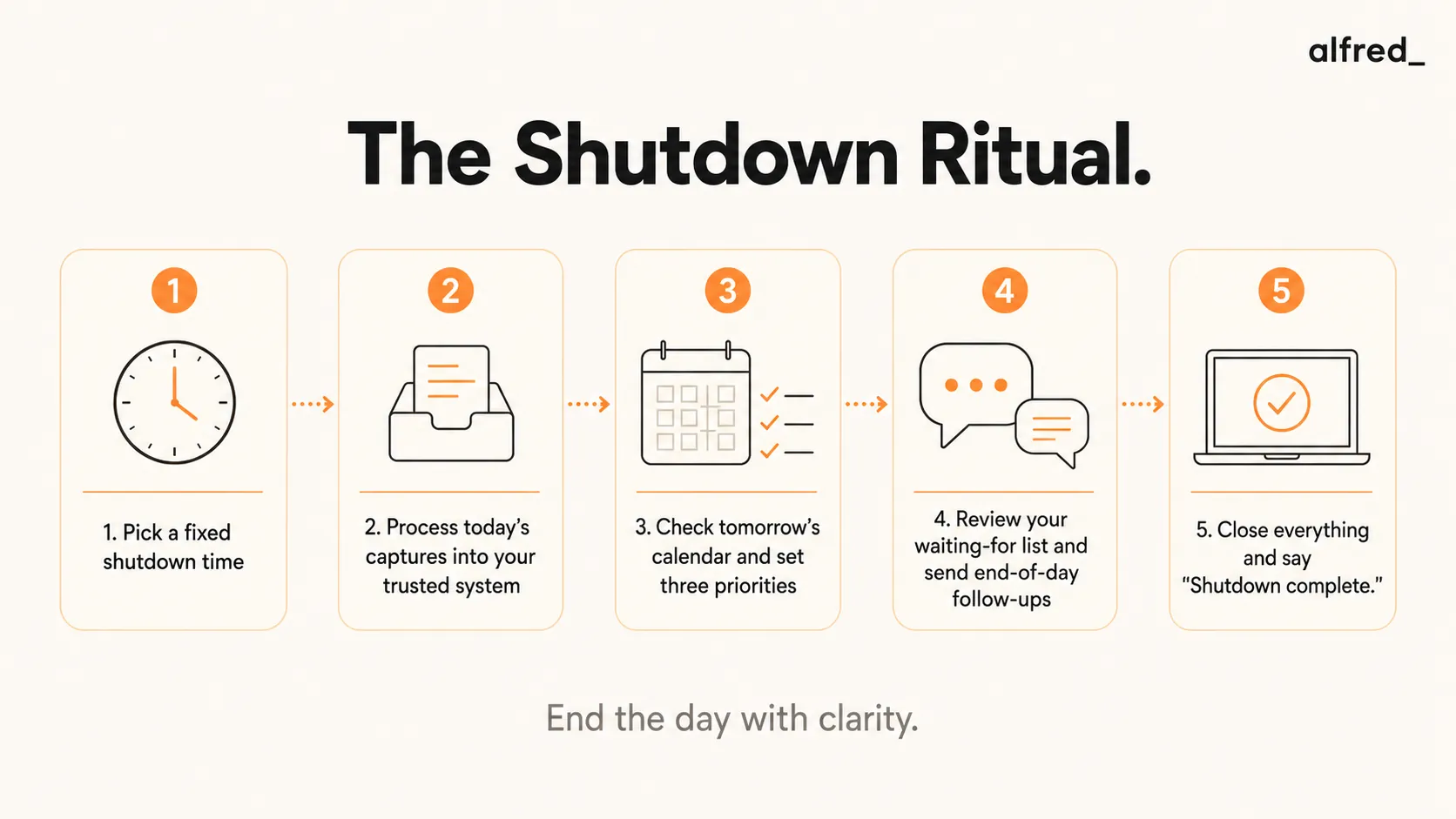
Newport’s Shutdown Ritual: Why “Stopping Work” Isn’t Enough
In Deep Work, Cal Newport describes a specific shutdown ritual he performs at the end of every workday. The ritual ends with a specific phrase said aloud or written down: “Shutdown complete.” This is not an affectation. It’s the operational signal to his brain that work is genuinely over for the day.
The purpose of the ritual is cognitive closure. Without it, the brain continues to generate reminder signals about unclosed items: the email you haven’t replied to, the decision you haven’t made, the task you promised but haven’t tracked. These background signals are what make it impossible to truly stop thinking about work. You’re physically away from your desk, but your working memory is still running the job.
“When you work, work hard. When you’re done, be done.”, Cal Newport, Deep Work
After saying “shutdown complete,” Newport’s rule is that no more work thinking happens. If a work thought arises in the evening, the response is: “I have a system. It’s handled. I don’t need to think about this right now.” The trust in the system, the certainty that nothing is lost, that everything is captured and will be addressed, is what makes genuine rest possible. Without the system, the anxiety is rational. With it, the anxiety is unnecessary.
Allen’s Capture and Close: The Cognitive Foundation
“Your mind is for having ideas, not holding them.”, David Allen, Getting Things Done
David Allen’s Getting Things Done framework rests on a single insight: the mind generates anxiety not from the volume of work, but from the unreliability of its own memory. When you’re trying to hold twelve open items in your head, your brain generates constant low-level stress signals, not because the items are threatening, but because the brain doesn’t trust itself to remember them. The solution is a trusted external system: comprehensive, current, clear, and accessible.
The shutdown ritual is the daily moment when you ensure nothing is still being held mentally. Every item from the day that was captured, notes, tasks, ideas, commitments, gets processed into the trusted system. Once it’s in the system, the brain can let go. The shutdown ritual is the daily reset that makes the trust in the system genuine, not theoretical.
Allen’s weekly review is a larger version of the same principle. The daily shutdown closes daily loops; the weekly review closes weekly ones. Together they ensure that nothing is ever held in working memory longer than one day: everything is either processed into the system or deliberately deferred to a specific future date.
The Shutdown Ritual: Each Component Explained
A complete shutdown ritual has five components. The entire ritual should take 15-20 minutes. If it’s taking longer, your capture system needs work. You’re processing items in the shutdown that should have been captured and processed during the day.
The Five Components
- 1. Process all captures: Review every note, task, and idea captured during the day. Clarify each item: is it actionable? If yes, what’s the next action? Add it to your task list with a context and, if relevant, a date. Nothing stays in the capture inbox.
- 2. Review tomorrow’s calendar: No surprises. Know what’s coming. If there’s a meeting that requires preparation you haven’t done, note it now: either do the prep or schedule it explicitly.
- 3. Confirm three priorities for tomorrow: Drucker’s contribution question applied daily: “What will I contribute tomorrow that matters most?” Name the three things. These become your first deep work blocks.
- 4. Review your waiting-for list: Scan every item you’re waiting on from others. If any have gone past expected response time, send a brief follow-up now, before you shut down.
- 5. Close everything, say “Shutdown complete”: Close all tabs, applications, and notifications. The phrase is the signal, to yourself and to your brain, that work is over.
Why the Ritual Must Be Non-Negotiable
Newport is explicit about this: the shutdown ritual is not an optional productivity enhancement. It is the practice that makes tomorrow more productive than today. Without it, cognitive recovery is incomplete. You finish the evening less rested than you began it, and you start the next morning carrying the residual cognitive load of the previous day’s unfinished loops.
Collins’s 20 Mile March adds a useful frame: the march has both a floor and a ceiling. You commit to a consistent output floor: you will march at least this far every day. But the 20 Mile March also has a ceiling: you stop at 20 miles even on good days. The shutdown ritual is the ceiling. Without it, there is no ceiling, and work expands indefinitely into time that should be recovery.
The consequence of no ceiling is what Newport identifies as a primary source of knowledge worker burnout: work that never ends doesn’t just harm evenings and weekends. It degrades the quality of tomorrow’s work. You’re not banking productivity by working until 10pm. You’re borrowing it from the next day and paying interest.
16%
year-over-year rise in meetings after 8pm, one marker of the 'infinite workday' where work bleeds into the evening, the exact pattern a deliberate shutdown ritual is built to stop
Microsoft Work Trend IndexStep-by-Step: Build Your Workday Shutdown Ritual
1. Choose a Fixed Shutdown Time, and Treat It as a Hard Commitment
Pick a specific time (6:00 PM, 5:30 PM, whatever fits your role) and treat it the way you treat a flight departure: non-negotiable. Collins’s fanatic discipline applies here. The value of the shutdown ritual comes precisely from its consistency. An “I’ll stop when I feel like it” approach produces no cognitive closure because the brain never stops anticipating additional work.
2. Process Today’s Captures into Your Trusted System
Review every capture from the day (notes, tasks, emails flagged for follow-up, commitments made in meetings). Clarify and move each into your trusted system. Allen’s standard: by the end of this step, nothing is being held in your head. If something requires action, it’s in the system with a context. If it’s information, it’s filed. If it’s irrelevant, it’s deleted.
3. Check Tomorrow’s Calendar and Set Three Priorities
Review tomorrow’s schedule. Note anything that requires preparation you haven’t done: either handle it now or explicitly schedule the prep in tomorrow’s plan. Then name three priorities for tomorrow using Drucker’s contribution question: “What will I contribute tomorrow that matters most?” These three items become tomorrow’s first blocks.
4. Review Your Waiting-For List: Send End-of-Day Follow-Ups
Scan your waiting-for list. alfred_ makes this step fast: it tracks delegated threads and flags anything that hasn’t received a response by the expected date. Send any needed follow-ups now, before you shut down. This prevents the 10pm anxiety of “I forgot to follow up on that”, because you already did.
5. Close Everything and Say “Shutdown Complete”
Close every browser tab, every application, every notification surface. Then say or write: “Shutdown complete.” Newport’s phrase, specific, deliberate, consistent, is what makes the ritual work as a cognitive signal. After this, if a work thought arises, your response is: “I have a system. It’s handled. I’ll address it tomorrow.” You don’t need to think about it tonight because the system has it.
Before and After: What Changes When You Have a Shutdown Ritual
Before: No Shutdown Ritual
- Work ends at 6pm but email stays open until 9pm “just in case.”
- Work thoughts at 10pm: the thread you didn’t reply to, the deadline you’re not sure about.
- Wake up already anxious, the open loops from yesterday are still running.
- First hour of the morning is spent re-establishing context from yesterday.
After: Consistent Shutdown Ritual
- 6pm: 15-minute shutdown ritual. “Shutdown complete.” Email closed.
- Evening is genuinely off: no work thoughts because the system holds everything.
- Morning starts with three explicit priorities already set, no re-establishment needed.
- First deep work block begins within minutes of starting the day.
When the Shutdown Gets Disrupted
Genuine emergencies happen. A client crisis, a production incident, an urgent situation that genuinely requires immediate attention. These are real and the shutdown ritual accommodates them.
Newport’s rule for these situations: if you choose to work past your shutdown time, that’s fine. But you must redo the ritual when you actually stop. The ritual isn’t about when you stop. It’s about how you stop. The closing of loops, the review of tomorrow, the “shutdown complete” signal: these steps can happen at 9pm just as well as 6pm. The goal is to always close deliberately, not to always close on schedule.
What you should not do is let the genuine emergency of tonight become the reason you never have a shutdown ritual. Exceptions are not reasons to abandon the practice. They’re just exceptions. The practice applies on normal days, which comprise the vast majority of your workdays.
How alfred_ Enables a Cleaner Shutdown
The hardest part of the end-of-day email review, step four of the shutdown ritual, is not knowing whether you’ve actually seen everything that came in. When your inbox contains 80 emails, skimming it for items that need an end-of-day response is an unreliable process. Important things get missed. The missed items become the 10pm anxiety.
alfred_ handles email triage throughout the day, so your inbox at shutdown time contains only the items that genuinely need your attention. The end-of-day Daily Brief shows exactly what arrived, what was handled automatically, and what still needs you. Reviewing it takes 5 minutes, not 30. The review is complete, not a best-effort skim.
alfred_ also tracks your delegated tasks and waiting-for items. The end-of-day waiting-for review becomes a one-click check: alfred_ surfaces anything that’s gone past its expected response date so you can send the follow-up before you shut down. Nothing falls through the gap between the end of your day and the start of someone else’s response.