


The Research Foundation: Ego Depletion
The foundational research comes from Roy Baumeister (then at Case Western Reserve University), whose seminal 1998 paper “Ego depletion: Is the active self a limited resource?” (Journal of Personality and Social Psychology, 74(5)) introduced the model that self-regulation is a limited resource that depletes with use.
The original experiment: participants who had to resist eating cookies (an act of self-control) subsequently gave up faster on a difficult geometry puzzle than participants who ate the cookies freely. The act of resisting the cookies depleted resources available for puzzle persistence, even though the two tasks were completely unrelated.
Subsequent research by Kathleen Vohs (University of Minnesota) extended ego depletion specifically to decision-making. Her 2008 paper in JPSP found that participants who made a series of consumer choices subsequently showed worse self-regulatory performance (less physical endurance, more procrastination) than participants who considered the same products without choosing. The act of choosing itself, independent of what was chosen, depleted the resource.
The Israeli Parole Board Study
The most striking field evidence for decision fatigue in high-stakes decisions was published in 2011.
Danziger, Levav, and Avnaim-Pesso analyzed 1,112 judicial decisions by eight Israeli parole board judges over 10 months. The pattern:
Early in each session (after a rest break)
Parole granted approximately 65% of the time
Late in each session (just before a break)
Parole granted at rates approaching 0%, essentially automatic denial
After each food break
Parole rate reset to approximately 65%
The pattern repeated across three sessions per day.
Replication caveat
A 2016 re-analysis by Andreas Glöckner argued that the effect could be partially explained by case ordering: easier cases may have been scheduled earlier, not purely depletion effects. The original authors have responded maintaining their interpretation. The study is compelling evidence but should not be cited as settled fact. The broader finding, that decision quality degrades across a session, is supported by multiple independent studies; the specific parole data is contested.
65% → ~0%
parole grant rates from early session to late session in the Israeli parole board study, resetting to ~65% after each food break
Danziger, Levav & Avnaim-Pesso (2011). Proceedings of the National Academy of Sciences, 108(17)How Public Figures Responded
Several prominent figures explicitly structured their lives to reduce trivial decisions, and described exactly why.
Barack Obama
From Michael Lewis’s profile “Obama’s Way” in Vanity Fair, October 2012:
“You’ll see I wear only gray or blue suits. I’m trying to pare down decisions. I don’t want to make decisions about what I’m eating or wearing. Because I have too many other decisions to make.”
Steve Jobs
Jobs wore the same outfit daily: the signature black turtleneck, Levi’s 501 jeans, and New Balance sneakers. He had Israeli designer Issey Miyake create approximately 100 identical black turtlenecks, which he kept in his closet. The decision to standardize his wardrobe was deliberate and described in terms identical to Obama’s: eliminating a class of trivial daily choices to preserve cognitive resources for decisions that mattered.
Mark Zuckerberg
Zuckerberg has explained his gray t-shirt wardrobe in identical terms, reducing trivial decisions to preserve cognitive resources for “work that actually matters.” He has described the choice explicitly in interviews as a productivity decision.
The 2016 Replication Controversy
The mechanistic explanation for ego depletion, that self-regulation literally draws on glucose as a fuel, has been contested since at least 2016.
Hagger et al. (2016) conducted a pre-registered multi-lab replication study in Perspectives on Psychological Science with 2,141 participants across 23 laboratories. The replication found no significant ego depletion effect (d = 0.04, 95% CI [−0.07, 0.15]).
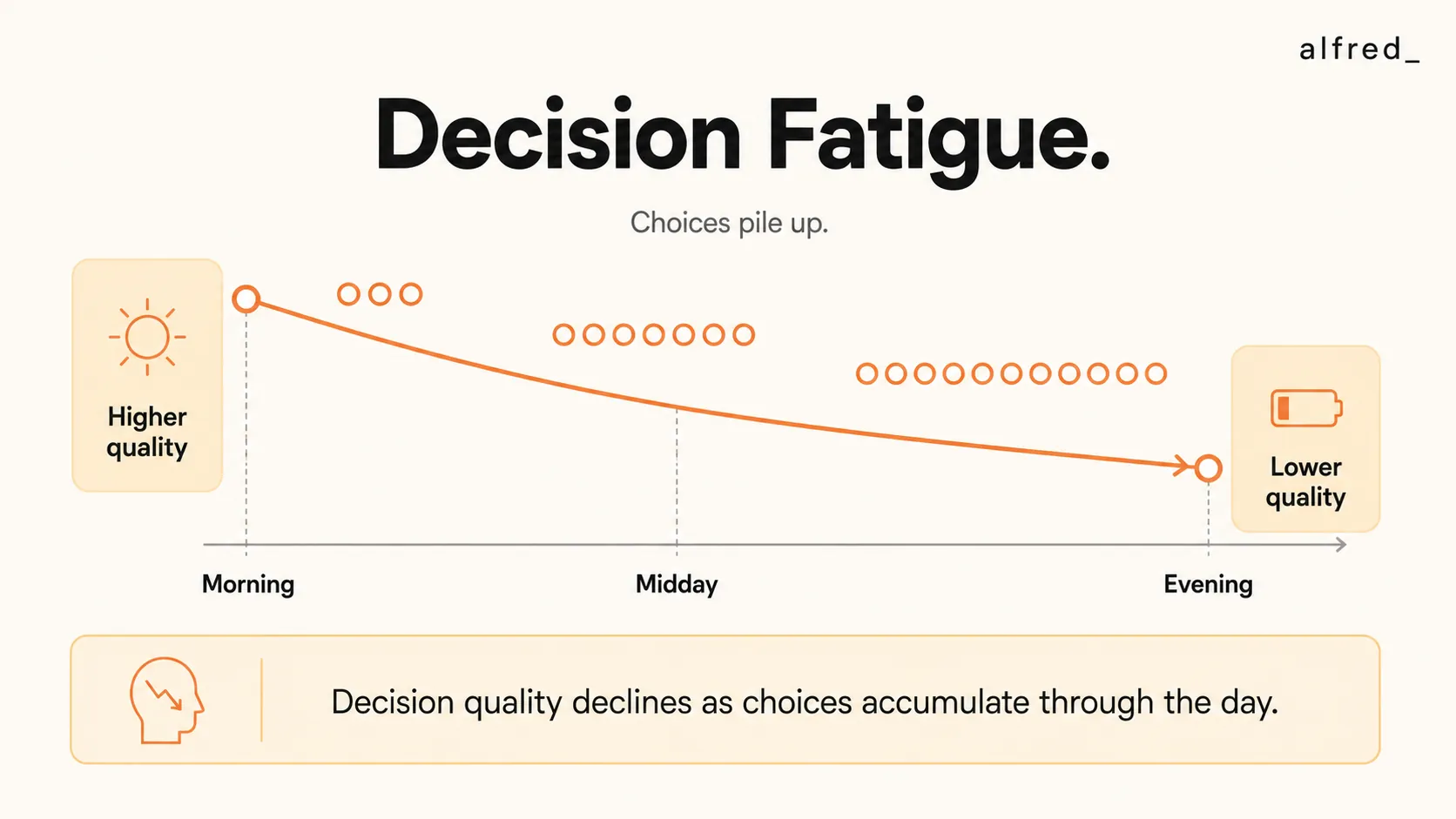
This does not mean decision fatigue is not real. It means the specific model, a literal limited-resource account where glucose depletion is the mechanism, is not supported. The effect itself (declining decision quality across a day) has good observational support from multiple independent contexts. What’s disputed is the mechanism.
For practical purposes: the strongest evidence supports scheduling important decisions earlier in the day, before accumulated choices deplete whatever resource is involved. The underlying science may not be fully characterized, but the applied finding is robust.
What the Evidence Actually Supports
Separating the contested from the robust:
Well-supported
- Morning decisions are higher quality across multiple domains and study types
- Default options are chosen more often as the number of prior decisions increases (Thaler & Sunstein’s nudge research; confirmed in retirement fund enrollment, organ donation, healthcare settings)
- Reducing the number of trivial decisions reduces decision stress, a finding robust across study designs
- Decision quality after poor sleep is significantly worse than after adequate sleep
Contested or uncertain
- The specific glucose mechanism for ego depletion: failed to replicate in large multi-lab study
- The Israeli parole board study: contested by re-analysis; plausible alternative explanation exists
- Whether all decisions draw from the same pool of resources, or only specific types
Practical Implications
The practical applications that follow from the best-supported evidence:
Schedule important decisions in the morning
Negotiations, strategic choices, performance reviews, investment decisions: anything where decision quality matters should be placed early in the day before accumulated choices have any effect. This is consistently supported across the literature regardless of the mechanism.
Automate or eliminate trivial decisions
The wardrobe strategy works not because outfit selection requires enormous willpower, but because it eliminates a decision that serves no purpose. The same logic applies to: weekly meal planning (eliminating daily food decisions), default responses for common email types, standing agendas for recurring meetings. Decisions that have a correct answer that doesn’t change day-to-day should be made once and implemented as habits.
Protect cognitive resources through recovery, not just elimination
The Israeli parole board study’s most actionable finding was not the depletion effect but the recovery: after a food break, the parole rate fully reset. Physical breaks, meals, and sleep restore decision-making capacity. Managing decision fatigue is not purely a task of reducing decisions. It also requires building genuine recovery into the day.
The logic that works for wardrobe choices extends to email triage. Each “reply or archive, delegate or handle, urgent or not” decision is a micro-choice that accumulates. Automating triage doesn’t require inbox-zero discipline. It requires removing the decision from your queue entirely.