
There is one task on your list right now that you already know matters more than the rest, and you are not doing it. You are doing email instead. You are doing the easy, legible, satisfying-to-cross-off things while the one that would actually move your week sits untouched, getting heavier by the hour. “Eat the Frog” is the method built to break exactly that pattern: do the most important, most avoided task first, before anything else lays a finger on your best hours. Here is where the idea really came from (not where you think), the neuroscience that makes it work, and the one type of person it gets dangerously wrong.
The Misattribution: Mark Twain Never Said It
Every version of the “Eat the Frog” framework traces to a quote that sounds like Twain:
“Eat a live frog first thing in the morning, and nothing worse will happen to you the rest of the day.”
Quote Investigator, the systematic research organization that traces the provenance of famous quotations, found zero evidence that Twain ever wrote or said this. Not in his published works, not in his letters, not in documented speeches. Nothing.
The earliest traceable linkage to Twain appears in an Ohio newspaper in 1988, 78 years after Twain’s death in 1910. The quote’s association with Twain is entirely posthumous and appears to have grown by the mechanism most misattributions grow: once a quote is attached to a famous name, it becomes more widely repeated, which makes it seem more verified, which accelerates further attribution.
The actual ancestral quote appears to belong to Nicolas Chamfort (1741–1794), a French writer and satirist who made an analogous observation about enduring something unpleasant first thing as a form of psychological inoculation for the rest of the day. Chamfort’s precise wording and the full chain of transmission to the modern version isn’t completely established, but the temporal evidence points to him rather than Twain.
1988
the earliest traceable year of the Twain attribution, 78 years after Twain's death in 1910. Quote Investigator found zero evidence Twain ever said or wrote the frog quote.
Quote Investigator research on the 'eat a live frog' attributionHow Brian Tracy Spread the Misattribution
Brian Tracy attributed the quote to Twain in the introduction of Eat That Frog! 21 Great Ways to Stop Procrastinating and Get More Done in Less Time, published in 2001. Tracy’s book became a bestseller and remains in print. It is the primary vector through which millions of readers absorbed the misattribution.
Tracy almost certainly believed the attribution was accurate. The Twain connection was already circulating in the late 1980s and 1990s before his book appeared. He was repeating a received attribution rather than fabricating one. But the result was the same: a false origin story became canonical at scale.
The historical correction does not undermine Tracy’s methodology, which stands on its own merits and has three convergent mechanisms of neuroscientific support. The misattribution is worth knowing because intellectual honesty matters, and because it illustrates how origin stories attach to famous names regardless of evidence.
Tracy’s Specific Three-Step Methodology
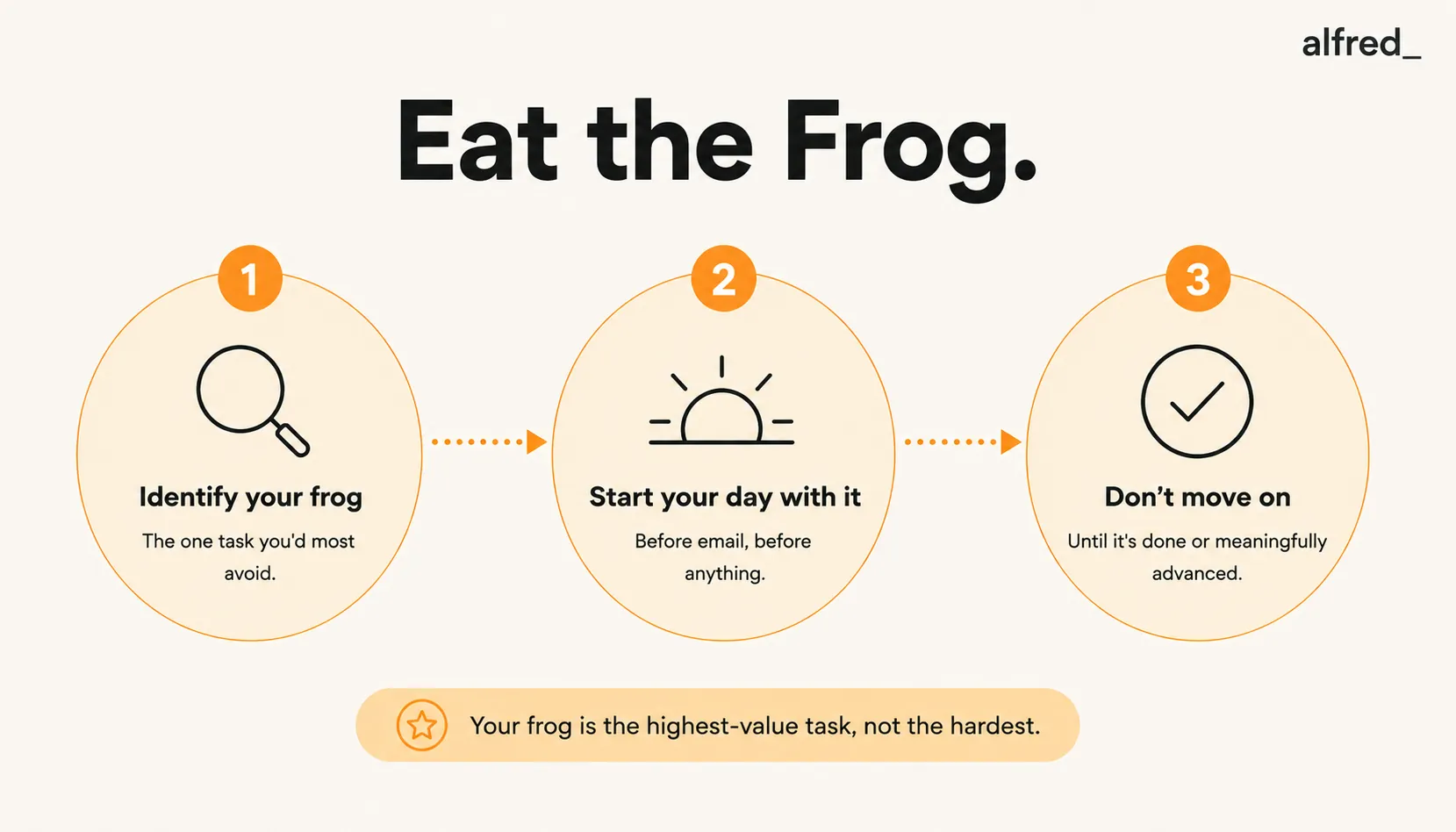
Stripped of its apocryphal origin story, Tracy’s method is straightforward. From Eat That Frog!:
1. Identify your frog
The frog is the most important task on your list, the one with the highest long-term impact, that you have been avoiding. It is typically avoided because it involves complexity, discomfort, uncertainty, or fear of failure. The frog is not the most pleasant task or the most urgent. It is the one that matters most and is easiest to defer.
2. Begin your day with that task
No email first. No meetings first. No “warm-up” activities before attacking the frog. The frog goes first, before any other work is touched. This sequencing is not about preference; it’s about preserving the cognitive and willpower resources that the frog requires.
3. Don’t move to other work until the frog is eaten or meaningfully advanced
“Eaten” means finished. “Meaningfully advanced” allows for tasks too large to complete in one session: you work the frog until you’ve made genuine progress, then transition. The critical rule: don’t let anything displace it before it’s done.
The Three Converging Mechanisms of Neuroscience
The “eat the frog first” prescription isn’t just intuitive. It has three independent streams of research converging on the same recommendation.
1. Circadian Cognitive Peak
Research by behavioral scientist Dan Ariely and chronobiologists shows that most people experience their sharpest cognitive clarity roughly 2 hours after waking. For morning chronotypes, the majority of adults, this places the cognitive peak between approximately 8 AM and 11 AM. Cognitive speed, working memory accuracy, and analytical reasoning all peak during this window and decline through the afternoon.
Performing the most cognitively demanding work during this peak window is not just preference. It produces measurably higher quality output than performing the same task during off-peak hours.
2. Ego Depletion
Roy Baumeister et al. (1998) demonstrated that self-regulation capacity (willpower) is a depletable resource that declines with use throughout the day. The research found that acts of self-control draw on a limited pool of cognitive resource, and that subsequent self-control tasks become harder as that pool depletes.
The implication: the hardest task, the one that requires the most discipline to start and sustain, should be tackled first, before the self-regulation pool has been drawn down by smaller decisions and resistances. Doing the frog last means doing it with the least willpower available.
3. Decision Fatigue
Vohs et al. (2008) demonstrated that decision quality degrades with the volume of prior decisions made. Morning is the lowest-decision-load period of most people’s workdays, because the decisions of the day haven’t accumulated yet. By mid-afternoon, the cognitive load of prior decisions has measurably degraded the quality of subsequent decision-making.
Complex, important work requires good decision-making. If the frog involves judgment (strategic analysis, nuanced writing, difficult problem-solving), morning is when that judgment is sharpest.
2 hours after waking
when cognitive clarity peaks for morning chronotypes, according to Dan Ariely's research: the optimal window for tackling the most important, most difficult work
Dan Ariely and chronobiology research on circadian cognitive peaksThe Psychological Mechanism: Relief and Momentum
Beyond the neuroscience, the Eat the Frog method creates a psychological effect that amplifies the rest of the day. When the most important, most avoided task is completed first, or meaningfully advanced, it produces a specific kind of relief and momentum that an easy morning cannot generate.
The reverse is also true and well-documented: when the frog is deferred, when a morning of email and meetings passes and the important task remains undone, the psychological weight of the avoided task accumulates throughout the day. It appears in the background of every subsequent activity as unfinished business, degrading the quality of everything else.
David Allen’s psychic RAM concept applies directly here: an important deferred task is an open loop that occupies working memory whether or not you’re consciously thinking about it. Completing the frog closes the loop. The cognitive relief that follows is real, measurable, and compounds into better afternoon performance.
The Chronotype Failure Mode
“Eat the Frog” is one of the most chronotype-dependent productivity prescriptions in the field. The morning-first recommendation is built on the premise that morning is when you are cognitively sharpest. For approximately 70% of the population, morning and intermediate chronotypes, this is accurate.
For the remaining 20–30% of the population who are evening chronotypes (“night owls”), the cognitive peak arrives in the afternoon or evening. For these individuals, the morning-first prescription is actively counterproductive: they are being asked to perform their hardest work at their worst time, with the least cognitive clarity available.
Research on chronobiology is unambiguous on this point: chronotype is largely genetic and doesn’t respond to lifestyle change. A night owl cannot train themselves to be a morning person in any deep sense. The cognitive peak arrives when it arrives.
For evening chronotypes, the correct adaptation is simple: eat the frog at your peak, which is afternoon. The sequencing principle holds: most important task first in your best cognitive window. The “morning” in the conventional framing is incidental, not structural.
20-30%
the portion of the population who are evening chronotypes, for whom morning-first execution is counterproductive, as their cognitive peak arrives in afternoon
Research on human chronobiology and chronotype distributionWhat “The Frog” Actually Is
The most common failure mode of the Eat the Frog method is misidentifying the frog. The frog is not the most unpleasant task. It’s the most important task that you have been avoiding. These are often the same thing, but not always.
The frog is typically the task with the highest long-term leverage: the strategic document that would clarify the team’s direction, the difficult conversation that would resolve a months-long ambiguity, the proposal that could bring in the largest client, the technical debt that is silently slowing everything else down. It is the task that, if done, changes the trajectory of everything downstream.
It is avoided not because it’s unpleasant per se, but because it’s complex, uncertain, and requires more than a quick decision. The avoidance is a form of self-protection from the discomfort of genuinely hard work. That discomfort is also the signal: when you find yourself creating reasons to do email instead of starting the thing you know matters most, you’ve found your frog.
Why the Frog Keeps Losing to the Inbox
Notice what the method names, over and over, as the thing that eats your frog: email. The avoidance behavior is checking the inbox. The misidentified frog is whatever feels urgent in your messages. The squandered cognitive peak is the morning you spent “just clearing email first.” The method is sound, but it is fighting a current, because the inbox is right there, it is easy, and it rewards you for not starting the hard thing.
alfred_ is what takes that current away. It triages the inbox in the background, drafts the routine replies, and holds everything that is not genuinely urgent until later, so the email that would have colonized your first two hours is simply handled by the time you sit down. Your sharpest window stays clear for the frog instead of being spent proving you are busy. And because alfred_ surfaces what actually needs you, the frog is easier to identify in the first place: it is the important work that remains once the noise has been cleared away, not the loudest thing in an unsorted inbox.