


Psychology

The Spotlight Effect: Others Notice You Half as Much as You Think

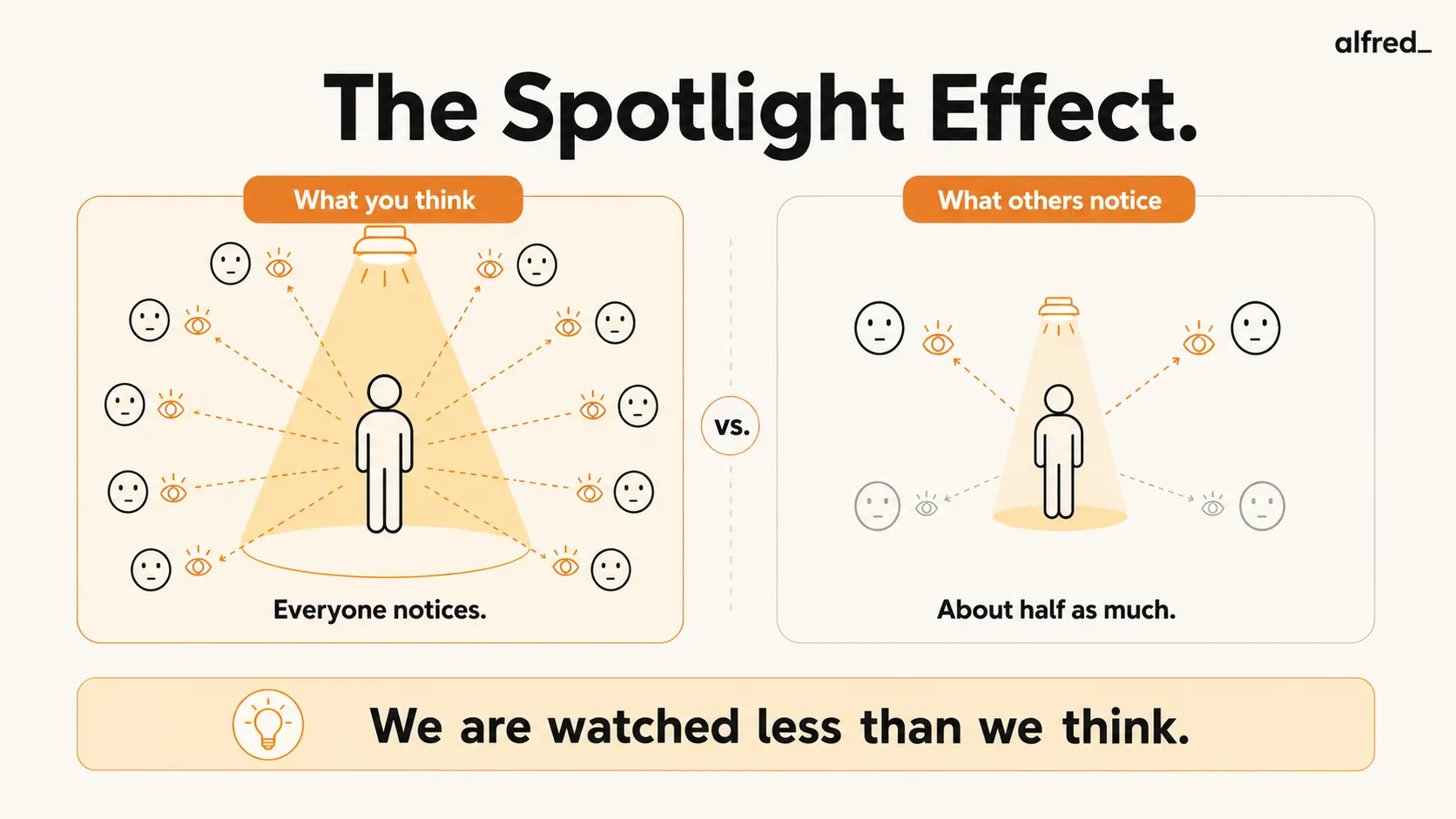
The pause before asking a question in a large meeting: 'everyone will think I missed the point.' The reluctance to send an unusual email: 'they'll notice how different this sounds.' The embarrassment after a visible error in a presentation: 'everyone will remember this.' These fears share a common structure, the overestimation of how much others notice and evaluate what you do. The research shows that the audience's attention is approximately half of what the protagonist assumes.

Feb 19, 20266 min read
Quick Answer

What is the spotlight effect?

  • The spotlight effect is the tendency to overestimate how much others notice and evaluate your appearance, actions, and mistakes
  • Gilovich, Medvec & Savitsky (2000) found participants estimated 50% of observers noticed their embarrassing t-shirt; the actual rate was 25%
  • The mechanism is egocentric anchoring: your own intense awareness of your behavior anchors your estimate of how noticeable you are to others
  • The effect applies to positive and neutral situations too, not just embarrassing ones, making it a general feature of social perception

Gilovich, Medvec & Savitsky (2000), Journal of Personality and Social Psychology, 78(2), 211–222.

The Barry Manilow Study

Thomas Gilovich, Victoria Medvec, and Kenneth Savitsky published "The Spotlight Effect in Social Judgment: An Egocentric Bias in Estimates of the Salience of One's Own Actions and Appearance" in the Journal of Personality and Social Psychology in 2000 (Vol. 78, No. 2, pp. 211–222).
The most cited study asked participants to put on a t-shirt featuring a photograph of Barry Manilow (pre-tested with this student population as a moderately embarrassing item) and then walk into a room containing other students who were filling out questionnaires. After a brief exposure, the t-shirt wearer was taken out of the room and asked to estimate what percentage of the students in the room had noticed their shirt.

50% vs 25%

estimated versus actual proportion of observers who noticed the embarrassing t-shirt: participants wearing the shirt estimated roughly half of observers had noticed; the actual rate was approximately half that estimate.

Source: Gilovich, Medvec & Savitsky (2000), Journal of Personality and Social Psychology, 78(2)

Wearers estimated approximately 50% of observers had noticed. The actual rate, measured by asking the room occupants, was approximately 25%. The spotlight was perceived as twice as intense as it actually was.

Subsequent studies in the paper showed the same pattern for neutral stimuli (not just embarrassing ones): people overestimate how many others notice what they're wearing, how they're behaving, and what they're doing in social settings. The effect is not limited to embarrassment; it is a general feature of egocentric social perception.

The Mechanism: Egocentric Anchoring

Gilovich and colleagues proposed that the spotlight effect reflects egocentric anchoring: we are highly aware of our own appearance and behavior, these stimuli being central and salient in our own experience. We use this self-awareness as an anchor when estimating how noticeable we are to others, and we adjust insufficiently for the crucial fact that others have their own equally compelling internal worlds and are not focused on observing us.

The other people in the room are processing their own experiences, attending to their own tasks, thinking about their own concerns. They have limited attentional capacity and no particular reason to allocate it to noticing details of the person who just walked in. The gap between self-focused awareness and other-focused awareness is the cognitive source of the bias.

This is the same general structure as the anchoring bias: start from a highly available anchor (your own intense awareness of your appearance), and adjust insufficiently for the difference between your perspective and the other person's. The adjustment direction is correct (you probably recognize that not everyone noticed), but the adjustment magnitude is too small.

Try alfred_

See what this looks like in practice

alfred_ applies these principles automatically — triaging your inbox, drafting replies, extracting tasks, and delivering a Daily Brief every morning. Theory becomes system. $24.99/month. 30-day free trial.

Try alfred_ free

Professional Applications

  • Presentation anxiety and public mistakes. The conviction that a presentation stumble (losing your place, a mispronunciation, an incorrect figure quickly corrected) is permanently visible to the audience is spotlight-effect driven. Audiences are engaged with the content and their own reactions; they are not cataloging the presenter's errors with the intensity the presenter imagines. This doesn't mean mistakes don't matter, but the spotlight effect inflates their perceived impact on audience impressions by approximately the same factor documented in the research.
  • Communication hesitation. Many professionals hesitate to send an unusual message, raise a non-standard idea, or ask an "obvious" question because they overestimate how prominently the message will register with recipients. Emails are processed in the context of dozens of other emails; messages that feel remarkably visible to the sender are processed as one among many by the recipient. The spotlight effect inflates the psychological cost of communication that feels exposed.
  • Recovery from visible errors. The lingering embarrassment after a public mistake is partly sustained by the spotlight effect: the person who made the mistake continues to process it as highly salient, and assumes the audience's salience matches theirs. Research on the "audience tuning" effect shows that observers' memories of others' public mistakes fade considerably faster than the actor's memory of the same event. The actor's spotlight remains on; the audience has already moved on.

Frequently Asked Questions

Does the spotlight effect apply to positive things, or only to embarrassing moments?

Gilovich and colleagues explicitly tested neutral and positive stimuli alongside embarrassing ones and found the spotlight effect in all conditions. People overestimate how much observers notice them wearing a socially approved t-shirt as well as an embarrassing one, and how much observers notice good performance as well as mistakes. The effect is somewhat larger for embarrassing or identity-threatening stimuli (because self-awareness is higher in those conditions), but it is a general feature of egocentric social perception, not specific to embarrassment. For positive contexts, this means that individual contributions and visible good work are also less salient to observers than to the person who produced them.

Do experienced public speakers or senior executives still experience the spotlight effect?

Research on expertise and spotlight effect is limited, but the available evidence suggests the effect is attenuated but not eliminated by experience. Public speaking experience reduces presentation anxiety and may improve calibration in that specific domain. But the spotlight effect appears to be a general feature of egocentric social judgment rather than a domain-specific inexperience effect; it should persist at some level even among experienced communicators, simply with lower emotional intensity. The mechanism (insufficient adjustment from self-awareness to others' awareness) is not overridden by knowing you're good at presenting; it operates at the level of automatic social inference.

How does the spotlight effect relate to imposter syndrome?

They involve related but distinct mechanisms. Imposter syndrome involves believing that one's competence is lower than others perceive, specifically the fear of being discovered as less capable than one appears. The spotlight effect involves overestimating how salient one's specific behaviors and attributes are to observers. They can operate in opposite directions: imposter syndrome can occur when the spotlight effect is absent (people aren't noticing your performance signals as much as you fear they are), and spotlight effect can occur without imposter syndrome (overestimating how many people noticed your confident presentation). In practice, both contribute to public performance anxiety, and both can be partially addressed by calibrating expectations about how much of your experience (both capability and behavior) is visible to others.

Try alfred_

Send the Message

alfred_'s briefing structure makes the communication cost concrete: every deferred or unsent follow-up has a visible consequence. The spotlight effect inflates the perceived cost of sending; deferred action has a real cost that the spotlight effect keeps invisible. $24.99/month.

Try alfred_ Free