


The Moral Credentials Mechanism
Benoît Monin and Dale Miller published “Moral Credentials and the Expression of Prejudice” in the Journal of Personality and Social Psychology in 2001 (Vol. 81, No. 1, pp. 33–43). The paper examined a specific mechanism, the moral credentials pathway, in which prior non-prejudiced behavior establishes a reputational credential that reduces the social risk of later prejudiced behavior.
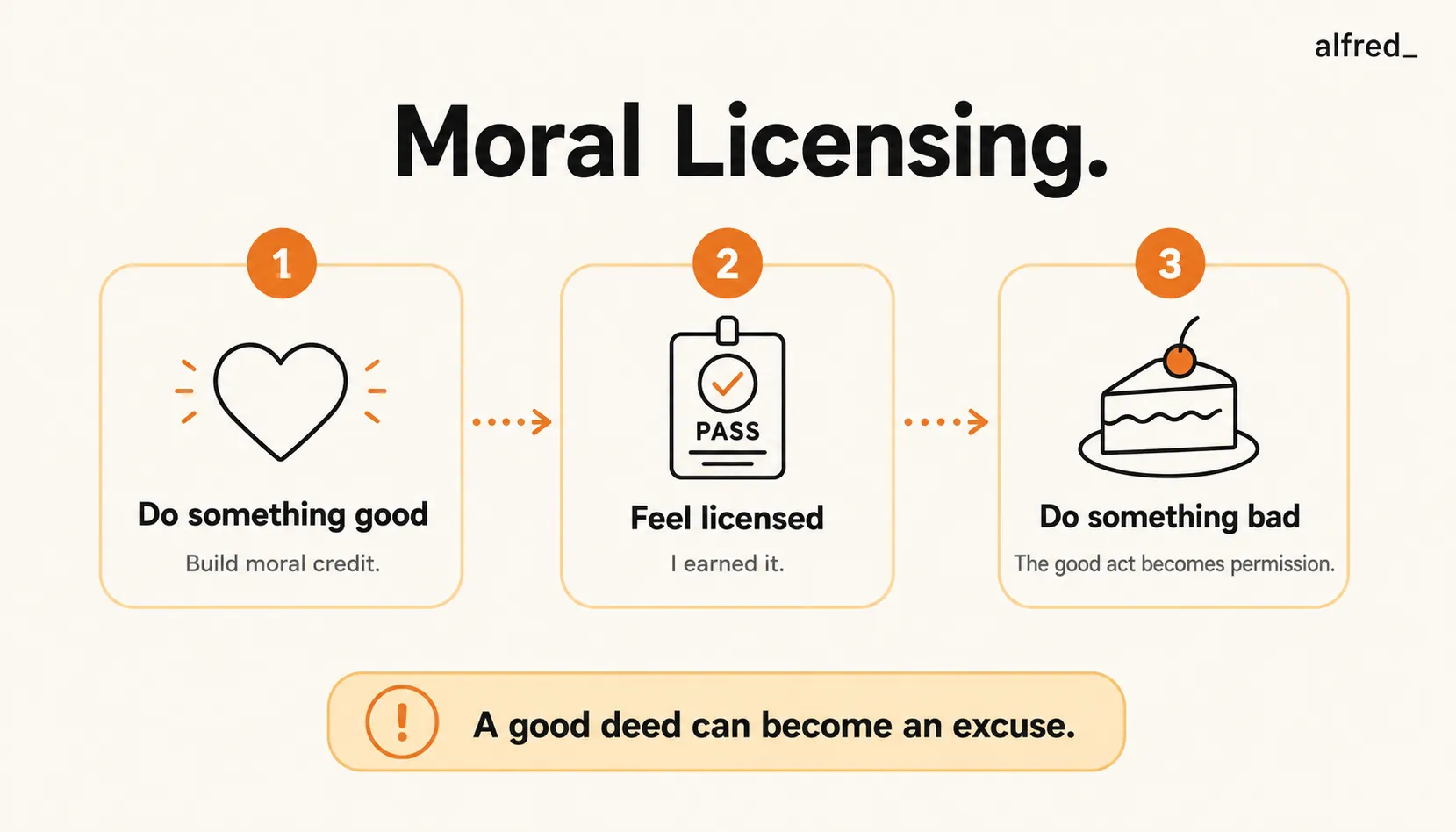
In the studies, participants who had previously endorsed non-stereotypical positions in an unrelated context were subsequently more likely to recommend a stereotypically male candidate (a police chief) to a male applicant in a clearly biased way, and felt more comfortable expressing racial preferences in workforce decisions. The mechanism is reputational: having established that “I am a fair-minded person” through prior behavior, the subsequent behavior is less threatening to that self-concept. The credential licenses behavior that would otherwise feel inconsistent with the self-image.
This is distinct from a second pathway in the broader moral licensing literature: moral credits, in which good deeds are treated as a bank balance that can be spent on subsequent bad behavior. For example: “I donated this morning, so I can skip this meeting’s ethical consideration.” Monin and Miller specifically documented the credentials pathway; the credits pathway has been documented in separate research. Both operate under the umbrella of “moral licensing” but through different psychological mechanisms.
The Meta-Analysis
Blanken, van de Ven, and Zeelenberg published a meta-analysis of the moral licensing literature in Personality and Social Psychology Bulletin in 2015 (Vol. 41, pp. 540–558). The analysis covered k=91 studies and found reliable evidence for the moral licensing effect: prior virtuous behavior or self-concept does reduce subsequent ethical vigilance and increase licensing of less-virtuous behavior.
The meta-analysis also found that the effect is moderated by several factors: it is stronger when the licensing behavior is in the same domain as the prior virtue (health credentials license health indulgences more reliably than they license financial indulgences), when the prior virtue is perceived as diagnostic of moral character rather than situationally constrained, and when there is opportunity for the individual to observe their own virtuous behavior before the subsequent decision.
Professional Implications
- Corporate social responsibility and ethical decision-making. Organizations that publicly emphasize their ethical commitments (through CSR reports, diversity pledges, environmental certifications) may inadvertently create moral licensing conditions for individual decision-makers within those organizations. The credential (“we are an ethical company”) reduces the individual vigilance that produces the ethical behavior the credential is meant to reflect. The corrective is not to abandon public commitments but to ensure that ethical decision processes are procedural and structural, not purely dependent on individual virtue that is being credentialed away.
- Feedback cycles in performance and conduct. Managers who have recently delivered difficult but fair feedback, handled a conflict transparently, or made a difficult personnel decision may subsequently be more lenient in the next decision of the same type. Having credentialed their fairness, they feel freer to be less rigorous in the next instance. Performance management systems that track consistency over time and flag systematic leniency drift are partly addressing this problem.
- Health and productivity trade-offs. The moral credits mechanism operates in personal productivity contexts: completing a demanding cognitive task in the morning creates a sense of license for lower-effort activity in the afternoon; exercise in the morning licenses dietary indulgence at lunch. The license is experienced as earned rather than as a deterioration in effort, which is why it persists despite being counterproductive to the overall goal.