
The Researcher and the Question
Mihaly Csikszentmihalyi (1934–2021) was a Hungarian-American psychologist who spent most of his academic career at the University of Chicago and later Claremont Graduate University. The pronunciation of his name is approximately “cheeks-sent-me-high.”
His entry into flow research came through an unusual path. As a child in Hungary, Csikszentmihalyi survived World War II and observed that most adults around him fell apart under the pressure of political upheaval and poverty, while some maintained equilibrium and even found meaning. He became interested in what psychological resources enabled that resilience, which eventually led him to study the conditions of optimal experience.
His initial research subjects in the 1960s and 1970s were people who reported doing activities for their own sake: artists, chess players, rock climbers, surgeons, factory workers. From thousands of interviews across those populations, he identified a common structure in the experiences they described. He called this structure flow.
The central work: Flow: The Psychology of Optimal Experience (Harper & Row, 1990). The earlier academic treatment: Beyond Boredom and Anxiety (Jossey-Bass, 1975), the first book-length treatment of the concept.
The Definition
“The state in which people are so involved in an activity that nothing else seems to matter; the experience itself is so enjoyable that people will do it even at great cost, for the sheer sake of doing it.”
Csikszentmihalyi, Flow (1990)
Csikszentmihalyi called the state autotelic, from the Greek auto (self) + telos (goal). An autotelic experience is its own reward. The activity is done not for an external outcome but for the intrinsic experience of doing it at full capacity.
The phenomenological description that emerged from his interviews was consistent across cultures, age groups, and types of activity:
- 1: Complete concentration on the task: Attention is entirely focused. Irrelevant stimuli are excluded without effort, not suppressed, but genuinely absent from awareness.
- 2: Clarity of goals and immediate feedback: The person knows exactly what to do next and receives real-time feedback on whether they are doing it correctly.
- 3: Loss of self-consciousness: Concern about how one appears to others disappears. The self-monitoring that characterizes most social situations goes offline.
- 4: Altered time perception: Hours feel like minutes, or time becomes irrelevant. The subjective experience of duration decouples from clock time.
- 5: Intrinsic reward: The activity is done for its own sake. External motivation becomes secondary or irrelevant during the experience itself.
- 6: A sense of personal control: Not certainty of success, but the sense that success is within the person’s capacity and that actions affect outcomes.
The Challenge-Skill Balance
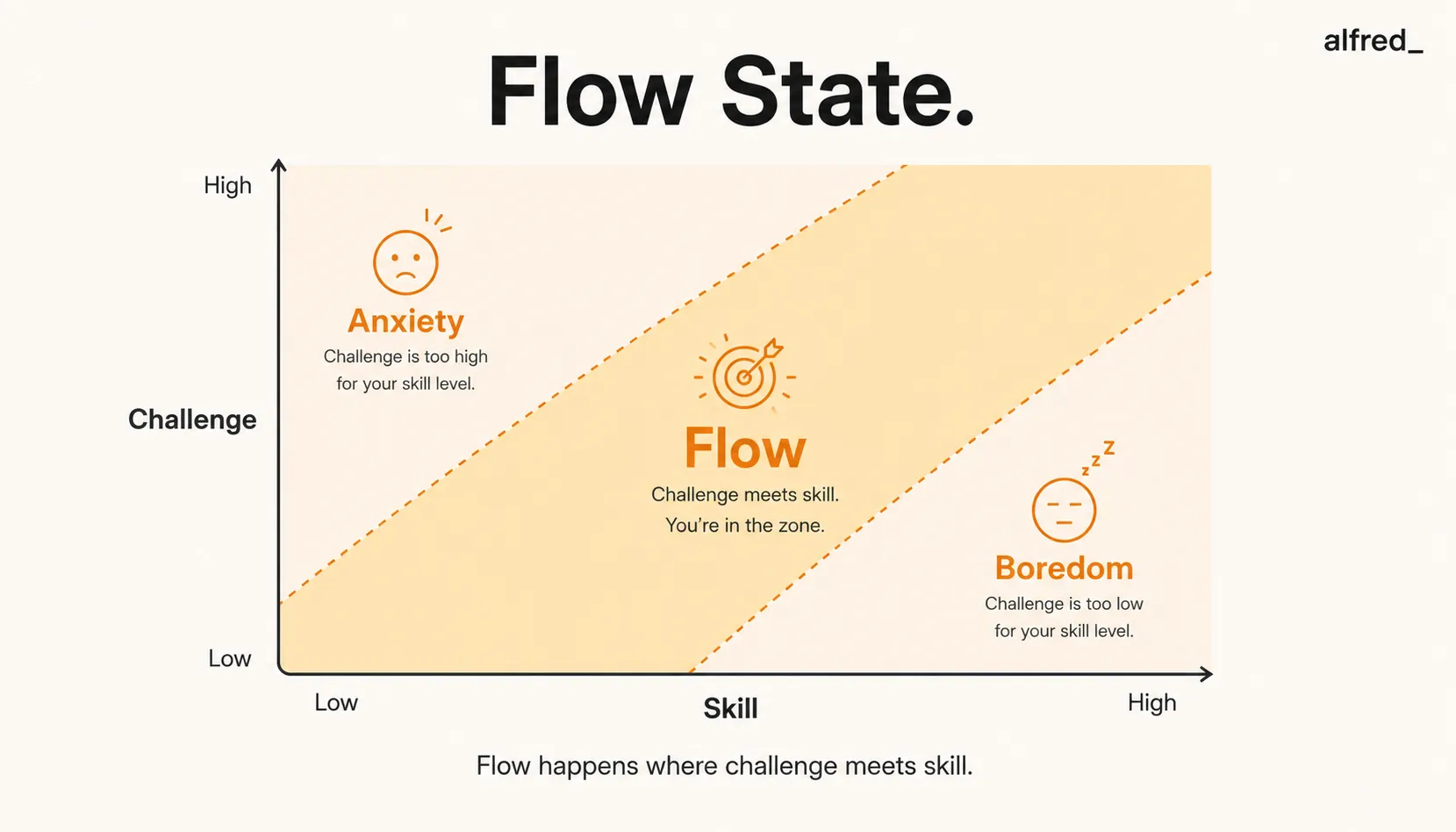
The central structural finding of flow research is that flow occurs in a specific relationship between perceived challenge and perceived skill:
Challenge >> Skill → Anxiety
The task feels overwhelming. The person experiences stress, self-doubt, and the desire to escape.
Skill >> Challenge → Boredom
The task is beneath the person’s capability. Engagement drops; attention wanders; the work feels mechanical.
Challenge ≈ Skill (both high) → Flow
The task fully engages current capabilities without overwhelming them. The person is stretched but not broken.
Two critical nuances. First: it is perceived challenge and perceived skill that matter, not objective measures. An expert doing easy work experiences boredom regardless of the task’s objective difficulty. A novice doing moderately hard work experiences anxiety regardless of what the task looks like to an expert.
Second: the flow channel is not a thin line but a zone. Mild skill advantage produces relaxation. Mild challenge advantage produces arousal. The overlap between these states is where flow is most accessible.
The Counterintuitive Finding: More Flow at Work Than at Leisure
Csikszentmihalyi and his colleagues pioneered the Experience Sampling Method (ESM), in which participants were given pagers (later smartphones) that signaled at random intervals throughout the day. At each signal, participants recorded what they were doing and how they felt.
Across decades of ESM research in multiple countries, a striking pattern emerged: people reported higher engagement, satisfaction, and positive affect during structured activities (particularly work) than during leisure.
This was counterintuitive. Participants consistently expected leisure to be more enjoyable, and they consistently rated work as more engaging when actually in it. Television watching, the most common leisure activity, rated among the lowest for flow, engagement, and post-activity satisfaction.
Csikszentmihalyi’s interpretation: the conditions for flow (clear goals, immediate feedback, challenge-skill balance) are more naturally present in structured activities than in passive leisure. Television has no goals, no feedback, and no skill development. It rarely produces flow. But because it requires no activation energy to begin, it gets chosen as leisure despite producing less of what people actually want from their downtime.
Higher at work
People consistently report more flow, engagement, and positive affect during work than during passive leisure, a counterintuitive finding from decades of Experience Sampling Method research across multiple countries
Csikszentmihalyi, M. Flow: The Psychology of Optimal Experience (1990); ESM studies, University of ChicagoThe Conditions That Make Flow More Likely
From Flow and subsequent research, five conditions make flow more accessible:
1. Clear, specific goals
Vague objectives (“do good work on this”) do not produce flow. Specific, immediate goals (“write the next 500 words of this section,” “solve this specific algorithm problem”) do. The goal needs to be concrete enough that you know whether you are succeeding moment-to-moment.
2. Immediate feedback
The activity must provide real-time feedback on performance. Programming produces error messages and test results. Chess produces immediate consequences. Writing requires the practitioner to develop internal feedback (sensing whether a sentence is right or wrong) when external feedback is absent. Activities with no feedback loop rarely produce flow.
3. Elimination of interruption
External interruptions break the attentional absorption flow requires. A single notification, question, or environmental distraction can collapse the state and require 15–30 minutes to rebuild. The environment must actively support uninterrupted concentration, which for most knowledge workers requires deliberate structural choices.
4. Appropriate challenge level
The task must be hard enough to fully engage current capability but not so hard as to overwhelm it. This requires honest self-assessment and often requires actively adjusting the challenge level: finding a harder problem within a project, or breaking an overwhelming task into manageable pieces.
5. A trusted environment
Unresolved anxieties, open loops, pending obligations, and interpersonal conflicts all compete for background attention. Flow requires enough psychological safety and environmental order that the mind can genuinely commit to the task at hand. This is why David Allen’s GTD system and Newport’s shutdown ritual are described by their practitioners as enabling deeper work: they reduce background noise.
The Critical Failure Mode: Flow Cannot Be Programmed
The most pervasive misconception about flow is that it can be reliably produced on command. Csikszentmihalyi was explicit:
“Flow is not something that happens to you; it is something you do. Yet it cannot be forced. The conditions can be created; the experience emerges from the conditions.”
Practitioners who create optimal conditions (structured environment, clear goals, appropriate challenge level, elimination of interruption) report flow more frequently. But it is not guaranteed. Some sessions under ideal conditions produce flow; others produce focused work that is valuable but not transcendent.
The practical implication: optimize conditions and measure your outcomes by whether high-quality work is being produced, not by whether you are in the phenomenological state Csikszentmihalyi describes. Chasing the feeling of flow is a reliable way to not produce it.