

The Jam Study
Sheena Iyengar and Mark Lepper published “When choice is demotivating: Can one desire too much of a good thing?” in the Journal of Personality and Social Psychology in 2000 (79(6), 995–1006). The paper reported three studies; the most cited is the supermarket field experiment.
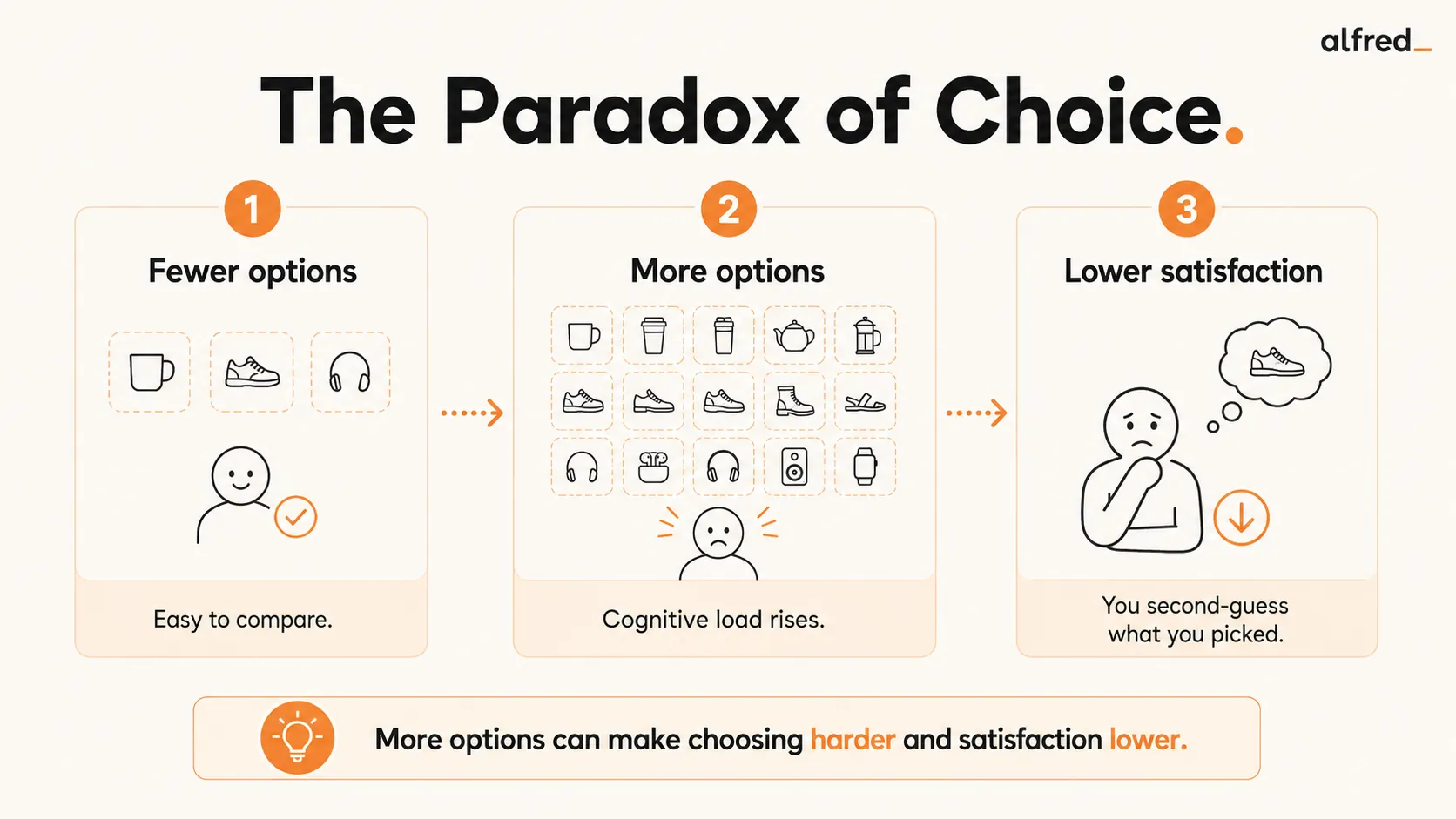
In a California grocery store, they set up a tasting booth offering either a large display of 24 varieties of Wilkin & Sons jam or a limited display of 6 varieties. The displays alternated throughout the day. The large display attracted more initial attention: 60% of passersby stopped to sample, compared to 40% for the small display. But purchase behavior showed the reverse pattern: 30% of those who visited the 6-jam display made a purchase, compared to only 3% of those who visited the 24-jam display.
30% vs. 3%
Purchase conversion rate: 30% of customers who stopped at the 6-jam display made a purchase; only 3% of those who stopped at the 24-jam display did. The larger display attracted more browsers but produced far fewer buyers, roughly 10 times the conversion advantage for the limited option set.
Iyengar, S.S. & Lepper, M.R. (2000). Journal of Personality and Social Psychology, 79(6), 995–1006.The paper included two additional laboratory studies showing that participants who chose from a smaller set of chocolates or essay topics were more satisfied with their choices and produced better work than those choosing from larger sets. Barry Schwartz synthesized this and related research in The Paradox of Choice: Why More Is Less (Ecco/HarperCollins, 2004), applying the findings to consumer behavior, career decisions, and life satisfaction more broadly.
Why Too Much Choice Hurts
Schwartz and subsequent researchers identified several mechanisms:
- Cognitive load and decision paralysis. Evaluating each option requires attention and working memory. More options exhaust these resources, making the decision harder to complete. Decision fatigue sets in, and the result is either avoidance (no decision) or default to the status quo. This explains the jam study’s non-purchase rate: the cognitive cost of evaluating 24 options exceeded the benefit, so most visitors deferred.
- Elevated opportunity cost. With more options, each choice involves forgoing more alternatives, raising the perceived opportunity cost of any selection. The option not chosen becomes more salient as the number of rejected alternatives grows. This increases anticipated regret before the decision and experienced regret after it.
- Higher standards and reduced satisfaction. When many options are available, there is always the possibility that a better option exists among the ones not selected. This makes the chosen option feel less definitively optimal, reducing post-decision satisfaction even when the choice was objectively good. Schwartz’s “maximizer” construct describes individuals especially prone to this: those who try to find the best possible option rather than a satisfactory one.
Professional Applications
- Prioritization and recommendation structures. Presenting a decision-maker with a curated recommendation (“here are the top two options, with my recommendation”) produces better decisions than presenting all evaluated options. The value of a strategic advisor or chief of staff is partly in choice reduction: converting an unmanageable option set into a ranked short list with a clear recommendation. The paradox of choice research supports this as a structural decision improvement, not just an efficiency shortcut.
- Backlog and inbox management. Inboxes and backlogs that grow without active prioritization create choice overload conditions: every decision point involves an implicit meta-decision about which of many items to address first. The cognitive load of this meta-decision reduces quality on all of the object-level decisions. Priority systems, meaning any system that reduces the active choice set to a small, ranked list, counteract choice overload by doing the selection work in advance.
- Product and service design. The jam study finding has direct design implications. Reducing options, providing defaults, and offering curated recommendations all reduce choice overload. The most effective approach is not eliminating choice but pre-filtering it: making the choice set manageable before the decision point while preserving the ability to access broader options for those who want them.