


The Studies
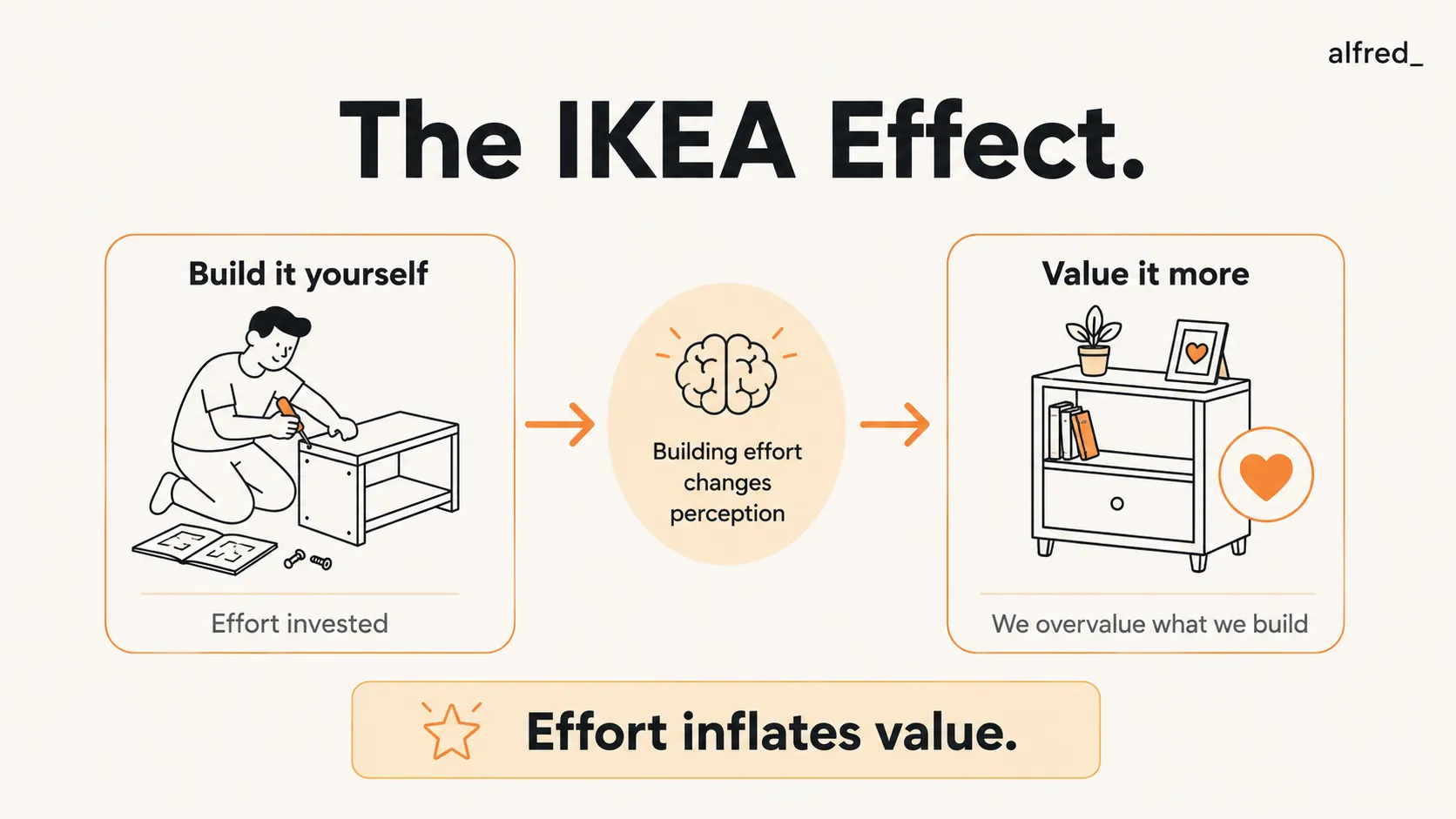
Norton, Mochon, and Ariely published “The IKEA Effect: When Labor Leads to Love” in the Journal of Consumer Psychology in 2012 (Vol. 22, Issue 3, pp. 453–460). The paper reported three studies using different products and different forms of construction effort.
$0.23 vs $0.05
average bids for amateur origami creations. Builders bid approximately $0.23 for their own folded origami; non-builders bid approximately $0.05 for identical creations made by the same builders. Builders valued their work roughly 5x more than non-builders valued the same objects.
Norton, Mochon & Ariely (2012), Journal of Consumer Psychology, 22(3)In the first study, participants assembled simple IKEA storage boxes and then reported their willingness to pay for the finished product, compared to participants who did not assemble the box. Assemblers valued the finished box significantly more than non-assemblers. In the origami study, participants folded origami frogs or cranes using standard instructions. Builders valued their own creations nearly as much as outside observers valued expert-crafted origami, while non-builders (who saw the same amateur creations without having made them) valued them far less. The third study used Lego sets and replicated the finding.
A critical boundary condition: the effect requires task completion. Participants whose creations were destroyed before they could take them home, or who were prevented from finishing their construction task, showed no valuation premium compared to non-builders. The labor-to-love relationship activates when the effort culminates in a completed, owned product, not when it is interrupted or reversed.
Why Labor Creates Love
Norton and colleagues proposed two complementary explanations. The first is signal-based: effort signals competence, and perceiving oneself as competent in a domain inflates the perceived value of the product that demonstrates that competence. Assembling something successfully (even something simple) signals that you are capable, and this positive self-signal transfers to the product.
The second is justification-based: people rationalize the time and effort they have invested by raising their evaluation of the product. This is related to the sunk cost mechanism but operates even prospectively. The investment of effort creates a motivational pressure to see the output as worthwhile, independent of its objective quality.
Both mechanisms produce the same practical prediction: any process that gives users, employees, or stakeholders a meaningful role in creating something will inflate their perceived value of the outcome relative to what an identical externally-produced outcome would produce.
Professional Applications
- Co-creation and product design. Users who have any hand in defining or building a product feature, through user research participation, beta testing, feature voting, or customization, will show disproportionately high attachment to that feature relative to its objective value. Co-creation strategies leverage the IKEA effect deliberately; they produce users who are more engaged with the product because their labor investment creates the valuation premium that engagement requires.
- Strategy and organizational decisions. Strategies developed through participatory processes, with genuine input from stakeholders who shaped the direction, are valued and implemented more thoroughly than strategies handed down from above, even when the content is identical. The IKEA effect partly explains why strategy implementation is stronger when the people who will implement it had a meaningful role in creating it.
- Evaluating internally developed versus externally acquired work. The IKEA effect predicts that any organization will systematically over-value internally developed solutions relative to externally acquired ones, even when the external solution is objectively superior. This is not just NIH (not-invented-here) syndrome in its cultural form; it is a predictable cognitive bias that inflates the perceived value of whatever the team built.