

Distance Changes How You Think, Not Just What You Think About
Yaacov Trope and Nira Liberman published their comprehensive statement of Construal Level Theory (CLT) in Psychological Review in 2010 (Vol. 117, No. 2, pp. 440–463). The core proposition: psychological distance across temporal, spatial, social, or hypothetical dimensions systematically shifts how events are mentally represented.
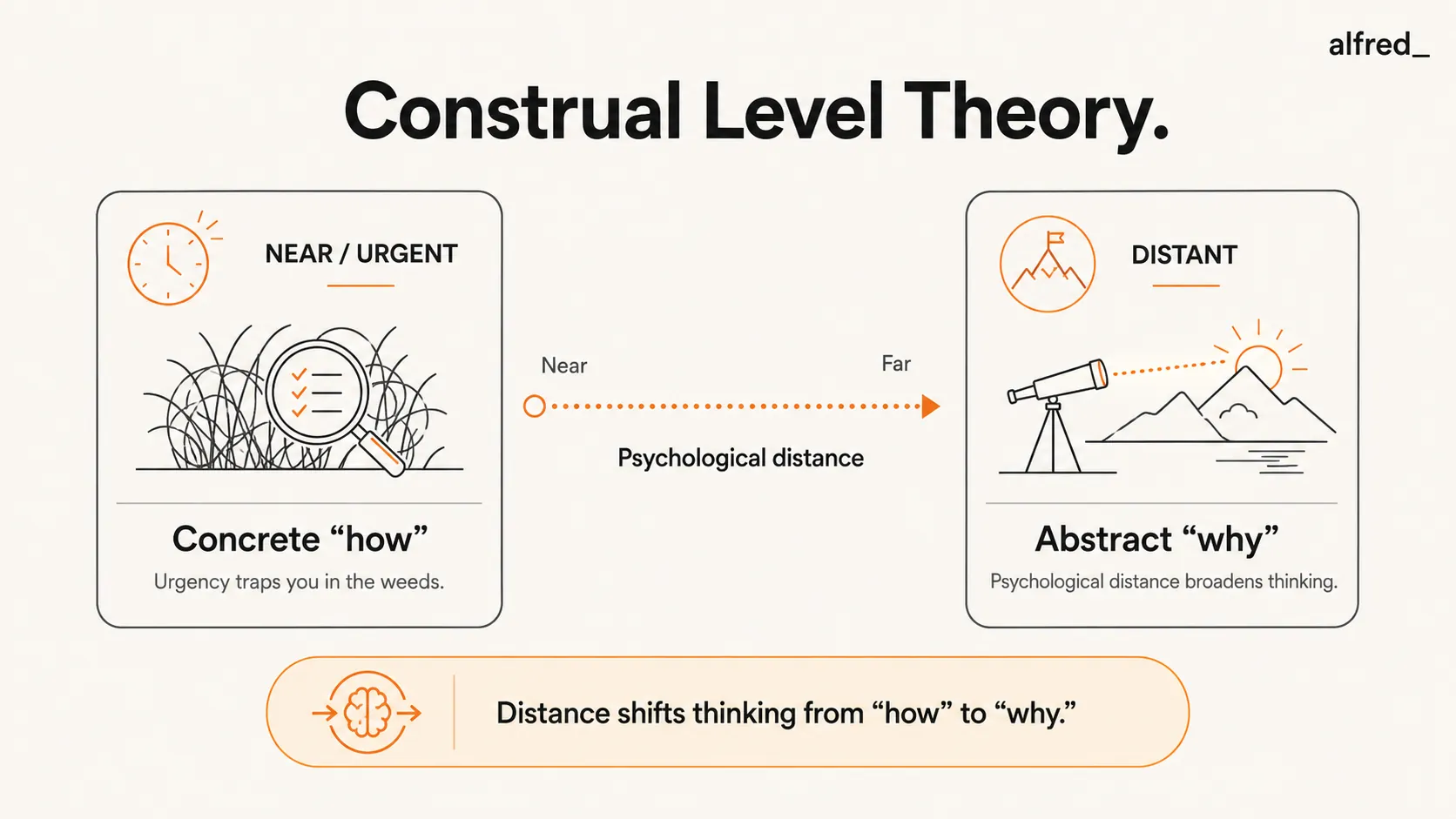
Near events are represented concretely: specific, detailed, contextual, focused on “how” (the mechanics, logistics, and immediate obstacles). Distant events are represented abstractly: schematic, essential, focused on “why” (the goals, values, and desirability). The same event produces different mental representations depending purely on how far away it feels.
Liberman and Trope’s 1998 study in Journal of Personality and Social Psychology demonstrated this with activity choice. Near-future decisions (next week) were dominated by feasibility concerns: whether the activity was easy and convenient. Far-future decisions (distant future) were dominated by desirability: whether the activity was meaningful and valuable. Same activity, same person, different evaluative lens based solely on temporal framing.
What This Means for Strategic Work
Operating in a high-urgency environment doesn’t just consume time. It enforces low-level construal as the dominant cognitive mode. When the inbox is full of immediate demands, the mind is processing concretely: how do I respond to this? What is the specific action required here? What are today’s deliverables?
Strategic thinking requires high-level construal: what are we trying to accomplish? Why does this direction matter? What is the essential goal beneath the operational complexity? This is not a different domain of knowledge. It is a different mode of representing the same situation. And the research suggests these modes are partially mutually exclusive: engaging deeply in concrete processing makes it harder to shift to abstract processing, not just less likely due to time pressure.
This is why executives who are perpetually in operational mode can become strategically ineffective even when they are highly intelligent and well-informed. They are not lacking strategic capacity; they are lacking the cognitive conditions (psychological distance) under which strategic thinking naturally operates.
Engineering Distance
The practical implication: strategic thinking requires artificially creating the psychological distance that operational environments remove. Several approaches are research-consistent:
- Temporal reframing. “What would I think about this decision in five years?” shifts construal level by increasing temporal distance. This is not merely a thought experiment: it literally changes the cognitive processing mode applied to the question, producing more abstract, values-based reasoning.
- Third-person perspective. Social distance, imagining how a respected outsider would evaluate the situation, creates the abstract processing that immediate personal involvement suppresses. “What would my board say?” or “How would a competitor interpret this?” invoke social distance and higher construal.
- Hypothetical distance. “If we were starting from scratch, what would we do?” removes the concrete constraints of the existing situation and forces abstract (“what is essential?”) rather than concrete (“what do we have to work with?”) reasoning.
- Structural separation of operational and strategic work. The clearest finding: operating in a low-urgency, concrete-demand-free environment on strategic questions is not just symbolically important. It is mechanistically necessary. Strategic thinking cannot be squeezed into the gaps of an operational day. It requires the distance that the operational environment destroys.
The advice ‘work on the business, not in the business’ has a mechanism: ‘In the business’ demands create low-level construal mode that makes ‘on the business’ thinking cognitively unavailable. You can’t just decide to think abstractly while also managing a full inbox of concrete demands. The structural separation is necessary, not optional.