


You can have a perfectly optimized calendar and still do mediocre work. Two people get the same eight hours; one produces something sharp and finished, the other produces a tired draft they will redo tomorrow. The difference is not time, which they had in equal measure. It is energy: the capacity to actually use the time well. Jim Loehr spent decades watching this play out with elite athletes, and Tony Schwartz carried the finding into the corporate world. Their conclusion reframes the entire productivity question. Here is the four-dimension framework, the oscillation principle underneath it, and why optimizing your schedule on a depleted body barely moves the needle.
The Framework and Its Origins
Jim Loehr is a sports psychologist who spent decades working with elite athletes, including tennis players Jim Courier and Monica Seles, and Olympic speed skater Dan Jansen. His work focused on what separated athletes who sustained peak performance under pressure from those who performed well in practice but degraded in competition.
His finding: the distinguishing variable was not physical skill or tactical preparation. It was energy management. Specifically, how athletes managed the oscillation between intense effort and genuine recovery.
Tony Schwartz, founder of The Energy Project, collaborated with Loehr to apply these athletic principles to corporate performance. Their joint book, The Power of Full Engagement: Managing Energy, Not Time, Is the Key to High Performance and Personal Renewal (Free Press, 2003), argued that knowledge workers face the same fundamental challenge as elite athletes, and fail at it for the same reason.
“The ultimate measure of our lives is not how much time we spend on the planet, but rather how much energy we invest in the time that we have.”
Honest caveat: The four-dimension energy model described below is Loehr and Schwartz’s own intellectual synthesis, not a framework derived from a single body of peer-reviewed research. The individual components (sleep science, exercise physiology, purpose psychology) have strong research support. The integration into a four-part pyramid is their contribution. Treat it as a powerful organizing framework, not a proven scientific taxonomy.
The Four Dimensions of Energy
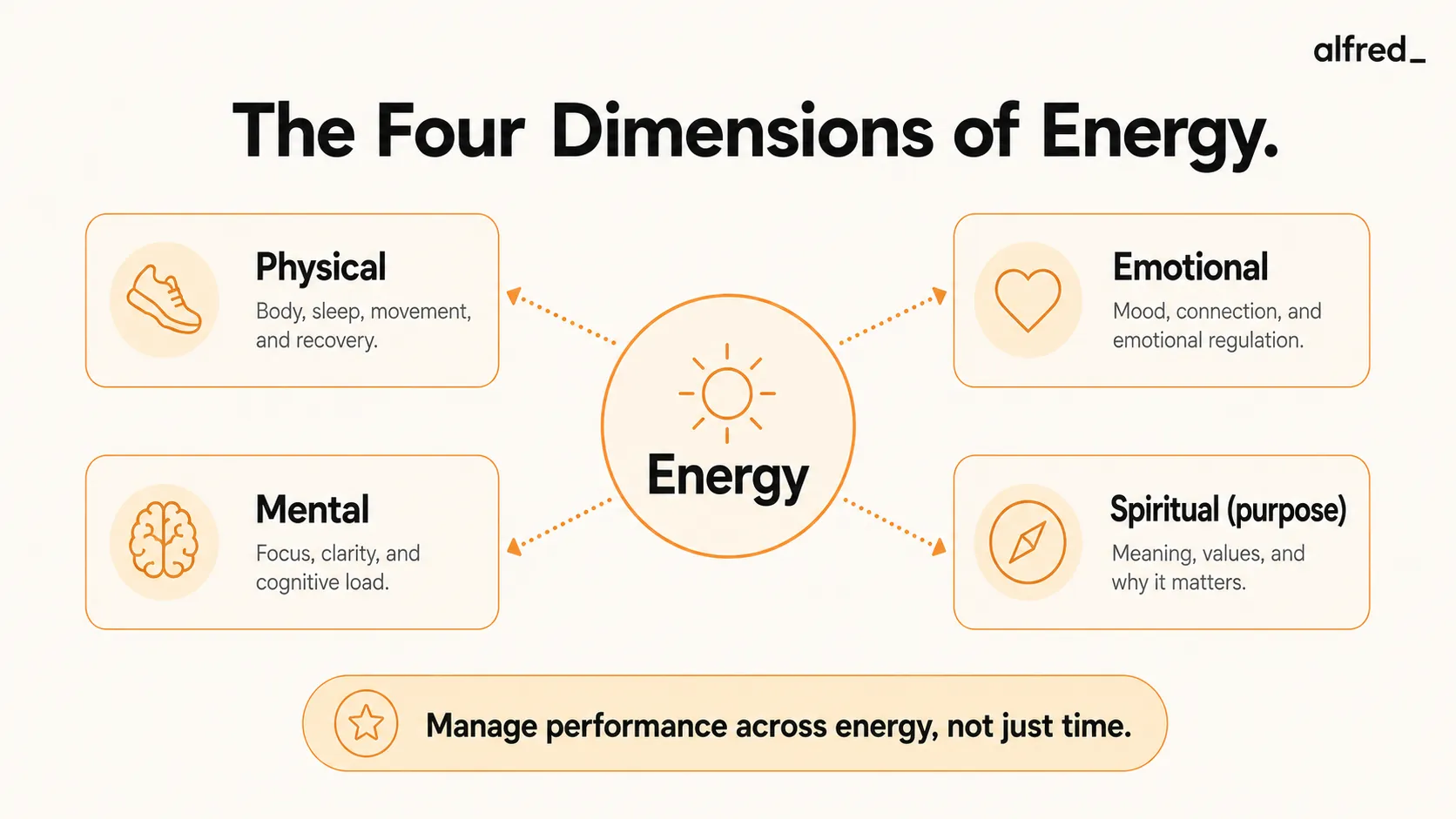
Loehr and Schwartz identify four dimensions of energy, organized as a hierarchy in which each dimension depends on those below it.
1. Physical Energy: The Foundation
Physical energy is the most fundamental because it underlies all other energy forms. It is produced by sufficient sleep, proper nutrition, regular exercise, and strategic recovery.
Key research: Harvard sleep researcher Charles Czeisler has found that sleeping less than 6 hours per night for extended periods produces cognitive impairment equivalent to extended sleep deprivation, with the critical caveat that the sleep-deprived person is not aware of how impaired they are. Self-assessment of impairment is itself impaired.
Loehr’s athletes’ insight: performance depends not on the training load but on the oscillation between effort and recovery. Athletes who train hard without adequate recovery do not improve; they plateau or decline. The same applies to knowledge workers.
2. Emotional Energy
Emotional energy is defined as the quality and sustainability of emotional engagement: whether a person predominantly operates from positive, constructive states or negative, draining ones.
Loehr and Schwartz identify emotional flexibility as the key capacity: the ability to move from negative to positive emotional states and to sustain positive states under pressure.
The sports analogy: elite athletes use pre-competition rituals (specific sequences of music, visualization, physical warm-up, and self-talk) that reliably shift emotional state toward optimal performance readiness. Applied to knowledge work: morning routines, meeting preparation rituals, and pre-deep-work transitions can serve the same function.
3. Mental Energy
Mental energy is the capacity for focused attention, creative thinking, and sound judgment. It is depleted by distraction, multitasking, information overload, and sustained cognitive load without recovery. It is restored by sleep, physical movement, shifts to non-analytical activity, and “diffuse mode” thinking (walking, relaxed attention, manual work).
Loehr and Schwartz note that most knowledge workers respond to mental energy depletion by pushing harder: more caffeine, more willpower, longer hours. The evidence-based alternative is deliberate oscillation: working at high intensity in focused blocks, then recovering fully, rather than sustaining moderate effort all day.
4. Spiritual Energy: Purpose and Meaning
Loehr and Schwartz use “spiritual” without religious connotation. It refers to the energy derived from a sense of purpose, meaning, and alignment between actions and values.
Their finding from working with both athletes and executives: the most sustained high performers consistently draw energy from a sense of mission beyond immediate self-interest. Work aligned with values generates energy; work in persistent misalignment drains it disproportionately, regardless of compensation or external recognition.
This is the hardest dimension to manipulate through habits or schedules. It ultimately requires honest assessment of whether the work you do reflects the values you hold.
The Oscillation Principle
The most practically actionable finding from Loehr’s sports psychology work:
“We must learn to live our lives as a series of sprints, fully engaging for periods of time, and then fully disengaging and seeking renewal.”
The model is rhythmic, not linear. The natural model for human performance is: work → rest → work → rest. Loehr observed that most knowledge workers operate on a flat, sustained model instead: 8–12 hours of continuous (if fragmented) work, followed by insufficient recovery (evening phone scrolling, inadequate sleep, no genuine downtime). Over time, this produces the chronic fatigue and reduced creativity that many professionals experience as a normal baseline rather than a problem to be solved.
90–120 minutes
approximate ultradian rhythm cycle length, representing the natural oscillation between higher and lower alertness within the waking day that Loehr and Schwartz argue should structure work and recovery blocks
Loehr, J. & Schwartz, T. The Power of Full Engagement, Free Press, 2003; ultradian rhythm research, Kleitman et al.Why Most Productivity Systems Get This Wrong
Loehr and Schwartz’s key critique of conventional time management: it targets mental energy (how to organize and prioritize cognitive work) while ignoring the physical and emotional energy that makes mental energy possible.
A person who has restructured their calendar, implemented a perfect GTD system, and mastered time blocking will still perform poorly if they are chronically sleep-deprived, emotionally reactive from unmanaged stress, or disconnected from any sense of purpose in their work. The calendar optimization produces minimal returns on a depleted energy substrate.
The counterintuitive practical prescription: invest in sleep, exercise, and genuine recovery before optimizing your task system. The capacity to use time well depends entirely on the energy available to do so.
Practical Applications
Treat sleep as a performance input, not a lifestyle choice
Czeisler’s research establishes that adequate sleep (7–9 hours for most adults) is not a luxury. It is a prerequisite for cognitive performance at the level knowledge workers require. The executive who “functions fine on 5 hours” is typically not functioning fine by objective measures; they have lost the ability to accurately assess their own impairment.
Build recovery into the workday deliberately
The Israeli parole board data (see Decision Fatigue) shows that a food break completely resets performance. Physical walks, complete attention breaks (not scrolling, but genuine disengagement), and brief periods of non-demanding activity are not wasted time. They are the recovery phase that enables the next work sprint.
Schedule the hardest work for peak physical energy
Most people’s peak physical and cognitive energy occurs in the 2–4 hours after waking. Scheduling administrative tasks, email, and meetings for this window while saving complex, creative work for later reverses the energy optimization: doing low-leverage work with peak resources and high-leverage work with depleted ones.
Develop pre-performance rituals
Loehr’s athletes use specific pre-competition routines to reliably shift emotional state. Knowledge workers can develop analogous rituals: a specific sequence of actions before a deep work session (clearing desk, making coffee, reviewing the session’s goal) that serves as a reliable transition trigger. The ritual doesn’t have to be elaborate; consistency is the mechanism, not complexity.
Spend Peak Energy on What Deserves It
The framework’s sharpest practical instruction is also the one most people invert daily: do not spend your peak window on email, admin, and triage. Yet that is exactly where the morning goes, because the inbox is sitting there when energy is highest, and clearing it feels like progress. You burn your best two hours of physical and mental energy on the lowest-leverage work in the day, then meet your hardest task depleted. The energy is finite and you are spending it backwards.
alfred_ exists to stop that inversion. It handles the inbox triage, the routine replies, and the follow-up tracking, so the work that floods your peak window is no longer there to flood it. The drain Loehr and Schwartz identify, mental energy bled away by distraction, information overload, and continuous checking, is precisely the load alfred_ takes off you. You arrive at your sharpest window with it still intact, and you spend it on the work that actually deserves your best energy, not on the work that merely showed up first.