


You became a designer because you love design. An engineer because you love building. A writer because you love writing. A strategist because you love untangling complex problems. A consultant because you love the work, the actual work, the craft of it, the thinking and creating and making.
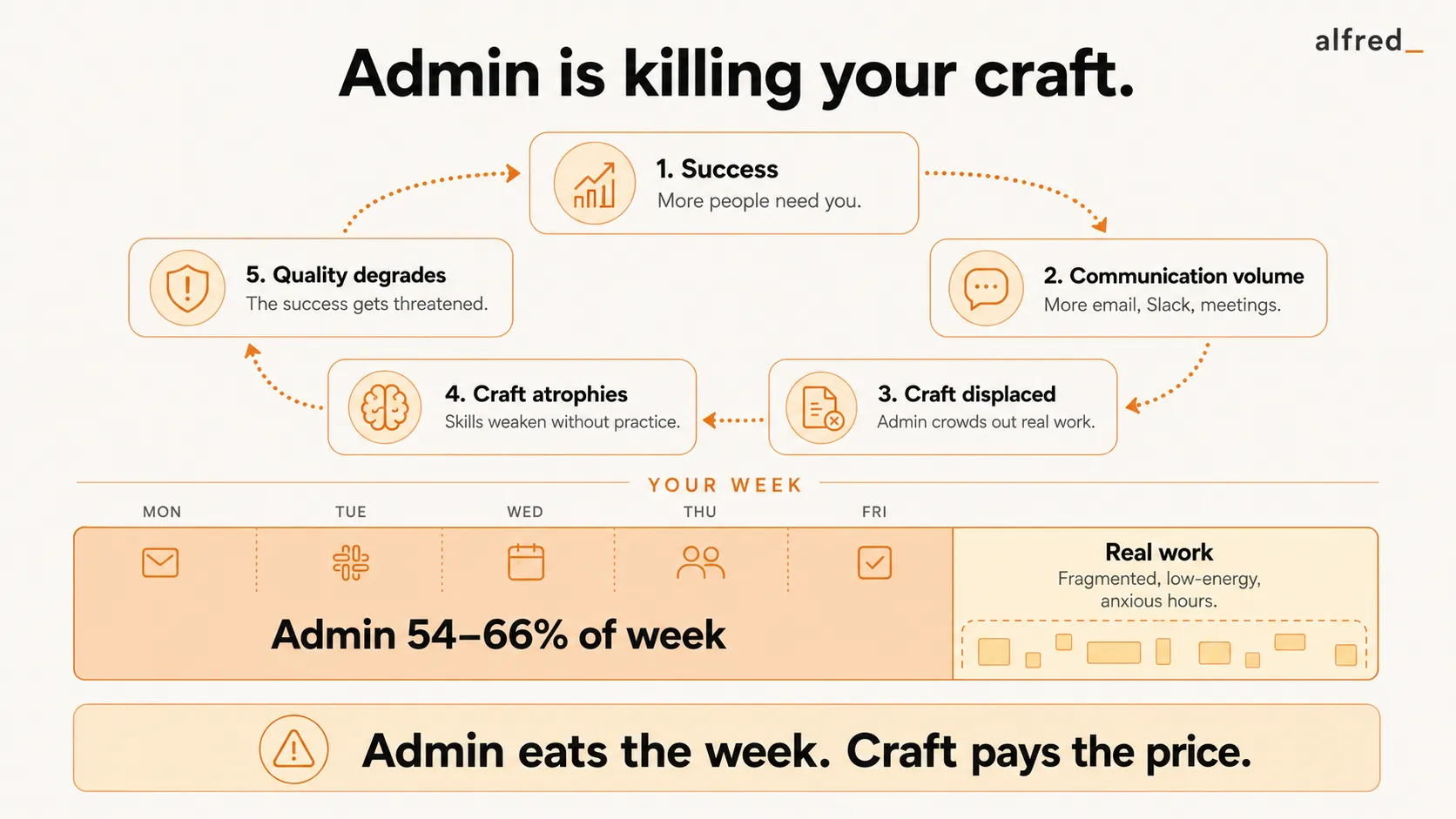
Now you spend most of your day on email.
Not all day. There are also meetings. And scheduling. And follow-ups. And status updates. And invoicing. And project coordination. And client management that is not really about the client’s problem but about the logistics of solving the client’s problem.
The craft, the work that made you good, the work that got you hired, the work that constitutes your professional identity, gets whatever time is left over. Which, increasingly, is almost none.
“I spend more time emailing about the project than actually working on it.”
The Numbers Nobody Wants to See
Here is the data on how creative and knowledge-work professionals actually spend their time.
Software Engineers: A study by Jellyfish, which analyzed engineering time across thousands of companies, found that software engineers spend approximately 30% of their work time actually writing code. The rest is meetings, code review overhead, documentation, Slack, email, and administrative coordination. Other industry analyses have found similar results, engineers consistently report spending only about a third of their time on focused coding.
Designers: Industry surveys consistently show that designers spend 60-70% of their time on non-design activities. Email, meetings, project management, client communication, administrative coordination, and file management consume the majority. Designers consistently report that the top frustration in their role is the amount of time spent on non-design work.
Writers and Content Creators: Freelancers Union surveys have found that freelancers spend an average of 36% of their time on non-revenue activities, finding clients, invoicing, scheduling, email, and client management. For writers at agencies and media companies, the percentage is often higher, with editorial meetings, revision tracking, and approval workflows adding additional overhead.
Consultants: McKinsey’s own research found that knowledge workers, the category consultants fall into, spend 28% of their workweek on email alone. Add meetings (which Atlassian found average 62 per month), and more than half the workweek is consumed by communication, not consulting.
Architects: Industry surveys suggest that principals and senior architects spend less than 40% of their time on design work, with the balance going to business development, project management, email, and admin.
The pattern is universal. The more experienced you become, the more admin you accumulate. The more admin you accumulate, the less you practice your craft. The less you practice your craft, the more it degrades.
The Dollar Cost: What Admin Actually Steals
Abstract “percentage of time” numbers understate the damage. Here’s the math in dollars for professionals who bill by the hour:
Assumes 52 working weeks. Admin hours = time spent on email, scheduling, coordination, status updates, follow-ups, everything that isn't the billable work itself.
| Role | Billable Rate | Admin Hours / Week | Annual Revenue Lost to Admin |
|---|---|---|---|
| Senior consultant | $300/hr | 12 hrs (30% of week) | $187,200 / year |
| Freelance designer | $150/hr | 14 hrs (35% of week) | $109,200 / year |
| Independent architect | $225/hr | 16 hrs (40% of week) | $187,200 / year |
| Agency owner (billing) | $250/hr | 15 hrs (37% of week) | $195,000 / year |
| Contract engineer | $175/hr | 14 hrs (35% of week) | $127,400 / year |
| Corporate attorney | $450/hr | 10 hrs (25% of week) | $234,000 / year |
For a solo consultant billing $300/hour, one hour per day reclaimed from admin is worth $78,000 per year. Two hours per day is $156,000. That’s not a productivity gain. It’s compensation for work you’re already doing but not capturing.
alfred_ is one of the most asymmetric returns in a professional’s tool stack: it pays for itself many times over in a single reclaimed billable hour, and the actual reclaim for most users is 5-10 hours per week. The math is not close.
This framing also explains why hiring a human assistant at $50-85K/year is economically rational for senior consultants billing $300+/hour but impossible for mid-career freelancers at $100-150/hour. AI assistance is the only scalable answer for the tier of professionals where the admin tax is largest in absolute hours but the billable rate doesn’t justify a full EA hire.
The Success Paradox
This is the cruelest version of the problem: admin work grows proportionally with success.
When you had two clients, you received 30 emails a day. You could handle them in 45 minutes. The rest of the day was craft.
When you had five clients, you received 70 emails a day. Two hours of email. Still workable, though the craft was compressed.
When you reached eight clients, the level of success you worked for years to achieve. You crossed 120 emails per day. Three to four hours of email. Add the meetings that come with eight client relationships (8-12 per week), and suddenly your day is 60-70% communication and coordination.
The craft, the reason the clients hired you, the reason you have eight of them, the reason you are successful, gets 2-3 fragmented hours per day. Down from 6-7 hours when you started.
“The better I get at my job, the less I actually do my job.”
This paradox traps every successful professional who operates without support. Growth creates communication volume. Communication volume displaces craft. Craft displacement degrades quality. Quality degradation threatens the success that created the communication volume. It is a cycle that leads to one of two outcomes: you cap your growth to protect your craft, or you let the craft erode to sustain the growth.
Neither is acceptable. Both feel inevitable.
The Atrophy Problem
Skills atrophy when they are not exercised. This is not a metaphor. It is a documented neurological reality.
Research on use-dependent plasticity, the brain’s tendency to strengthen neural pathways that are used frequently and weaken those that are not, has been extensively documented in neuroscience. Cognitive science research has found that expert performance in cognitive tasks degrades measurably when practice is reduced, even among highly experienced practitioners.
For creative professionals, this has direct implications. Design intuition, the ability to look at a layout and know instantly what is wrong, is sharpened by practice and dulled by its absence. Engineering judgment, the ability to hold a complex system in your head and reason about edge cases, requires sustained focus that email days cannot provide. Writing fluency, the ability to find the right word, the right rhythm, the right structure, atrophies when the hours between writing sessions stretch from days to weeks.
You have probably felt this. The work is harder than it used to be. The creative leaps that once came easily now require effort. The strategic clarity that used to appear in the first 30 minutes of thinking about a problem now requires an hour you do not have. You attribute it to age, or burnout, or the increasing complexity of the work.
It is none of those things. It is displacement. You are not losing your skills because of who you are. You are losing them because of what you spend your time on. The admin did not just take your hours. It is taking your edge.
The 2-Hour Compression
When the admin claims 5-6 hours of an 8-hour day, your craft gets compressed into the remaining 2-3 hours. But those hours are not the same as the first 2-3 hours of a full day of creative work.
They are fragmented. Scattered between meetings, interrupted by notifications, bookended by email catch-up sessions. You do not get a clean 2-hour block. You get four 30-minute windows, each one requiring 10-15 minutes to reload context from the previous session.
They are low-energy. The admin takes your morning. Your peak cognitive hours. By the time you clear your inbox and survive the morning meetings, it is 11 AM or noon and your sharpest thinking is behind you. The craft gets your afternoon brain. The tired brain. The brain that is running on its second coffee and still carrying the attention residue of the 47 emails it processed earlier.
They are anxious. Even when you are doing the craft, part of your mind is monitoring the admin. Research on continuous partial attention, a term coined by Linda Stone, describes the state of maintaining peripheral awareness of multiple information channels while nominally focusing on one task. You are “designing” while wondering if that client email has been responded to. You are “coding” while thinking about the scheduling conflict you noticed in your calendar. The craft gets your attention minus the tax of everything else.
A 2-hour creative window that is fragmented, low-energy, and anxious is not equivalent to 2 hours of creative work. It is equivalent to perhaps 45 minutes of actual focused craft. At $200/hr, you are paying a significant premium for degraded output.
What Admin Actually Consists Of
When people say “admin,” it sounds vague. Here is what it actually is for most professionals:
Email (28% of workweek): Reading, triaging, responding, forwarding, filing. A McKinsey study puts this at 11+ hours per week. It is the single largest category of admin for nearly every knowledge worker.
Meetings (15-20% of workweek): Attending, preparing, following up. The Atlassian study found 62 meetings per month, with half considered unnecessary by attendees. The preparation and follow-up time roughly doubles the time commitment of the meetings themselves.
Scheduling coordination (5-8% of workweek): The back-and-forth of finding meeting times, confirming appointments, handling reschedules and cancellations. For client-facing professionals, this is particularly time-consuming because it involves multiple parties with conflicting availability.
Follow-up tracking (3-5% of workweek): Remembering what is outstanding, who owes what, which proposals are waiting for responses, which deliverables are approaching deadlines. This is partially a time cost and partially a cognitive cost, the mental overhead of keeping track.
Invoicing and business admin (3-5% of workweek): For freelancers and firm principals, the operational work of running a business: billing, contracts, expense tracking, vendor management.
Total: 54-66% of the workweek. Leaving 34-46% for actual craft. Before fragmentation and energy depletion are factored in.
Why Email Is the Key
Of all the admin categories, email is the largest, the most persistent, and the most amenable to intervention.
Meetings require your physical or virtual presence. They cannot be delegated (though meeting prep and follow-up can be). Invoicing is periodic and procedural. Scheduling coordination is embedded in email.
Email is the load-bearing wall of admin. If you reduce email, genuinely reduce it, not just sort it into folders, the downstream admin shrinks too. Less email means less scheduling back-and-forth. Less email means fewer follow-ups to track. Less email means fewer meetings spawned by email threads that spiraled. Less email means more hours for the work you were hired to do.
This is why email apps fail at solving the admin problem. SaneBox ($7-36/month) sorts email but does not reduce it. Superhuman ($30-40/month) makes email faster but does not eliminate it. Shortwave bundles email but does not answer it. Every email app changes the experience of email without changing the fundamental burden: you are still the one doing it.
alfred_ does not change the experience of email. It changes the volume of email that requires you.
alfred_ reads every email. It understands context. Your calendar, your relationships, your commitments, your communication patterns. For the 60-70% of email that is routine, scheduling, acknowledgments, status updates, FYIs, follow-ups. It drafts replies in your voice and either sends them automatically (for categories you pre-approve) or queues them for your review. For the 30-40% that needs your judgment, it assembles context and surfaces them in your daily briefing.
The result: the email block shrinks from 3 hours to 30-40 minutes. The scheduling coordination happens without your involvement. The follow-ups are tracked automatically. The admin that was consuming 54-66% of your workweek drops to 25-35%.
And the craft gets the rest.
The Morning You Get Your Craft Back
You open your laptop at 8:30 AM. Your briefing shows 6 items that need your attention. You handle them in 15 minutes.
At 8:45 AM, you open Figma. Or VS Code. Or your writing document. Or the strategy canvas. The actual work. Your work.
You work for three hours. Uninterrupted. Not because you are being disciplined, because there is nothing to interrupt you. The email is handled. The scheduling is handled. The follow-ups are tracked. The admin that used to claim your morning is running in the background, managed by something that has your context and your voice.
At 11:45 AM, you check your briefing. Two new items. You handle them in 8 minutes. You go back to craft.
At 2:00 PM, a meeting. After the meeting, the follow-up emails are already drafted by alfred_. You review and approve them in 3 minutes.
At 2:20 PM, more craft. The afternoon block that used to be lost to email catch-up is now available. You use it.
At 5:00 PM, you close your laptop. You did 5+ hours of actual craft today. Not 2 hours and 48 minutes. Not fragmented scraps between email sessions. Five hours of the work that made you good at this. The work that your clients are paying for. The work that, until today, the admin was slowly killing.
“I didn’t become a designer to spend my life on email.”
You did not. And you do not have to.
The admin that has been suffocating your craft is not a fixed feature of professional life. It is a communication volume problem with a specific answer. alfred_ gives you back the hours that belong to the work. Your work, the real work, the work you spent years learning how to do.
The craft is still in you. It just needs the hours back.
Frequently Asked Questions
How much time do creative professionals actually spend on their craft?
The numbers are consistently discouraging. A study by Jellyfish found that software engineers spend only about 30% of their work time actually writing code. Design industry surveys report that designers spend 60-70% of their time on non-design activities: email, meetings, project management, and administrative coordination. Freelancers Union surveys have found that freelancers spend an average of 36% of their time on non-revenue activities including admin and finding clients. The pattern is consistent across creative and knowledge-work professions: the craft is a minority of the workweek.
Does admin work actually degrade professional skills?
Yes. Research on skill maintenance in cognitive science demonstrates that cognitive skills require regular practice to maintain performance levels. The concept of “use-dependent plasticity” in neuroscience shows that neural pathways strengthen with use and weaken without it. For creative professionals, the implication is direct: if you spend 2 hours per day on design instead of 6, your design skills degrade over months and years. The degradation is gradual and often attributed to aging or burnout rather than its actual cause, displacement by admin work.
Why does admin work increase as you become more successful?
Success creates communication volume. Each new client, project, or relationship adds emails, meetings, and coordination overhead. A consultant with 2 clients might receive 30 emails per day. A consultant with 8 clients might receive 120+. The admin scales linearly (or super-linearly) with success while the hours in a day remain fixed. This creates a paradox: the more successful you become at your craft, the less time you have to practice it. Senior professionals often report spending less time on their core expertise than when they were junior, despite being more skilled.
Can I just hire someone to handle the admin so I can focus on craft?
This is the correct instinct but it faces practical barriers. A skilled assistant costs $50,000-85,000/year. Most individual professionals and small studios cannot justify this expense. Virtual assistants at $15-25/hr lack the context to handle client communication effectively. And email, which constitutes the largest category of admin work, requires judgment that generic delegation cannot provide. alfred_ solves the cost-context-judgment problem specifically for communication admin: it reads every email, understands your relationships and commitments, drafts replies in your voice, and tracks follow-ups.
What is the most effective way to protect creative time from admin creep?
The most effective approach is volume reduction rather than time protection. Time blocking protects hours but the admin accumulates during those hours, creating catch-up pressure. Volume reduction means fewer emails require your attention in the first place. alfred_ achieves this by handling the 60-70% of email that is routine, reducing your daily email load from 100+ messages to 30-40 that genuinely require your expertise. The remaining creative hours are not just protected. They are unburdened by the anxiety of what is accumulating.