

It is 5:37 PM. You should be done.
Your calendar says you are done. Your official hours ended 37 minutes ago. The meeting you were in ran late. They always run late, and by the time you got back to your desk, it was already past five. You did not get to the last batch of emails. You know they are there. You can see the notification badge from where you are sitting. 23 unread since 3 PM.
You should close the laptop. You should be done. Dinner is in an hour. The kids have homework. There is a show you said you would watch. Normal evening things. Earned evening things.
But you are not closing the laptop. You are negotiating.
I’ll just look at the subjects. I won’t reply. Just look. Just to know what’s there.
You look. Three of them are nothing. Two are FYIs that can wait. One is from Sarah about the project that has been consuming your week. Her email starts with “Quick question, “ which you know from experience means it is not a quick question.
You should not reply now. It is 5:43 PM. You should save it for tomorrow. But if you save it for tomorrow, you will think about it all evening. You will compose the reply in your head during dinner. You will wonder if Sarah is waiting. You will feel guilty for not responding.
So you reply. The reply takes 11 minutes. While you were replying, two more emails arrived. You check those. One needs a response. You respond. Another arrives. You check. You respond.
It is 6:28 PM. You close the laptop. You are not done. You are just stopping. There is a difference.
“The mental overhead of ‘I need to respond to that’ is worse than actually responding.”
The Guilt That Has No Off Switch
What you are feeling has been studied extensively, even if nobody calls it by its name.
Researchers call it workplace telepressure, the preoccupation and urge to respond quickly to work-related messages. A study by Barber and Santuzzi found that telepressure predicts lower psychological detachment from work, higher physical and cognitive exhaustion, more sleep problems, and increased burnout. It operates independently of actual workload. You can have zero truly urgent emails and still feel the guilt of logging off.
A majority of American workers say they cannot stop thinking about work during off-hours. Over half check work email before bed. For many, the checking is not driven by employer expectation. It is driven by the internal pressure of unresolved tasks. The guilt of leaving things undone.
“It’s this constant low-level anxiety. Always there. Even on weekends.”
The end-of-day guilt is a concentrated form of this. Throughout the day, you accumulate unanswered emails. Some you deferred intentionally, “I’ll get to this after the meeting.” Some you did not see until late afternoon. Some arrived at 4:58 PM, too late to address thoughtfully but early enough to register on your awareness.
Each unanswered email is a Zeigarnik loop, an incomplete task that your brain tracks in background memory. At 5:30 PM, you have accumulated perhaps 15-20 open loops. Closing the laptop means closing the laptop on all of them simultaneously. Your brain protests. Not loudly. Not dramatically. With guilt. A quiet, insistent feeling that you are leaving something undone. That you are being irresponsible. That you should check one more time.
The “Last Check” Spiral
The negotiation is always the same.
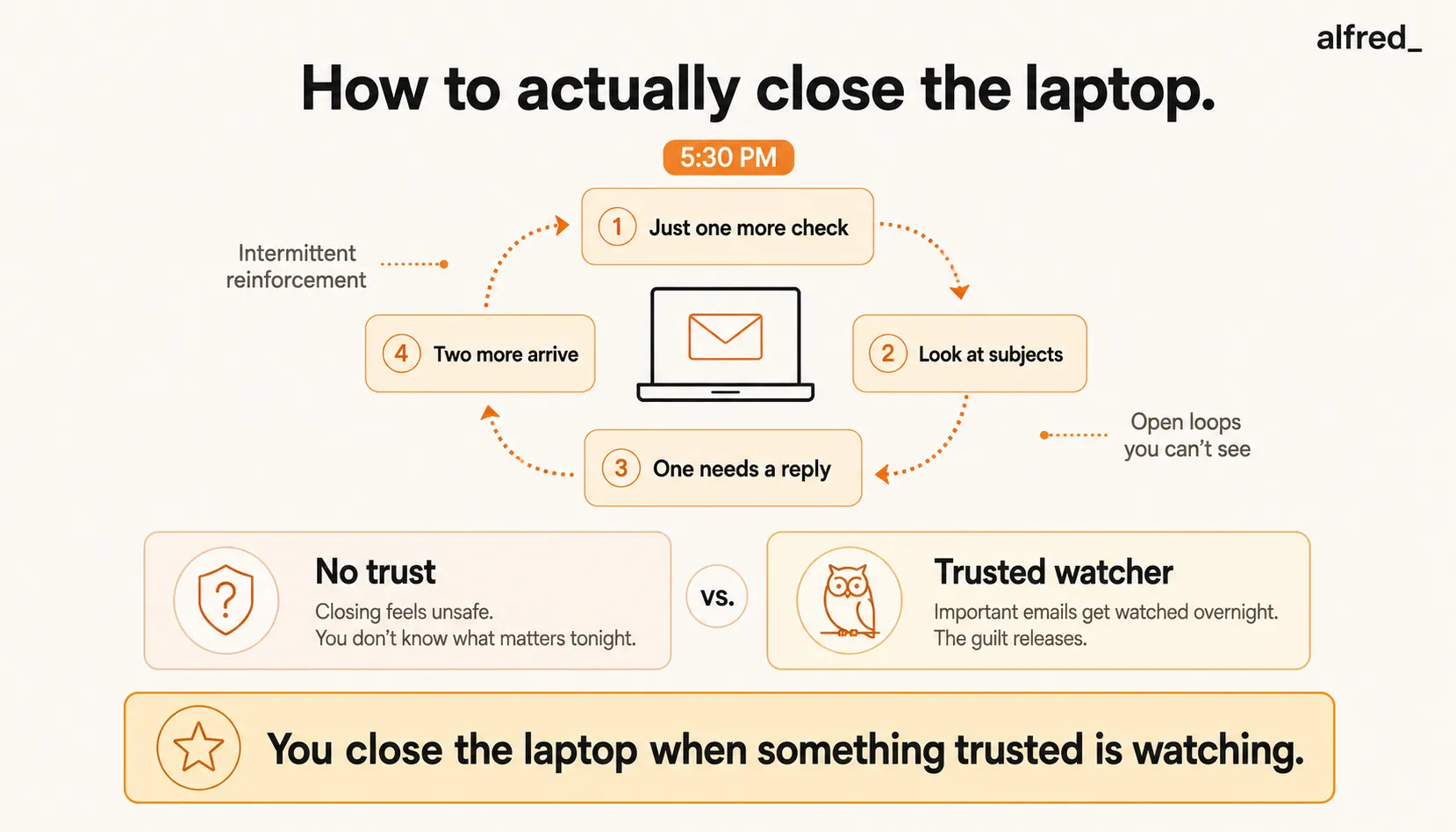
Just one more check. Just to make sure nothing urgent came in. Then I’m done.
You check. Nothing urgent. Relief. You close the laptop. Thirty seconds later: But what about that thread with the vendor? I saw it earlier but didn’t open it. It might be time-sensitive.
You reopen the laptop. You open the vendor thread. It is not time-sensitive. But while you were in the inbox, you see two new messages. You check one. It is from a colleague. It says “Can you look at this when you get a chance?”
When you get a chance. That is now ambiguous. Does “when you get a chance” mean tomorrow? Or does it mean tonight? If you wait until tomorrow, will they think you are ignoring them? If you respond now, you are reinforcing the pattern of being available past 5:30.
You respond now. Two more emails arrive. The spiral continues.
This is the mechanism of intermittent reinforcement, the most addiction-resistant conditioning schedule. Sometimes the last check reveals something actionable, providing a small reward (resolution, helpfulness, being seen as responsive). Most times it reveals nothing. But the occasional reward trains your brain to keep checking, because the next check might be the one that matters.
Slot machines use the same principle. You keep pulling because the next pull might pay out. You keep checking because the next email might be the one that needed your immediate attention. The occasional hit, “Good thing I checked, that was actually urgent”, reinforces a behavior that costs you hours of evening peace across weeks and months.
What the Research Says About Not Detaching
Sabine Sonnentag at the University of Mannheim has spent decades studying recovery from work stress. Her research consistently identifies psychological detachment, the ability to mentally disconnect from work during off-hours, as one of the strongest predictors of:
- Better sleep quality, Workers who detach sleep deeper and wake more rested
- Lower emotional exhaustion, The buffer against burnout replenishes overnight
- Higher next-day engagement. You start the day with cognitive resources intact
- Reduced psychosomatic complaints, Fewer headaches, muscle tension, and GI issues
The flip side is equally clear. Workers who cannot detach, who continue checking, ruminating, and worrying about work during their evenings, show higher cortisol levels, worse sleep architecture, and decreased performance the following day. The inability to close the laptop is not just an inconvenience. It is a measurable health risk.
A study published in Organizational Behavior and Human Decision Processes specifically examined smartphone use for work during evening hours. The findings were stark: evening work-related phone use was associated with reduced sleep quantity and quality, and lower engagement the following morning. Not because the work was difficult. Because the cognitive arousal of checking, even briefly, even finding nothing, activates neural circuits that should be winding down.
“I turned off notifications and it somehow got worse, now I compulsively check manually.”
The cruel paradox: turning off evening notifications does not fix the guilt. It removes the prompt but not the drive. The guilt is internal. It is the weight of open loops. Turning off notifications just means you carry the weight in silence, checking manually because the not-knowing amplifies the guilt.
Why You Cannot “Just Answer Everything Before You Leave”
The advice sounds reasonable: clear your inbox before end of day. Respond to everything. Close every loop. Then close the laptop with a clean conscience.
This does not work for a simple reason: email does not stop arriving.
At 121 emails per day, messages arrive roughly every 4-5 minutes during business hours. While you are responding to the emails from 3 PM, new emails arrive at 4 PM. While you are responding to those, new ones arrive at 5 PM. The inbox is a river, not a lake. You cannot drain it.
To clear all email by 5:30 PM, you would need to stop receiving email at approximately 3:30 PM and spend two hours processing. But emails keep arriving at 4, 5, and often 6 PM, especially from colleagues in different time zones. The inbox you emptied at 5:15 has 7 new messages by 5:30.
And even if you could clear every email, the guilt would persist for messages that need action you cannot take today. The client wants a proposal by Friday. You responded acknowledging receipt, but the proposal is not done. Loop still open. The boss asked for headcount numbers. You responded that you would pull them tomorrow. Loop still open. Your brain tracks these because they are commitments, and commitments do not close just because you sent an acknowledgment.
The Real Problem Is Trust
The guilt is not really about email. It is about trust, specifically, the absence of it.
When you close the laptop, you are trusting that nothing critical will happen between now and tomorrow morning. You are trusting that no client emergency will escalate. You are trusting that the email you deferred will still be relevant and addressable in the morning. You are trusting that closing the laptop is safe.
Your brain does not trust this. It has evidence to the contrary. There have been times when an evening email was critical. There have been times when a delayed response did cause a problem. There have been times when closing the laptop was followed by a morning crisis. Your brain catalogued these events and uses them to justify the vigilance.
This is why the guilt feels rational even though it is disproportionate. Your brain is not being irrational. It is being risk-averse based on incomplete information. It knows that some evening emails matter. It does not know which ones. So it assumes all of them might, and generates guilt to keep you checking.
The solution is not discipline. Discipline is a finite resource that depletes throughout the day, exactly when you need it most, at 5:30 PM when your willpower is lowest. The solution is a system that provides the trust your brain is seeking.
What Changes When You Can Close the Laptop Cleanly
SaneBox ($7-$36/month) sorts email by importance. Low-priority messages go to @SaneLater. This helps during the day, fewer emails in the primary inbox means fewer loops to track. But at 5:30 PM, SaneBox does not help you close the laptop. It is not monitoring for evening urgencies. It is not drafting replies to messages that arrive after you log off. The guilt persists because the uncertainty persists.
Superhuman ($30-$40/month) makes email processing faster, which theoretically helps you clear more inbox before end of day. But speed does not solve the fundamental problem: email keeps arriving. Superhuman does not watch your inbox after you close it. The 7 PM email from a client in a different time zone is unseen until morning.
Spark and Shortwave offer notification management and AI categorization. Better than raw inbox. But when the laptop closes, these tools close with it. Nothing is watching.
alfred_ does not close when you close the laptop. It continues monitoring your inbox through the evening and overnight. If something genuinely urgent arrives at 7 PM, a client emergency, a deadline change, a critical escalation, alfred_ surfaces it. If nothing urgent arrives, which is the case most evenings. It triages incoming messages, drafts replies for items that need responses, and prepares your morning briefing.
The difference is not what happens to the email. It is what happens to the guilt.
When you trust that a system is watching, genuinely watching, with judgment, understanding context and urgency, the open loops stop generating guilt. They are still open. The emails are still unanswered. But your brain has delegated the monitoring to something it trusts, and the cognitive tension releases.
This is the same mechanism that allows executives with human assistants to leave the office at 5 PM without guilt. They are not more disciplined than you. They are not less conscientious. They trust that someone is watching. That trust permits the laptop to close.
The Evening You Get Back
There is a Thursday, ordinary Thursday, nothing special, when you notice something different.
It is 5:22 PM. You finished the thing you were working on. Your inbox has a handful of unreads. You glance at them. Two are from this afternoon, not urgent. One is a newsletter. alfred_ has already categorized the rest.
You close the laptop.
You walk away. You do not negotiate. You do not bargain with yourself about one more check. You do not feel the familiar pull back toward the desk. The laptop is closed. The evening has begun.
At dinner, your phone does not call to you from the counter. There is nothing to check. alfred_ is monitoring. If something matters, it will reach you. Nothing has reached you. Therefore, nothing matters right now.
Your partner says something about the weekend. You hear it. All of it. Not 70% of it while the other 30% rehearses a response to Sarah’s email. All of it. You respond. You are present. The evening is yours.
“I don’t need zero inbox. I need to not feel like I’m always behind.”
The guilt was never about the emails. It was about the uncertainty of what would happen to them after you stopped watching. It was about the open loops your brain could not close. It was about the absence of trust that logging off was safe.
alfred_ provides the trust. Not through reminders, not through notification management, not through batching strategies. Through the simple, profound assurance that someone is watching. That nothing will slip. That the loops are being monitored. That closing the laptop does not mean dropping the ball.
That assurance is what allows the guilt to release. And when the guilt releases, the evening comes back. The dinner comes back. The present moment comes back. The clean shutdown that everyone talks about but nobody achieves. It becomes ordinary. Not a triumph of discipline. Just Thursday.
The evenings you have been losing are worth far more than alfred_ costs.