

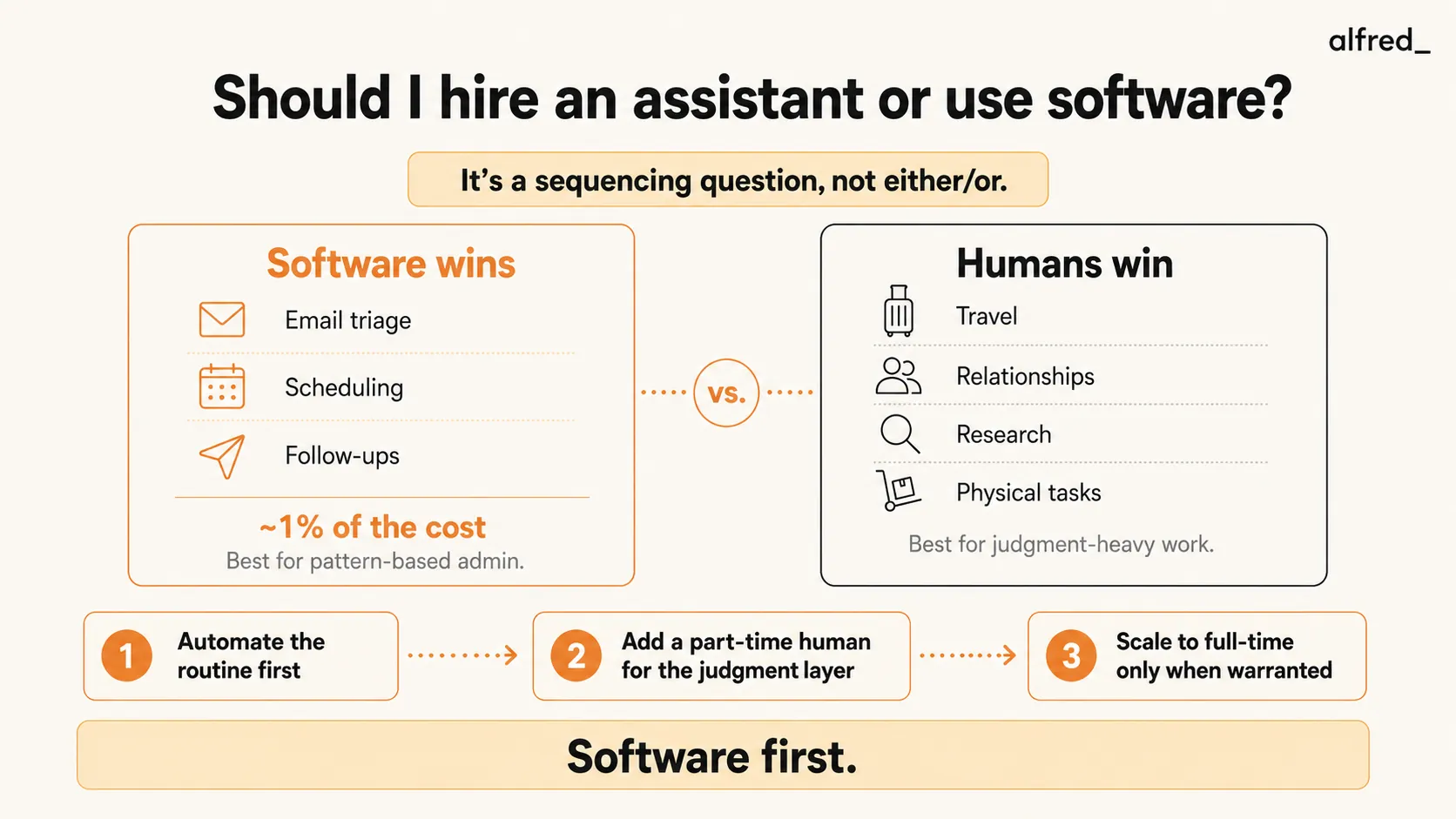
The Hire vs Buy Decision
You are drowning in admin work. Email takes 2 hours per day. Scheduling is a mess. Follow-ups fall through cracks. You know you need help.
Two paths present themselves. Path one: hire an assistant. Path two: buy software that handles it.
Both paths have zealous advocates who make the other side sound foolish. The “hire a human” crowd says AI cannot replicate the judgment and personal touch of a real assistant. The “use software” crowd says paying $75,000+ per year for tasks that a $25/month tool handles is financially irrational.
They are both partially right. Here is the full picture.
What a Human Assistant Actually Does
Let’s be specific about what you get when you hire a human assistant, because the category is broader than most people realize.
The routine layer (60-70% of the work)
Email triage: scanning your inbox, categorizing messages, drafting routine replies, flagging items that need your attention. Calendar management: scheduling meetings, handling reschedule requests, booking conference rooms, sending reminders. Task tracking: maintaining your to-do list, following up on delegated items, tracking deadlines. Information management: filing documents, organizing notes, maintaining contact information.
This work is pattern-based. It follows established rules (these senders are VIP, these types of emails get this response, meetings are scheduled in these time blocks). A good assistant learns your patterns in 2-4 weeks and executes them reliably.
The judgment layer (20-30% of the work)
Travel planning: researching flights with your preferences, booking hotels near your meetings, building itineraries with buffer time, handling changes when flights are delayed. Relationship management: remembering that a client’s daughter just graduated, suggesting a congratulatory note, ordering a gift. Complex research: finding the right vendor for a specific need, comparing options, and presenting a recommendation. Sensitive communication: knowing when a situation requires your personal involvement versus a standard response.
This work requires adaptation, context awareness, and the kind of judgment that comes from understanding you as a person, not just your inbox.
The physical layer (5-10% of the work)
In-person tasks: picking up dry cleaning, setting up a conference room, greeting visitors, managing an office. These are tasks that require a body in a location.
What Software Actually Does
AI assistant software operates primarily on the routine layer. Here is what it handles and how it compares.
Email triage: software wins on speed and consistency
A human assistant can triage 100 emails per day in roughly 1-2 hours. AI software like alfred_ triages 100 emails in minutes. The AI does not get tired at 4pm, does not have off days, and does not take vacation. It processes email at 2am on a Saturday with the same accuracy as 9am on a Monday.
More importantly, AI triage is consistent. A human assistant’s judgment varies with mood, energy, and attention. An AI applies the same criteria every time. For pattern-based triage (is this sender important? does this email need a response? what category does this belong to?), consistency is more valuable than occasional human insight.
Scheduling: depends on complexity
For standard scheduling (find a time, send an invite, handle one reschedule), software handles it as well as a human. Calendly eliminates booking back-and-forth. AI tools handle scheduling requests that arrive via email.
For complex scheduling (coordinating a multi-city trip with meetings in three time zones, planning a dinner for eight executives with dietary restrictions at a restaurant near their hotel), a human assistant is significantly better. This type of scheduling requires judgment, local knowledge, and the ability to handle exceptions that do not fit templates.
Follow-up tracking: software wins decisively
Humans forget. It is not a character flaw; it is a cognitive limitation. When you ask a human assistant to track 40 open follow-ups across email threads, some will slip. When you ask software to track 40 follow-ups, zero will slip. Software does not forget, does not lose track, and does not need to be reminded to check.
This is one of the clearest wins for software. Follow-up tracking is a pattern-recognition and reminder task. It plays directly to the strengths of automation and directly to the weakness of human memory at scale.
Draft responses: closer than you would expect
Two years ago, AI-drafted emails were obviously AI-generated. Today, tools like alfred_ that learn your specific writing patterns produce drafts that are difficult to distinguish from your own writing. For routine emails (acknowledgments, scheduling confirmations, information requests, brief updates), AI drafts are at parity with what a good assistant produces.
Where human assistants still excel: emails that require reading political dynamics, adjusting tone for a sensitive situation, or composing something that requires genuine emotional intelligence. A human assistant who knows you well can draft a condolence note that feels personal. AI is not there yet.
The Cost Comparison
Let’s put real numbers on this.
Full-time executive assistant (in-house)
- Salary: $55,000-$95,000 (Bureau of Labor Statistics median: $74,260, with senior EAs in major metros earning $90,000+)
- Benefits (health, dental, 401k match): $12,000-$25,000
- Payroll taxes (FICA, unemployment): $5,000-$8,000
- Office space, equipment, training: $3,000-$10,000
- Total: $75,000-$140,000 per year ($6,250-$11,700/month)
Part-time virtual assistant (remote)
- Agency rates (Belay, Time Etc): $35-$50/hour
- 20 hours per week: $2,000-$4,000/month
- Independent contractor: $20-$40/hour, 20 hours/week: $1,600-$3,200/month
- Total: $1,600-$4,000 per month
AI assistant software
- alfred_: $29.99/month
- Works 24/7 (equivalent to 168 hours per week versus 40 for full-time)
- No benefits, taxes, or overhead
- Total: $29.99 per month
For the routine work that overlaps (email triage, scheduling, follow-ups, task tracking), the cost difference is substantial. A human assistant costs roughly $1,400-$2,000 per month just for email triage (2 hours/day at $35-$50/hour). AI software handles the same triage for $29.99/month total.
The Honest Decision Framework
Start with software if:
- Your primary bottleneck is email, scheduling, and follow-up tracking
- You spend 1-3 hours per day on routine admin that follows patterns
- Your income is below $200,000 per year (the cost of a human assistant is disproportionate)
- You do not need physical presence for tasks
- You want help immediately (no hiring process, no onboarding, no management)
At this stage, AI software eliminates the routine layer at a fraction of the cost of a human. You recover 1-2 hours per day for $29.99/month. The math is not close.
Add a part-time human when:
- Software handles your routine admin but you still have judgment-heavy work piling up
- You need complex travel planning, relationship management, or research that requires synthesis
- Your income is above $200,000 per year and you have 10+ hours per week of judgment work that a human could handle
- You are spending more time on non-routine admin than on revenue-generating work
At this stage, you keep the software for routine (it is better and cheaper) and add a human for the judgment layer. The human assistant starts at a higher level because they are not spending 60-70% of their time on email triage. They focus on the high-value work that actually requires a human.
Hire full-time when:
- You have enough combined routine and judgment work to fill 40 hours per week
- You need physical presence for a significant portion of the work
- Your income is above $500,000 per year and the opportunity cost of your admin time vastly exceeds the cost of a full-time hire
- You run a team or organization where the assistant also supports others
Even at this level, most executives who hire full-time human assistants would benefit from giving that assistant AI software tools. The human focuses on judgment work while AI handles the pattern-based volume. This is the hybrid model, and it is increasingly how high-functioning executive support works.
Where alfred_ Fits
alfred_ occupies the first rung of this ladder: AI software that handles the routine layer.
At $29.99/month, it provides email triage, response drafting, task extraction, follow-up tracking, and calendar intelligence. It works 24/7, processes email in minutes, and never forgets a follow-up. For the 60-70% of assistant work that is pattern-based, it performs at or near the level of a trained human assistant at roughly 1% of the cost.
alfred_ does not replace a human assistant for judgment-heavy work. It does not plan your travel, manage personal relationships, or set up your conference room. If those needs are significant, you still need a human.
But here is the key insight: most people who think they need a human assistant actually need the routine layer handled first. They are drowning in email triage and scheduling, not complex travel planning. They need the $25/month solution, not the $5,000/month one.
Start with software. See how much capacity it frees up. Then decide whether the remaining work justifies a human hire.
The Sequencing Matters
The biggest mistake professionals make is treating this as an either-or decision. It is a sequencing decision.
Phase 1: Automate the routine. AI software handles email triage, scheduling, follow-ups, and task tracking. Cost: $25/month. Time recovered: 1-2 hours/day.
Phase 2: Evaluate what remains. After the routine is automated, look at the admin work that still requires your attention. Is it enough to justify a human? Is it the kind of work a human adds value to?
Phase 3: Add human support if warranted. If you have 10+ hours per week of judgment-heavy admin, hire a part-time virtual assistant. They start at a higher level because the routine is already handled.
Phase 4: Scale as needed. As your income and complexity grow, the human role expands. The AI layer stays as the foundation.
This sequence ensures you never pay human rates for work that software handles better, and you never ask software to do work that requires human judgment. Each layer does what it does best.
The question is not “hire or buy.” The question is “in what order?” And for nearly everyone, the answer is: software first.