


You billed a client $200 an hour last Tuesday. During that same hour, you also spent 22 minutes answering an email about a meeting time, forwarding a PDF someone could have found in the shared drive, and confirming receipt of an invoice.
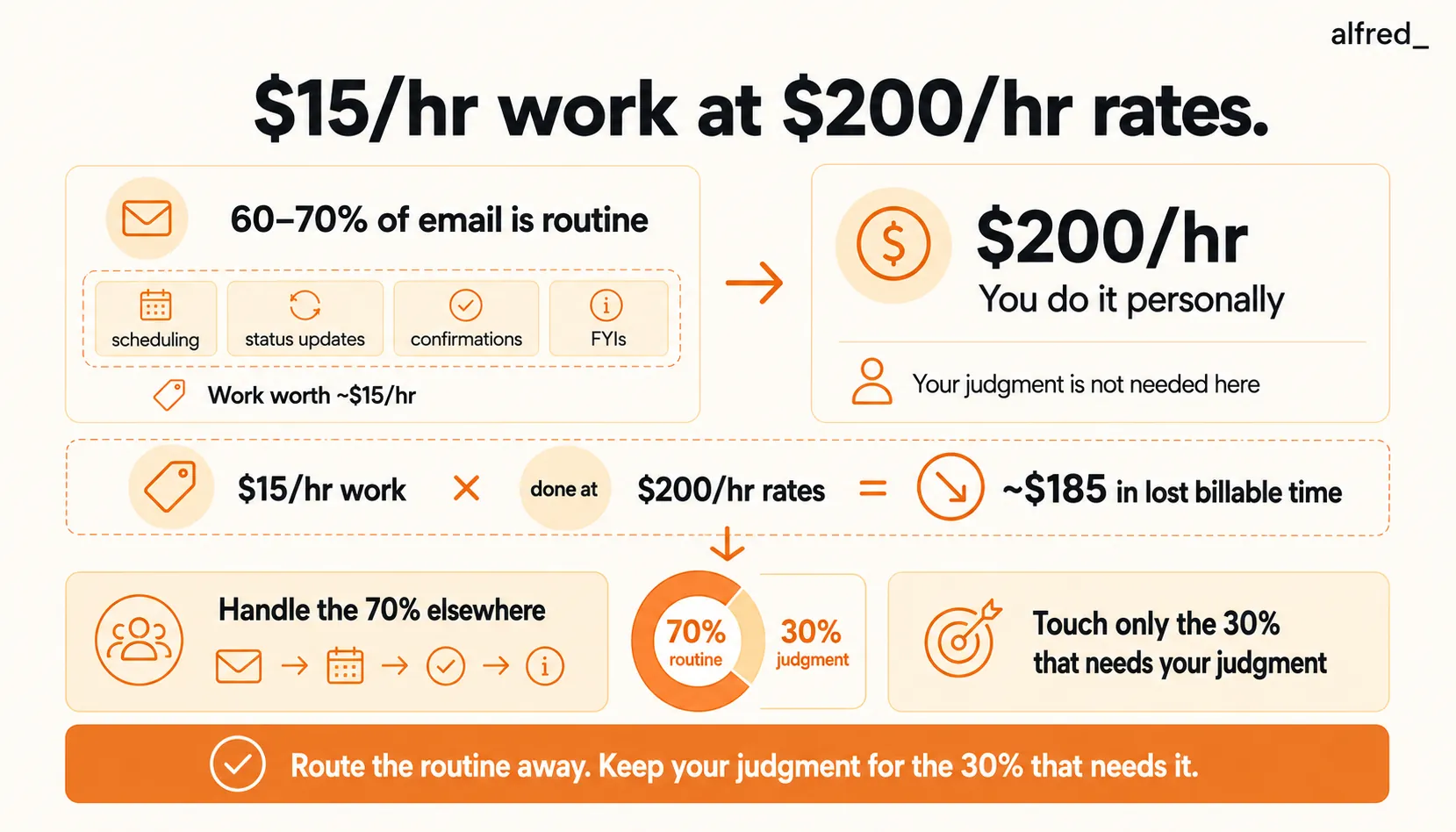
Twenty-two minutes. At $200/hr, that is $73.33 worth of your time. The work itself, picking a meeting slot, forwarding a file, typing “received, thanks”, is worth maybe $4.
You know this. You have known this for years. You have probably said something like it out loud, maybe at a dinner, maybe to a colleague, maybe to yourself while staring at your inbox at 7 AM on a Monday:
“I bill $200/hr and I spend 3 hours a day on email I could have a $15/hr assistant handle.”
Three hours a day. At $200/hr. That is $600 per day. $3,000 per week. $156,000 per year, spent on work that does not require your degree, your experience, your judgment, or your expertise. Work that requires a pulse and a keyboard.
And you keep doing it. Every day. Because the alternative feels impossible.
The Rate Mismatch Nobody Talks About
Every profession has a concept of “highest and best use.” An architect should be designing buildings, not filing permits. A surgeon should be operating, not scheduling follow-ups. A partner at a consulting firm should be advising clients, not confirming meeting rooms.
This is not a controversial idea. It is the foundation of professional leverage, the reason firms have associates, the reason executives have assistants, the reason specialists exist. You pay more for the brain, less for the hands.
And yet. The average knowledge worker spends 28% of their workweek on email, according to a McKinsey Global Institute study. For someone billing $200/hr on a 50-hour week, that is 14 hours, $2,800 per week, $145,600 per year, spent on communication that largely consists of scheduling, status updates, acknowledgments, and follow-ups.
The Radicati Group estimates that the average professional receives 121 emails per day. Most of those emails do not require the expertise of someone billing $200-500/hr. They require reading comprehension, a calendar, and the ability to type “Confirmed, see you Thursday.”
The rate mismatch is staggering. You are the most expensive email clerk in the building.
“By the time I actually sit down to do the work I was hired for, half my day is gone.”
Why You Haven’t Fixed This
You are not stupid. You understand opportunity cost. You have probably run the math yourself, probably felt a wave of nausea, and then gone right back to answering emails. Here is why:
The judgment problem. Email is not entirely mindless. Mixed into the scheduling and the status updates are emails that require real judgment, a client raising a concern, a proposal that needs a nuanced response, a negotiation that hinges on tone. You cannot hand your inbox to someone without judgment and trust them to distinguish between the $15/hr emails and the $200/hr emails. So you process all of them yourself, because the cost of missing a critical email feels higher than the cost of personally handling the trivial ones.
The context problem. Even if you found someone with judgment, they would lack context. They do not know that the email from Sarah is actually about the budget conversation you had in the hallway last Tuesday. They do not know that when this particular client says “let’s discuss,” it means they are unhappy, not just curious. They do not know your commitments, your calendar conflicts, your relationship dynamics. Context is the reason delegation fails.
The cost problem. A competent human executive assistant costs $4,000-6,000/month for full-time, or $2,000-4,000/month for part-time. That is $24,000-72,000 per year. For a solo practitioner or small firm principal, that is a significant fixed cost against variable revenue. You know you need the help. You cannot justify the overhead. So you remain the bottleneck.
The trust problem. You have tried delegating before. To a VA, to a junior team member, to an intern. Something slipped. A client got a response that did not sound like you. A meeting got scheduled over a conflict. An important email got buried. The cleanup cost more than the delegation saved. So you pulled it back. “It’s just easier if I do it myself” became your operating principle, and your prison.
The $185 Email
Here is a way to think about it that might make you uncomfortable.
Every email you personally handle that could have been handled by a $15/hr assistant has an implicit cost of $185. Not because the email itself costs $200, but because the 5-7 minutes you spent on that email could have been spent billing a client at $200/hr.
You send and receive roughly 80-100 actionable emails per day. Industry research suggests that 60-70% of professional email is routine, scheduling, status updates, confirmations, FYIs, acknowledgments. That is 48-70 emails per day that do not require your rate.
At 5 minutes per email, those 48-70 routine emails consume 4-6 hours of your day. At $200/hr, that is $800-$1,200 in daily opportunity cost. Per year, you are looking at $208,000-$312,000 in billing capacity absorbed by work worth a fraction of your rate.
This is not theoretical. This is the money you did not earn last year because you were confirming receipt of invoices.
“I can’t scale because I’m the bottleneck. And I’m the bottleneck because I’m the one answering all the emails.”
What You Actually Need
You do not need another email app. Superhuman ($30-40/month) makes you faster at processing email, but faster processing at $200/hr is still $200/hr processing. You saved 30 minutes, not $185 per email. SaneBox ($7-36/month) sorts your email into folders, but you still review those folders yourself. Shortwave bundles threads, but the bundles still require your eyes.
What you need is what every senior professional at a well-run firm has: someone who handles the 70% so you only touch the 30%. Someone with enough judgment to know which emails need you and which ones don’t. Someone with enough context to draft responses that sound like you, not like a template. Someone who operates continuously, not during business hours, not when you remember to check, but always.
You need an EA. But not a human EA at $4,000-6,000/month. You need the judgment of an EA at a price point that makes the ROI calculation absurd.
The Math That Should End This Debate
alfred_ costs a rounding error against the opportunity cost you are already paying.
alfred_ reads every email. It understands context. Your calendar, your commitments, your communication patterns, your relationship history with every contact. It triages by genuine urgency, not just sender reputation. It drafts replies in your voice for the 60-70% of emails that are routine. It tracks follow-ups. It assembles your morning briefing so you know exactly what needs your attention before you open your inbox.
The result: instead of processing 100 emails yourself, you review 20-30 decisions and approve 15-20 draft replies. The 4-6 hours of $15/hr work shrinks to 45-60 minutes of genuine $200/hr judgment calls.
Conservative math:
- Hours recovered per week: 12-15
- At $200/hr: $2,400-$3,000/week in recovered billing capacity
- Annual recovered capacity: $124,800-$156,000
- At 50% billing conversion: $62,400-$78,000 in actual additional revenue
- Cost of alfred_: $299.88/year
- ROI: 208x-260x
You do not need to believe all of those hours convert to billing. Even if only 25% convert, even if you use half the recovered time for deep work, strategic thinking, business development, or leaving the office before 7 PM, the ROI remains over 100x.
At $300/hr, the math is even more lopsided. At $500/hr, it borders on financial malpractice to continue doing the work yourself.
What the Morning Looks Like After
You open your laptop. Not to 121 emails. To a briefing.
Four items need your judgment. Two client emails with drafted responses that need your review. You scan them, adjust a sentence in one, approve both. One scheduling conflict that alfred_ flagged with a suggested resolution. One new business inquiry that actually requires your expertise.
Twelve minutes. You handled everything that needed you.
The other 109 emails? Sorted. The newsletters, archived. The CC threads, categorized. The scheduling back-and-forth with a client’s assistant, handled, meeting confirmed, calendar updated. The invoice acknowledgment, sent. The follow-up on a proposal from two weeks ago, drafted and waiting for your approval.
At 8:30 AM, you start doing $200/hr work. Not at 11 AM. Not after lunch. Not “once I clear my inbox.” Right now.
“I just want to open my laptop in the morning and know what actually matters today.”
That is not a fantasy. That is what happens when you stop doing $15/hr work at $200/hr rates.
The Question Is Not Whether You Can Afford It
The question has never been whether you can afford an AI assistant; it costs less than last week’s coffee. The question is whether you can afford to keep absorbing $600/day in opportunity cost because the alternative felt impossible.
It is not impossible, and it is cheap. The math is so clear it barely requires a calculator.
Every email you answer today that did not require your expertise cost you $185 in unrealized revenue. Tomorrow there will be 70 more. And 70 more after that. The leak does not stop. It does not slow down. It compounds.
alfred_ stops the leak. Not by making you faster at the work you should not be doing. By doing it for you, with judgment, with context, in your voice, so you can do the work that actually justifies your rate.
You did not spend years building your expertise to spend your days confirming meeting times.
Frequently Asked Questions
How much money do high-billing professionals actually lose to email?
A McKinsey Global Institute study found knowledge workers spend 28% of their workweek on email, roughly 11 hours. For someone billing $200/hr, that is $2,200 per week or $114,400 per year in billing capacity consumed by email. Even conservatively assuming half those emails genuinely require your expertise, you are still losing $57,200 annually to messages that any competent assistant could handle. At $300/hr, the annual loss exceeds $171,000. The math gets worse as your rate rises.
Why can’t I just batch email and handle it faster?
Batching reduces the number of context switches but does not change the total volume of work. Whether you process 60 emails in two batches or throughout the day, the time expenditure is roughly the same. Research from the University of California, Irvine found that email interruptions require an average of 23 minutes to recover from, so batching does help with focus recovery. But you are still personally performing $15/hr work. The rate mismatch persists regardless of when you do it.
Is hiring a virtual assistant more cost-effective than AI?
A competent virtual assistant costs $15-25/hr for domestic or $5-15/hr for overseas. At 20 hours per week, that is $1,200-2,000/month domestically. The challenge is not cost but context: human VAs lack access to your full email history, calendar context, and communication patterns. They require extensive training, ongoing supervision, and cannot operate independently on complex judgment calls. alfred_ has full context from day one because it reads every email and understands your calendar, commitments, and communication patterns.
What kinds of email can an AI assistant actually handle for me?
The emails consuming your time fall into predictable categories: scheduling coordination (25-30% of volume), status updates and acknowledgments (20-25%), routine questions with standard answers (15-20%), newsletter and notification triage (15-20%), and follow-up tracking (10-15%). alfred_ handles all of these by drafting replies in your voice, triaging by urgency, tracking commitments, and surfacing only the items that genuinely require your expertise. The remaining 10-20% that need your actual judgment reach you with full context already assembled.
What is the ROI of switching from personal email handling to an AI assistant?
If you bill $200/hr and recover even 8 hours per week from email, that is $83,200 in annual billing capacity. alfred_ costs $299.88 per year. Even at a conservative 50% recovery-to-billing conversion rate, the return is $41,600 on a $300 investment, a 138x ROI. For professionals billing $300-500/hr, the numbers become almost absurd. The question is not whether the ROI justifies it. The question is how long you continue absorbing the loss.