

You told yourself you would follow up. That was two weeks ago. The moment has passed.
The thread is still in your inbox. You have seen it every day. You have thought about it, probably more than once. You know exactly what you need to do: open it, write a few sentences, hit send. It would take three minutes. You have not done it for fourteen days.
This is not a memory problem. You remember. You remember every morning when you scan your inbox and your eyes snag on the thread. You remember at 2 PM when you have a gap between meetings and think “I should do that now.” You remember at 11 PM when the guilt hums louder than usual. You remember. You just do not write.
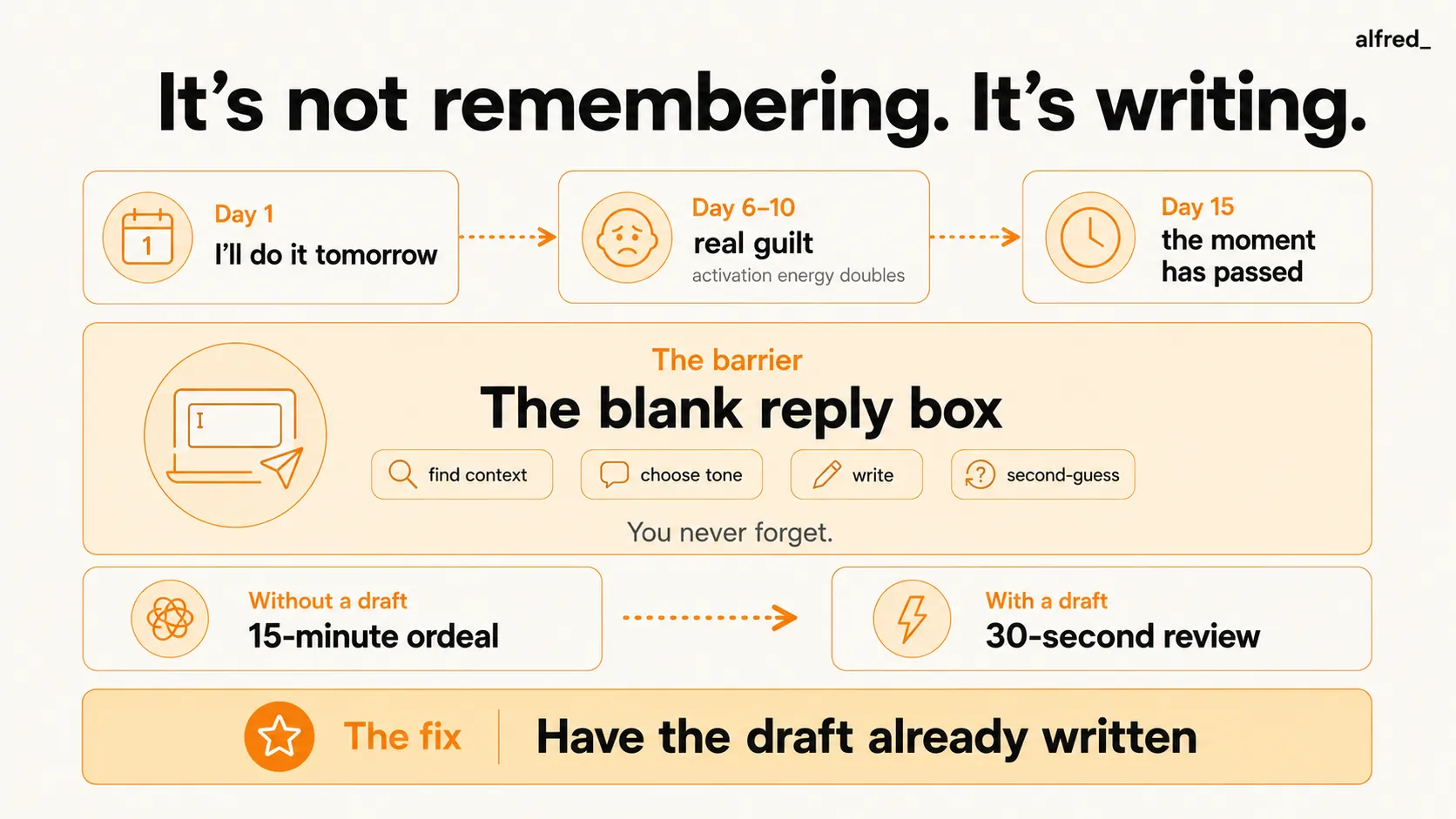
The Guilt Spiral
Here is how it works, and you will recognize every step:
Day 1-2. “I’ll follow up tomorrow.” Perfectly reasonable. No guilt yet.
Day 3-5. “I should have followed up by now.” Mild guilt. You open the thread, look at the blank reply box, close it. Tomorrow.
Day 6-10. The guilt is real now. Each day that passes makes the follow-up feel more awkward. “It’s been a week, do I acknowledge the delay? Do I pretend it hasn’t been that long? What’s the right tone?” The activation energy required to write the email has doubled since day one.
Day 11-14. The avoidance is in full control. You are actively not looking at the thread. The guilt has compounded into something heavier, a low-grade dread that sits in the back of your mind. You start to wonder if the opportunity is already lost. Maybe it is too late. Maybe following up now would look worse than not following up at all.
Day 15+. “The moment has passed.” You archive the thread or let it slide down the inbox. The guilt does not go away. It just gets quieter. Until the next one.
This is not laziness. Research calls it the guilt-avoidance spiral: knowing you should do something, procrastinating, feeling guilty about the procrastination, and then avoiding harder because the guilt makes the task feel bigger than it actually is (No Smoke and Mirrors 2026). Procrastination in email “isn’t a harmless delay. It compounds over time.”
A study of 9,351 participants found that procrastination correlates at r=0.60 with energy level, when energy drops, procrastination rises. Follow-up emails live in the worst possible category: important but not urgent. They never scream. They just sit there, getting heavier.
It Is Not About Remembering
Here is what every follow-up app gets wrong: they assume the hard part is the reminder.
Boomerang ($4.98-49.98/month) brings the email back to the top of your inbox at a time you choose. The reminder pops up. You look at the thread. You think about what to write. You close it and snooze it again. The email has now been reminded and re-snoozed three times.
Superhuman ($30-40/month) lets you snooze emails to resurface later. Same mechanism, faster interface. The thread appears at 9 AM Tuesday. You look at it. You do not write the reply. You snooze it to Thursday.
SaneBox Reminders ($7-36/month) alerts you if you have not received a reply within a set number of days. Useful information. Does not write the follow-up for you.
CRM sequences (HubSpot Free-$150/seat/month, Mixmax free to $129/user/month by sequence recipients) automate multi-step email cadences. Built for sales teams. Templated. Generic. Not something you would use for a warm contact, a colleague, or a client relationship where tone matters.
The fundamental problem: It is not about REMEMBERING. It is about WRITING.
You know you need to follow up. Every app in the world can remind you. But when the reminder appears, you still face the blank reply box. You still have to figure out the right tone. You still have to decide whether to acknowledge the delay. You still have to find the words.
That is the activation energy. And every reminder that goes unacted-on makes the next attempt harder.
The Cost of Not Following Up
The guilt is personal. The cost is measurable.
- 48% of salespeople never make a second contact after the first touchpoint (HubSpot). Not because they forgot. Because the follow-up felt harder than moving on.
- 80% of successful sales require 5-12 follow-ups after initial contact (IRC Sales Solutions). The deals close on the 5th, 6th, 7th attempt, long after most people have given up.
- 92% of salespeople stop following up after four or fewer attempts. But the data shows most deals close AFTER the 5th contact.
- Only 2% of sales close on the first interaction (ZoomInfo). If you do not follow up, you are leaving 98% of potential revenue on the table.
- Sending 4-7 emails in sequence produces a 27% reply rate, compared to just 9% for 1-3 emails (Growth List). The follow-ups you are not sending would have tripled your response rate.
- Leads contacted within 5 minutes are 21x more likely to qualify (MIT/InsideSales.com). Speed matters, and procrastination is the opposite of speed.
These are sales numbers, but the pattern applies everywhere. The client who went quiet after your proposal? A timely follow-up might have saved the deal. The colleague who owed you that document? A gentle nudge would have kept the project on track. The introduction someone offered to make? They are still willing. They just need you to close the loop.
Every unfollowed thread is a door that was open and is now slowly closing.
The Activation Energy Problem
In chemistry, activation energy is the minimum energy required for a reaction to occur. Below that threshold, nothing happens, no matter how favorable the conditions.
Follow-up emails have their own activation energy, and it is higher than it looks:
- Open the thread. Find it among 200 other emails. Read the previous messages to re-establish context. (2 minutes)
- Assess the situation. How long has it been? Is the opportunity still alive? What did I promise? What do they need from me? (2 minutes)
- Choose the tone. “Hi Sarah, just circling back…” vs “Hey, wanted to check in…” vs “Following up on my note from…”, each conveys something different. The longer the delay, the harder the tone choice. (3 minutes of staring)
- Write the email. Finally. Compose something that sounds natural, acknowledges the gap without being apologetic, and moves the conversation forward. (5 minutes)
- Second-guess it. Read it again. Is this too aggressive? Too passive? Does it sound desperate? Should I add more context? Less? (3 minutes)
- Send. (1 second)
Total time: maybe 15 minutes. But the perceived effort is enormous because steps 3-5 are emotionally loaded. The blank reply box is not blank. It is full of judgment calls about tone, timing, and what the other person might think of you.
That is why you can reply to a new email in 30 seconds but cannot write a three-sentence follow-up for two weeks. New emails have low activation energy: someone wrote to you, you reply. Follow-ups have high activation energy: nobody is asking for this email, you have to initiate it, and the delay adds friction.
Quick Comparison: What People Try
| What You Try | Monthly Cost | Reminds You | Drafts the Follow-Up | The Gap |
|---|---|---|---|---|
| Boomerang | $4.98–49.98 | Yes, resurfaces the email | No | You still face the blank reply box |
| Superhuman | $30–40 | Yes, snooze and resurface | No | Same problem, faster interface |
| SaneBox Reminders | $7–36 | Yes, alerts if no reply received | No | Notification only. Writing is still on you. |
| HubSpot Sequences | Free–$150/seat | Automated cadence | Templated only | Generic. Not your voice. Sales-focused. |
| Mixmax | Free–$129/user | Automated sequences for Gmail | Templated only | Templates feel impersonal. No calendar. |
| alfred_ | $29.99 | Tracks automatically | Yes, in your voice | Removes the activation energy barrier |
How alfred_ Removes the Barrier
alfred_ does not remind you to follow up. It writes the follow-up.
Auto-drafts in your voice. alfred_ identifies emails that have not received replies and drafts follow-ups based on the original thread context. Not templates. Not generic “just checking in” messages. Drafts that reference the specific conversation, use your writing patterns, and match your tone with each contact.
If you are direct: “Checking in on the proposal I sent last week. Happy to jump on a quick call if that’s easier.”
If you are warm: “Hope things are going well on your end. Wanted to circle back on our conversation from last Tuesday, no rush, just want to make sure it didn’t slip through.”
alfred_ knows the difference because it learned from your existing emails.
The blank reply box is already filled. This is the key. The activation energy of a follow-up drops from “figure out what to say, choose the right tone, write from scratch, second-guess yourself” to “read the draft, adjust one sentence if needed, hit send.” That is the difference between a 15-minute emotional ordeal and a 30-second review.
A Monday list, with drafts. You do not need to flag emails or remember which threads need attention. Turn on the Chase what I’m owed routine, or ask “who hasn’t answered me this week?”, and alfred_ lists them from your sent mail. The proposal you sent on Monday that has not gotten a reply by Thursday? Ask, and the draft is ready. The client who went quiet after you sent the scope document? Same. The invoice that is 30 days overdue? Draft ready, with the tone you use for payment follow-ups, not the tone you use for colleagues.
Appropriate timing. alfred_ does not blast follow-ups immediately. It understands context, some emails deserve a 48-hour follow-up window, others a week. It drafts at intervals that feel natural, not automated.
Calendar management included. Follow-ups often include a scheduling ask: “Want to hop on a call this week?” alfred_ handles the scheduling too, so the follow-up email and the calendar coordination happen in one motion.
Less than Boomerang’s Premium plan. And less than the cost of a single lost deal that you could have saved with a three-sentence follow-up you never wrote.
What Changes
The deal you would have lost because you did not follow up? It does not get lost. The draft was ready on day three. You reviewed it, hit send, and the conversation continued.
The client who went silent after the proposal? They got a thoughtful, timely, personalized follow-up, not because you remembered, but because alfred_ drafted it while you were doing actual work.
The invoice that is 30 days overdue? The carefully worded nudge, professional but firm, in your voice, was sent at the two-week mark. Because the activation energy of writing “just following up on my invoice” should not be high enough to cost you thousands of dollars.
The guilt spiral of “I should have followed up three days ago”? Gone. Because it was already drafted. All you had to do was review and send.
You did not forget to follow up. You never forget. The problem was never your memory. It was the blank page. And the blank page is already filled.