

Saturday morning. 9:14 AM. You are making pancakes. The kids are at the table. Coffee is brewing. It should be good.
But part of you is not here.
Part of you is thinking about that email you sent Friday at 4:47 PM, the one to the client about the revised timeline. Did they respond? Are they upset? Is the deal still on track? You told yourself you would not check until Monday. That was twelve hours ago. The phone is on the counter. You could just glance. Just a quick look. Just to see.
You glance. The client did not reply. That is somehow worse than a bad reply. Now you do not know. And the not-knowing will follow you through the farmers market, through the kids’ soccer game, through dinner, and into Sunday, where the real dread begins.
“It’s this constant low-level anxiety. Always there. Even on weekends.”
This is weekend work anxiety. And it is not about being bad at boundaries or loving your job too little. It is about your brain running a process it cannot shut down.
The Weekend That Is Never Really Yours
The numbers tell a story that most people recognize but few say out loud.
76% of workers experience “Sunday scaries”, the dread and anxiety that build as the weekend winds down and Monday approaches. But framing it as a Sunday problem understates what is actually happening. For most knowledge workers, the anxiety does not begin Sunday night. It begins Saturday morning, the moment the first work thought intrudes on what was supposed to be free time.
49% of full-time employees check work email during weekends and PTO. A study from the American Psychological Association found that 65% of Americans say work is a significant source of stress, and that stress does not pause on Friday evening. It follows you. It sits in the next room while you watch a movie. It rides in the car to brunch. It is there at the park with your kids, running as a background process that consumes attention you thought you had freed up.
“Even when I’m not checking email I’m thinking about what might be in there.”
Research has found that workers who are expected to be available for email outside work hours have measurably higher cortisol levels than those who are not. But here is the finding that should stop you: the cortisol elevation is present even when workers are not actively checking email. The expectation of availability is enough to keep their stress response elevated.
Your weekend cortisol is higher than it should be. Not because you are checking email. Because you might need to.
The “Just One Quick Check” Trap
You know how this goes.
Saturday morning. You told yourself no email today. But there is that one thing. The client. The proposal. The thread with your boss that was not quite resolved. You will just check that one thing. It will take 30 seconds. Then you can enjoy the day.
You check. Three things happen:
Scenario 1: The thing you were worried about is fine. Relief. For about 15 minutes. Then your brain finds the next open loop. Did Sarah send the revised deck? Is the Monday meeting still on? What about that vendor invoice? The one check spawned three new uncertainties.
Scenario 2: The thing you were worried about is not fine. The client’s reply is short and terse. Now you have to decide: respond now and ruin the morning, or wait until Monday and spend the entire weekend composing the reply in your head? Either way, the weekend is colored.
Scenario 3: There is no reply. The worst outcome. No information. The uncertainty persists, and now you are checking compulsively every 45 minutes to see if the reply has arrived.
A study published in the Journal of Occupational Health Psychology found that work-related smartphone use during off-hours was associated with higher emotional exhaustion and lower work-life balance satisfaction, but only when the use was driven by anticipatory anxiety rather than genuine work demands. It is not the checking that damages the weekend. It is the reason for checking: the inability to tolerate the uncertainty of not knowing.
“I turned off notifications and it somehow got worse, now I compulsively check manually.”
The Open Loops Your Brain Cannot Close
There is a psychological phenomenon called the Zeigarnik effect, named after Soviet psychologist Bluma Zeigarnik. It describes the tendency for incomplete tasks to occupy mental space disproportionately. Your brain treats unfinished tasks as open loops and allocates cognitive resources to keeping them active until they resolve.
This is why you remember the waiter’s order before it is delivered but forget it after. This is why a song stuck in your head resolves when you hear the ending. And this is why unanswered emails follow you home on Friday night.
Every email you did not respond to is an open loop. Every thread that was not resolved is an open loop. Every task you deferred to Monday is an open loop. Each loop demands a small allocation of working memory. Individually, they are negligible. Collectively, they are the background hum that ruins your weekend.
Research by Baumeister and Masicampo at Florida State University confirmed this mechanism in a 2011 study: participants who were interrupted mid-task showed persistent intrusive thoughts about the unfinished task, which impaired their performance on subsequent tasks. However, simply making a plan to complete the task, even without actually doing it, was enough to reduce the intrusive thoughts.
This is the key insight. Your brain does not need the task to be done. It needs to trust that the task is handled. The loop closes not when the email is answered, but when your brain believes the email will be answered and nothing will fall through the gap.
Why “Just Disconnect” Is Not a Real Answer
Every wellness article says the same thing. Set boundaries. Turn off email after 6 PM. Do not check on weekends. Protect your time.
This advice is correct in theory and useless in practice for anyone whose weekend anxiety is driven by uncertainty.
Setting a boundary, “I will not check email until Monday”, creates a 60-hour gap between your last check on Friday and your first check on Monday. During that gap, emails arrive. Things happen. Clients write. Colleagues respond. Deadlines shift. And you know all of this is happening, even though you cannot see it.
For some people, the boundary holds and the anxiety is manageable. For most knowledge workers, especially those in client-facing, leadership, or high-accountability roles, the boundary collapses. Not because they lack discipline. Because the anxiety of not-knowing eventually exceeds the discomfort of breaking the boundary.
The guilt cycle makes it worse. You check email on Saturday, breaking your own rule. Now you feel guilty for not disconnecting. The guilt adds a layer of stress on top of the email stress. You resent the email for making you check. You resent yourself for giving in. You resent the job for creating a situation where weekends do not feel like weekends. The resentment builds, the boundary feels increasingly futile, and eventually you stop trying.
“The mental overhead of ‘I need to respond to that’ is worse than actually responding.”
The structural problem: boundaries create an information vacuum. If nothing fills that vacuum, your brain fills it with worry. The fix is not a stronger boundary. The fix is something that fills the vacuum with certainty.
What Changes When Something Is Watching
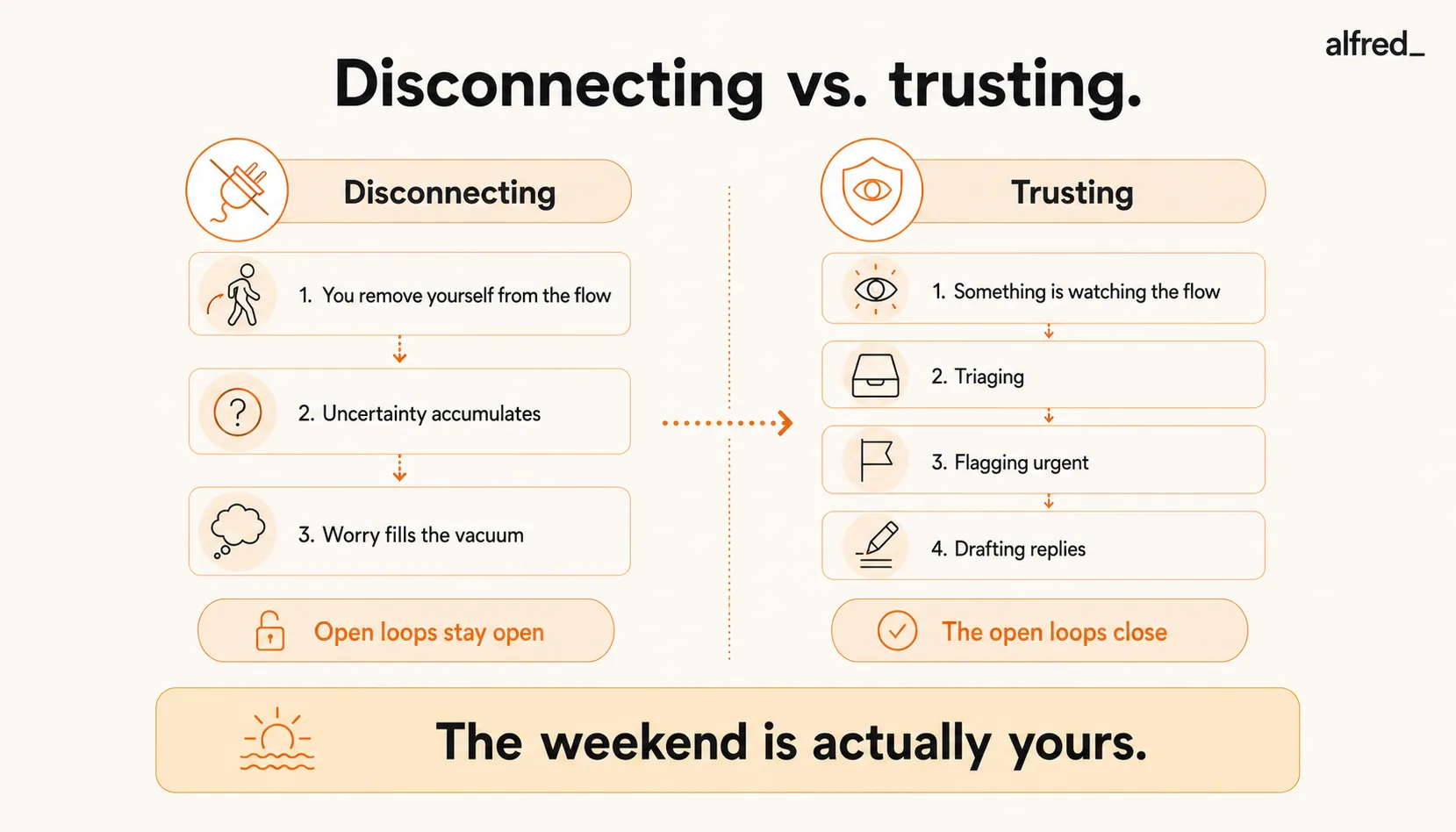
Here is the difference between disconnecting and trusting.
Disconnecting means removing yourself from the information flow. Email arrives, but you do not see it. Things happen, but you do not know. The uncertainty accumulates like unread messages.
Trusting means knowing that something is watching the information flow even though you are not. Email arrives and is triaged. Things happen and are categorized. Urgent items are flagged. Context is gathered. Replies are drafted.
SaneBox ($7-$36/month) sorts your email into folders. On Saturday, emails continue arriving and SaneBox continues sorting. But when you check on Monday, you still face the sorted pile, potentially hundreds of messages, just in different folders. The uncertainty was organized but not resolved.
Superhuman ($30-$40/month) does not work when you are not using it. It is a processing tool, not a monitoring tool. Your inbox on Monday is exactly what it would have been without it, unseen, untriaged, waiting for you.
Todoist and Notion help you track tasks, but they do not close open loops. They record them. Your task list on Monday reminds you of everything you deferred on Friday. The loops are documented but not resolved.
alfred_ works over the weekend. It reads every email that arrives. It understands context, who sent it, what it references, whether it connects to something on your calendar or a prior thread. It triages by urgency. It drafts replies in your voice. It tracks follow-ups. When Monday comes, or whenever you decide to look. You do not face a wall of unknown messages. You face a briefing: here is what happened, here is what matters, here is what is already handled.
The difference is not productivity. It is permission. Permission to make the pancakes without half your brain running an email monitoring subroutine. Permission to be at the soccer game, fully there, not checking under the bleachers. Permission to let Sunday night be Sunday night, not a pre-Monday anxiety spiral.
The Saturday Morning That Finally Feels Like Saturday
There is a specific moment when it shifts. It does not happen gradually. It happens all at once.
You wake up Saturday morning. The phone is on the nightstand. You do not reach for it. Not because you are exercising discipline. Because there is nothing to reach for. alfred_ sent you a notification at 6 AM: two emails arrived overnight, neither urgent, both have draft replies waiting for Monday. Everything else was noise.
You make the pancakes. You are actually here. The client email you were worried about. It turns out they replied at 11 PM Friday, and the reply was fine. You know this because alfred_ flagged it with a summary. You did not need to check. The loop closed itself.
The kids are talking about something that happened at school. You are listening. Not partially listening while composing a response in your head. Listening.
“I don’t need zero inbox. I need to not feel like I’m always behind.”
alfred_ does not give you a weekend free of email. Email keeps arriving. What it gives you is a weekend free of uncertainty about email. The emails exist. They are being watched. Nothing will slip. Nothing will be buried. When you are ready to come back to work, you will come back to clarity instead of chaos.
That is not a productivity upgrade. That is your weekend back.
The Saturday that is actually Saturday. The Sunday that is not pre-Monday. The weekend that belongs to you because you trust that someone, something is watching the rest.
Your weekends are worth far more than what alfred_ costs.




