


Monday. 8:07 AM. Laptop open. Coffee not yet working.
The inbox loads. The number appears. 214 unread.
Your stomach does the thing. Not quite nausea. Not quite dread. Something between the two, a heaviness that says: this is going to take a while and you are already behind.
You start scrolling. Some of them are noise, newsletters you never unsubscribed from, automated notifications from tools you barely use, CC threads that resolved without you. You archive those. That takes 15 minutes and gets the count to 167. The dopamine hit of “147 to 167 to 214, wait, it went up” because 3 new emails arrived while you were archiving.
Now the real ones. The client email from Saturday morning that you should have responded to yesterday. The internal thread about the deliverable due Wednesday that has already gone three rounds without you. The message from your boss marked “urgent” at 9 PM Sunday that is definitely not what you want to read right now. The meeting invite for 10 AM that has 7 responses, all with different scheduling preferences, and somehow you are the one who needs to sort it out.
It is 10:34 AM. You have processed approximately half the inbox. You have not started any actual work. Your first meeting starts in 26 minutes. The morning is gone.
“Even when I’m not checking email I’m thinking about what might be in there.”
The Weekly Stress Event Nobody Names
Every Monday morning is a mini-crisis. Not officially. Nobody puts “process 200 emails” on the calendar. Nobody acknowledges that the first working hours of the week are consumed by catch-up rather than creation. It is simply accepted that Monday mornings are for triage, for wading through the pile, rebuilding context, and reacting to whatever accumulated while you were trying to have a weekend.
The numbers are straightforward. The Radicati Group estimates 121 business emails per day. Over a two-day weekend, that generates roughly 240 messages. Weekend volume tends to be lower than weekday volume, so the realistic range is 150-250 messages depending on your role, industry, and how many people consider Saturday a working day.
At an optimistic processing speed of 2 minutes per email, 200 messages require 6.7 hours. At a more realistic pace that accounts for reading, thinking, and responding, call it 3 minutes per email on average. It is 10 hours. More than a full workday. Just on Monday’s email.
Of course, you do not spend 10 hours. You spend 2-3 hours doing rough triage, handling the urgent, starring the important, archiving the noise, and defer the rest. The deferred emails become Tuesday’s problem on top of Tuesday’s emails. The backlog propagates through the week like a wave, never fully clearing before Friday refills it.
A Microsoft Work Trend Index report found that time spent in meetings had increased significantly for the average worker, creating downstream email: meeting invites, agenda updates, follow-up threads, action item summaries, rescheduling requests. More meetings mean more email. More email means a bigger Monday pile. The cycle feeds itself.
Sunday Night Is Already Monday Morning
The Monday overwhelm does not begin on Monday. It begins Sunday night.
76% of American workers experience “Sunday scaries” according to a Monster.com survey, the anxiety and dread that build as the weekend winds down. For knowledge workers, the primary trigger is email: the uncertainty about what accumulated over the weekend and how overwhelming Monday morning will be.
Research on the cortisol awakening response, the natural spike in cortisol that occurs in the first 30-45 minutes after waking, shows that this spike is amplified when you anticipate a stressor. Your body begins preparing for Monday’s inbox while you are still in Sunday’s pajamas. The stress is anticipatory. The emails have not been read. The problems may not exist. But your adrenal system does not distinguish between real and imagined threats.
“Sunday nights are ruined because I’m mentally pre-triaging Monday’s inbox.”
You lie in bed Sunday night and your brain starts running scenarios. What did Sarah send about the proposal? Did the vendor confirm the pricing? Is that deliverable still on track? Did anyone reply to the thread about the budget? You are triaging an inbox you have not seen, using incomplete information, in the dark, while you are supposed to be sleeping.
A study published in the Journal of Occupational Health Psychology found that anticipatory work stress during the weekend was associated with lower sleep quality, higher fatigue on Monday morning, and reduced cognitive performance during the first hours of the workweek. You arrive at Monday’s inbox already depleted, having spent Sunday night’s cognitive resources on worrying about what Monday would bring.
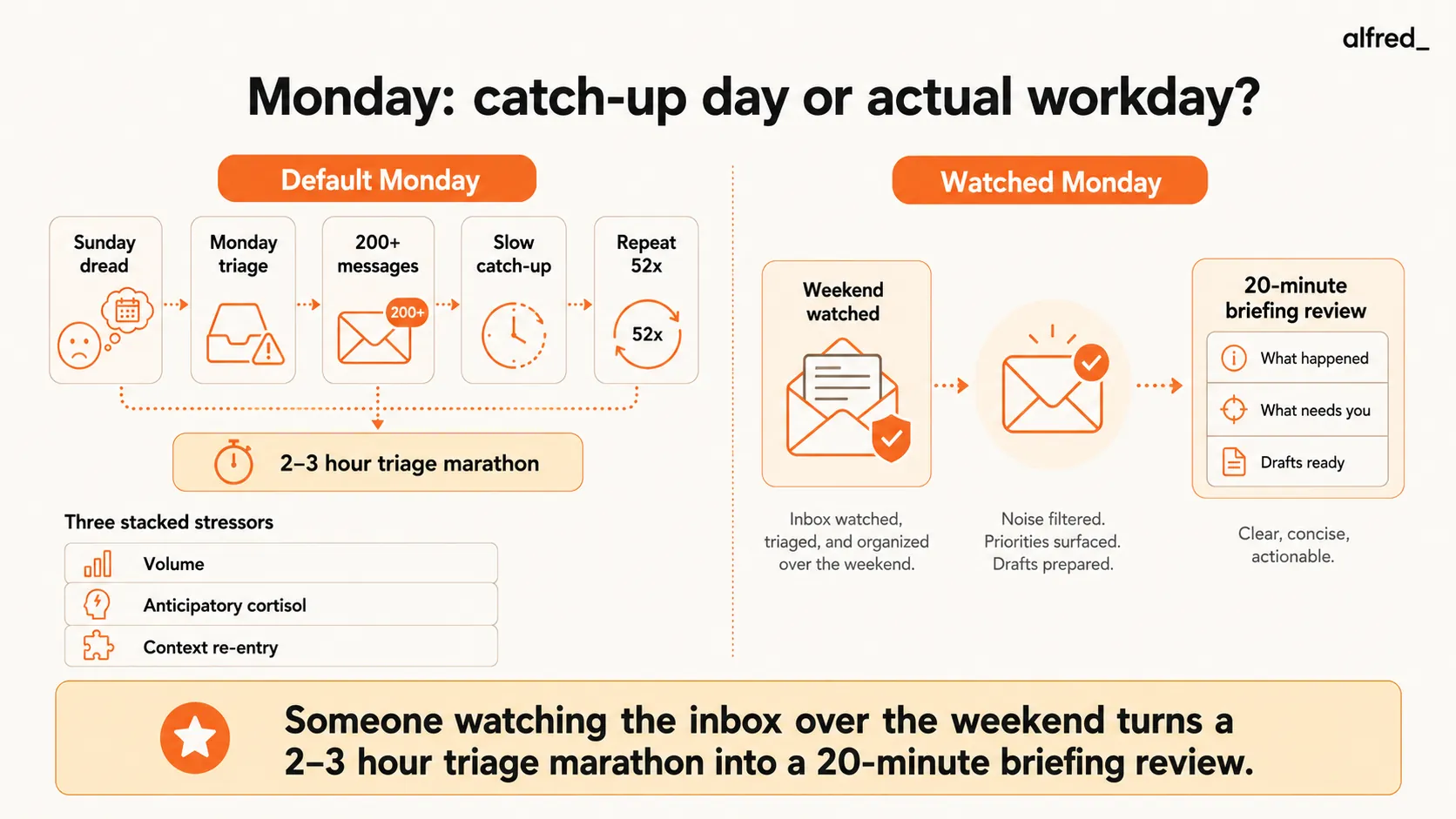
The Monday overwhelm is not just about the email. It is about the entire cycle: Sunday dread, Monday triage, the slow catch-up through the week, Friday’s relief, Saturday’s brief freedom, and Sunday’s return to dread. The cycle repeats 52 times a year. Every year.
The Context Rebuild Problem
There is a hidden cost to the Monday pile that goes beyond processing time. It is context re-entry.
On Friday at 5 PM, you were in the middle of things. You had context. You knew where the client project stood. You knew what Sarah was working on. You knew the status of the budget discussion. You held all of these threads in working memory.
By Monday at 8 AM, the context is gone. Two days of non-work, or at least attempted non-work, have cleared your working memory of the specifics. Now every email requires rebuilding context before you can respond.
The email says: “Following up on the revised timeline, are we still targeting the 15th?”
You think: Which timeline? The one for the Henderson project or the Acme project? What was the previous target date? What changed? You scroll down the thread. You check your calendar. You search for related emails. Five minutes to reconstruct enough context to write a 30-second reply.
Research by Gloria Mark at the University of California, Irvine quantified this as the “resumption lag”, the time required to re-engage with a task after an interruption. For email, the resumption lag includes not just re-reading the message but reconstructing the broader context: what was the situation, what was decided, what was deferred, what was promised.
On Monday morning, every email has a resumption lag. You are not just processing 200 messages. You are rebuilding 200 contexts. The cognitive cost is enormous, which is why Monday morning feels so much more exhausting than a regular morning of email processing.
Why “Get Through It Faster” Misses the Point
The productivity internet has a lot of advice for Monday mornings. Get up earlier. Process email first thing. Use keyboard shortcuts. Sort by priority. Batch similar responses.
All of this advice optimizes the same process: you, alone, facing the pile, processing it faster.
Superhuman ($30-$40/month) is the apex of this approach. Keyboard shortcuts. Split inbox. AI triage. Read receipts. It is the fastest email client available. If your goal is to get through 200 emails as quickly as possible, Superhuman is the best tool for the job. But you are still getting through 200 emails. You are still facing the pile cold. You are still rebuilding context manually. The overwhelm lasts 45 minutes instead of 2 hours. That is better. But 45 minutes of overwhelm is still overwhelm, and it still costs you Sunday night’s sleep.
SaneBox ($7-$36/month) reduces the pile by sorting unimportant email to @SaneLater. Maybe 200 emails become 80 in your primary inbox. That is a legitimate improvement. But the 80 remaining are the ones that actually matter, client emails, boss emails, project updates, and they still arrive undifferentiated. You still face them cold. You still rebuild context from scratch.
Spark and Shortwave offer smart categorization, grouping emails by project or type. This makes the pile look less chaotic. But visual categorization does not eliminate the processing. The pile is still the pile, just with nicer section headers.
The structural problem remains: Monday morning is catch-up day because nobody was watching your inbox over the weekend.
What Monday Morning Looks Like When Someone Was Watching
alfred_ works over the weekend. Not in bursts. Not on a schedule. Continuously. As emails arrive Saturday morning, Saturday night, Sunday morning, Sunday evening, alfred_ reads them. It understands who sent them, what they reference, how they connect to your calendar and your prior conversations. It triages by urgency. It drafts replies in your voice. It tracks which threads need follow-up and which can wait.
By Monday morning at 7 AM, your briefing is ready. Not a sorted pile. A briefing.
It looks something like this:
Needs your attention (3 items):
- Sarah replied to the Henderson timeline, she is pushing to the 22nd. Here is context from the last 3 messages in the thread. Draft reply attached.
- New inbound from a referral, Dave Chen introduced you to someone at Meridian Corp. Draft reply attached.
- Your boss sent a question about Q3 numbers at 9:14 PM Sunday. Marked urgent. Here is the relevant data from recent threads. Draft reply attached.
FYI, no action needed (7 items):
- Budget thread resolved without you, final numbers attached.
- Vendor confirmed pricing. No changes from the proposal.
- 3 meeting confirmations for this week. Calendar updated.
- 2 newsletters relevant to your current project, summaries below.
Handled (190 items):
- Automated notifications archived.
- CC threads without action items archived.
- Marketing emails categorized.
- Duplicate follow-ups consolidated.
You review the 3 items that need attention. You approve two of the draft replies with minor edits. You spend 10 minutes on the boss’s question because it requires your judgment. Total time: 25 minutes.
It is 8:32 AM. Monday has started. Not catch-up Monday. Not triage Monday. Monday. You open the project you meant to work on. You have the entire morning. The pile does not exist because it was handled before you arrived.
The Sunday Night You Get Back
Here is the secondary effect nobody expects.
When Monday morning is no longer a dreaded triage marathon, Sunday night changes. The anticipatory stress, the cortisol that starts building as the weekend winds down, dissipates. Not immediately. Your nervous system takes a few weeks to trust the new pattern. But once it does, Sunday evening feels like what it is supposed to feel like: the end of the weekend. Not the beginning of Monday’s overwhelm.
You are on the couch. It is 8 PM Sunday. A thought floats through: I wonder what’s in my inbox. For the first time, the thought does not spike your pulse. You know the answer. alfred_ is watching. Anything urgent would have been flagged. Nothing was flagged. The inbox is being handled.
You go back to the movie. You are actually watching it.
“It’s this constant low-level anxiety. Always there. Even on weekends.”
That hum, the one that follows you from Saturday morning to Sunday night and into Monday’s chaos, quiets. Not because you developed better coping mechanisms. Because the thing that caused it, the uncertainty about the pile, the dread of the triage, the knowledge that Monday morning will be lost to catch-up, is gone.
Monday morning becomes what it should be: the start of a productive week. Not the penalty for taking a weekend.
The first hours of your week are worth far more than what alfred_ costs.
Frequently Asked Questions
How many emails pile up over a typical weekend?
At the average rate of 121 emails per day, a standard two-day weekend accumulates approximately 240 emails. In practice, weekend email volume tends to be lower than weekday volume, so most people face 150-200 messages on Monday morning. Even at the lower estimate, processing 150 emails at 2 minutes each requires 5 hours, the entire morning. And that is just email. Add Slack messages, meeting notifications, and project management updates, and the first half of Monday is consumed before any meaningful work begins.
Why does Monday morning feel so much worse than other mornings?
Monday morning combines three stressors simultaneously. First, the accumulated volume, two days of messages waiting. Second, anticipatory stress, research on the cortisol awakening response shows that your body amplifies its morning cortisol spike when it anticipates a stressor, meaning your stress levels start elevated before you even open your laptop. Third, context re-entry, after two days away from work, you have lost the mental context of where things stood on Friday, making every email harder to process because you have to rebuild context before you can respond.
Will getting up early on Monday to tackle email help?
Getting up early to process email does reduce the backlog, but it does so at significant cost. It sacrifices rest, extends the workday before it officially begins, and trains your brain to associate Monday mornings with a punishing triage session. Over time, this reinforces the dread rather than relieving it. Your Sunday evening anxiety may actually increase because you know the alarm is set earlier. The research on recovery from work stress emphasizes the importance of psychological detachment during off-hours. Early-morning email processing directly undermines that recovery.
How does alfred_ specifically help with Monday morning overwhelm?
alfred_ works over the weekend, continuously reading and triaging email as it arrives. By Monday morning, every message that arrived since Friday has been categorized by urgency, contextualized against your calendar and prior conversations, and, where appropriate, draft replies have been prepared in your voice. Instead of opening to 200 undifferentiated messages, you open to a briefing: what happened, what matters, what can wait. The 2-3 hour triage session becomes a 20-minute review.
Is Monday morning overwhelm getting worse?
Evidence suggests yes. The volume of workplace communication has increased significantly in recent years, with email volume growing year over year and the addition of platforms like Slack, Teams, and project management notifications creating additional channels of incoming communication. A Microsoft Work Trend Index report found that the number of meetings per week had increased substantially for the average worker, with more meeting scheduling and follow-ups generating more email. The Monday morning pile grows as the total volume of workplace communication grows.