

You know the feeling.
It’s 7:43 AM and your thumb hovers over the mail icon. You haven’t even gotten out of bed yet. Part of you needs to check. Part of you is already bracing for whatever’s in there. Your chest tightens slightly. Your stomach does that thing. You tap it anyway, because not knowing is somehow worse than knowing.
This is inbox dread. And if you recognize it, you are not alone, and you are not broken.
The Feeling Nobody Talks About
There are thousands of articles about email overload. They talk about volume, about 121 emails per day, about the 28% of your workweek swallowed by your inbox. Those numbers are real. But they miss the point.
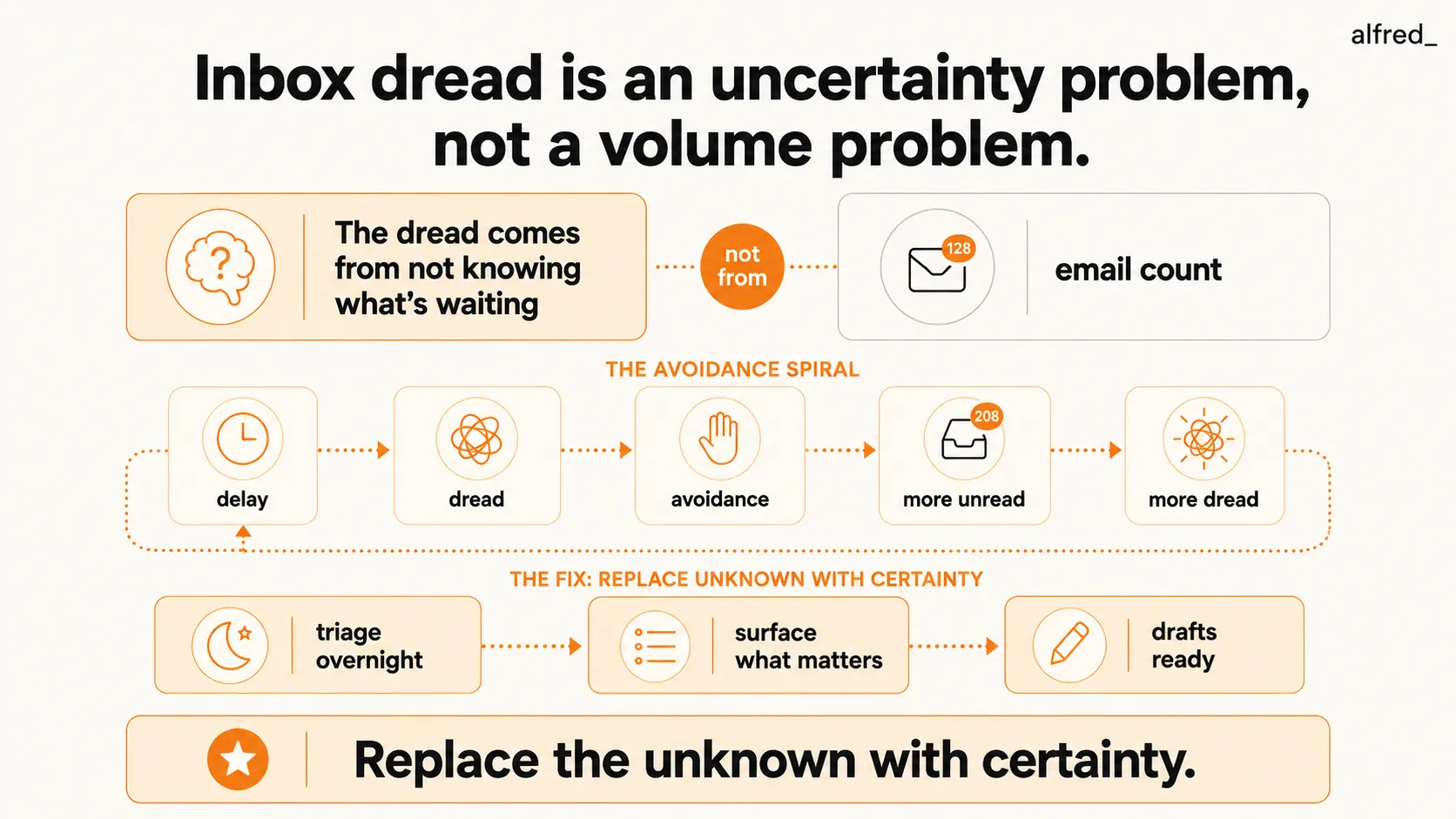
Inbox dread is not about how many emails you have. It is about not knowing what is in there.
“The worst part isn’t the emails. It’s wondering what’s buried in there that I’ve missed.”
That quote came from a Reddit thread, but it could have come from anyone. A VP at a Fortune 500. A freelance designer. A graduate student three weeks behind on responses. The dread is universal because the uncertainty is universal.
Research backs this up in uncomfortable ways. A study at Loughborough University measured participants’ stress responses while they processed email. Cortisol spiked. Heart rate increased. Blood pressure rose. But here is the part that should stop you: participants did not realize they were stressed. Their bodies were in fight-or-flight mode while they consciously reported feeling fine. A separate 2019 study published at CHI by Akbar et al., literally titled “Email Makes You Sweat”, used thermal imaging on 63 participants and confirmed the same physical stress response.
Your inbox is stressing you out more than you think it is. Your body already knows this. Your brain just hasn’t caught up.
The Avoidance Spiral
Here is what happens next, and you already know this part because you have lived it:
- You delay opening email because the dread is uncomfortable
- The delay creates more unread messages
- More unread messages increase the uncertainty
- Increased uncertainty amplifies the dread
- Amplified dread makes you avoid it longer
- The cycle accelerates
“I’ve started just… not opening it. Which makes it worse. I know it makes it worse.”
This is not laziness. It is not a character flaw. It is a clinically documented avoidance cycle, the same pattern that appears in anxiety disorders, ADHD, and chronic procrastination. Delay leads to dread. Dread leads to avoidance. Avoidance compounds the problem. The cycle feeds itself.
For people with ADHD, the spiral hits harder. Rejection Sensitivity Dysphoria means every inbox opening is a potential social minefield. You re-read messages five, ten times, searching for hidden negative meaning. Did that “Thanks” have a period because they’re angry? Was the CC passive-aggressive? The cognitive cost of email triples when your brain is wired to scan for threats in every sentence.
58% of workers feel anxious when opening their inbox. Two-thirds have lost sleep over work-related stress. 82% have missed important messages because there were simply too many to track.
You are not imagining this. And you are not alone in it.
Why Every Fix You Have Tried Felt Hollow
You have tried things. Of course you have. Here is why they did not work.
“Just check less”, The most common advice and the most useless for anyone with actual inbox dread. If the anxiety is about not knowing, checking less does not reduce the anxiety. It amplifies it. You create longer gaps of uncertainty and fill them with rumination.
Gmail filters, Static rules that match keywords and senders. They cannot understand context. An email from your biggest client about a missed deadline gets the same treatment as their lunch calendar invite. Filters also break silently, sender formats change, Gmail overrides them for “important” messages, and too many rules conflict with each other. You build a system, trust it, and then something critical slips through because the filter did not account for the way Sarah formatted the subject line this time.
Inbox Zero methods. These require you to process every email yourself. If the dread is about facing the inbox, telling someone to face it more methodically does not fix the feeling. You still have to open it. You still have to look at everything. You just do it with a system that demands you touch each message, which is the opposite of relief.
Turning off notifications. This one is cruel. Research from Kushlev & Dunn at UBC found that people who limited email checking to three times daily reported less stress. But in our view, this only works if something else provides the certainty your brain is seeking. For people whose anxiety comes from uncertainty, removing notifications removes the external trigger and replaces it with compulsive manual checking. You check your phone 30 times because you turned off the thing that would have told you there was nothing to worry about.
The structural problem with every approach above: they treat email as a volume problem. But inbox dread is an uncertainty problem. The fix is not fewer emails or faster processing. The fix is certainty.
What Actually Works: Replacing Uncertainty with Certainty
Here is the difference between the approaches that exist today:
| Approach | What It Does | Does It Fix Dread? |
|---|---|---|
| Gmail/Outlook filters | Moves emails matching keywords to folders | No, uncertainty moves to different folders |
| SaneBox ($7–$36/mo) | Sorts by sender headers into @SaneLater | Partially, less noise, but you still open cold |
| Superhuman ($30–$40/mo) | Split Inbox + speed shortcuts | No. You face the inbox faster, not with less dread |
| Shortwave ($30–$120/seat/mo) | AI bundles reduce visual noise | Partially, looks less overwhelming, but no briefing |
| Fyxer AI ($37–$49/mo Pro) | Auto-drafts replies, filters spam | Partially, drafts help, but no contextual triage |
| alfred_ | Triages overnight, surfaces urgency, drafts replies | Yes. You open to certainty, not the unknown |
SaneBox deserves credit for reducing noise. It learns from your email headers over 4-6 weeks and routes unimportant messages to @SaneLater. That is legitimately helpful. But the dread is not about newsletters and marketing emails. The dread is about the client email buried in the pile, the follow-up you forgot, the thing that slipped. SaneBox does not read your emails. It does not know that Sarah’s message is about the contract that closes Friday. It sorts. Sorting is not the same as knowing.
Superhuman is genuinely fast. The keyboard shortcuts are excellent. Split Inbox separates human messages from automated noise. If your problem is speed, if you need to get through 200 emails in 45 minutes, Superhuman does that. But fast does not fix dread. Superhuman helps you face the inbox faster. It does not tell you what is in there before you look. The stomach drop still happens. You just recover from it more quickly.
alfred_ takes a different approach entirely. It connects to your Gmail or Outlook and works overnight, or continuously throughout the day, reading your emails, understanding the context (who sent this, what it references, how it connects to your calendar and commitments), and triaging by urgency. When you open your inbox in the morning, the work is done. Not sorted. Not filed. Done. Urgent items are surfaced with context. Replies are drafted in your voice, waiting for your review. The noise is categorized and archived.
The dread dissolves because the uncertainty dissolves. You are not opening your inbox wondering what is buried. You are opening a briefing that tells you exactly what needs your attention and why.
The Moment It Changes
There is a specific moment when inbox dread breaks. It is not gradual. It is not a slow improvement over weeks. It is a single morning.
You wake up. Your phone is on the nightstand. You do not reach for it immediately. Not because you are exercising discipline. Because you already know. The briefing came in at 6 AM. Three items need your attention. Two have drafts waiting. One is a meeting prep reminder because the meeting is at 10 and your calendar knows. Everything else was noise and it has been handled.
Your thumb does not hover over the mail icon. Your stomach does not drop. You get out of bed and you make coffee first.
That is not a productivity improvement. That is relief.
“I don’t need zero inbox. I need to not feel like I’m always behind.”
alfred_ does not give you inbox zero. It gives you something better: the certainty that nothing is buried, nothing has slipped, and nothing is waiting to ambush you, for less than what most people spend on coffee in a week. It replaces the worst feeling in your workday with the absence of that feeling.
The dread was never about email. It was about not knowing. And now you know.