

You have twelve direct reports. Your calendar is a wall of 1:1s. Your inbox is a stream of questions, requests, updates, and escalations from people who need you to unblock them. By the time you finish responding to your team’s needs, it’s 5 PM. You haven’t started your own work.
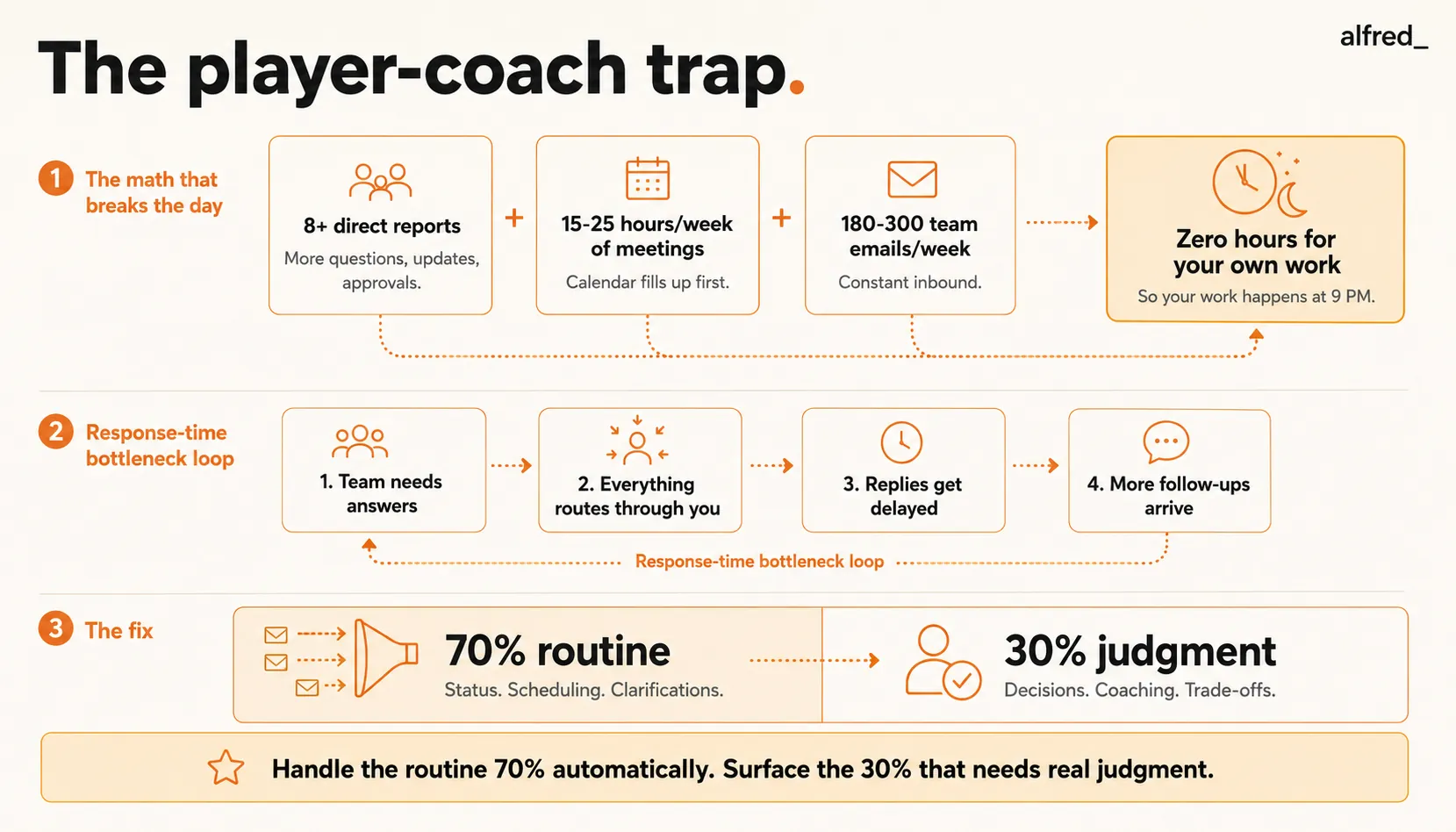
So you do your own work at night. After dinner. On weekends. In the margins between other people’s priorities.
This is the player-coach trap, and if you have more than 8 direct reports, you’re already in it.
The Math That Broke Your Calendar
Let’s start with the calendar, because that’s where the damage is most visible.
When you have 8+ direct reports, you can easily spend 35-50% of your workweek in 1:1 meetings alone. If you’re running biweekly 1:1s with 12 reports at 30 minutes each, that’s 3 hours per week of 1:1s. If they’re weekly, and most companies expect weekly, that’s 6 hours. Add team meetings, cross-functional syncs, skip-levels, and stakeholder updates, and your calendar shows 15-25 hours per week of meetings before you open your inbox.
In a 40-hour week, that leaves 15-25 hours for everything else: your own deliverables, strategic thinking, responding to email, eating lunch.
Now open your inbox.
180 Emails a Week From Your Team Alone
Each direct report generates 15-25 emails per week to you: status updates, questions that need answers, PTO requests, meeting reschedules, escalations from their own teams, project updates, “can I get your input on this?” messages, and the inevitable forward of a customer complaint that “you should see.”
At 12 direct reports, that’s 180-300 emails per week from your team alone. Add your manager’s emails, cross-functional threads, HR communications, and the all-company announcements, and you’re looking at 300-500 emails per week. The Radicati Group’s Email Statistics Reports have consistently shown that the average business professional receives well over 100 emails per day. Managers with large spans of control blow past that number by 30-50%.
“My entire day is other people’s priorities. By 5 PM I’ve answered 60 emails, sat in 5 meetings, unblocked 3 people, and done zero of my own work. Then I open my laptop at 9 PM and try to do the thinking that’s supposed to be my actual job.”
The insidious part is that every one of those emails feels important. A report asking how to handle a difficult client. Another one flagging a deadline at risk. A third requesting a budget exception. None of these are noise. They all require your judgment, your context, your response. You can’t filter them. You can’t batch them. You can’t delegate them, because you’re the one they were delegated to.
The Player-Coach Myth
The term “player-coach” sounds dynamic. It sounds like you’re doing both things well. In practice, it means you’re doing neither.
Lattice benchmarking data shows the average number of direct reports per manager rose from 4.3 to 5.2 between 2020 and 2022, settling at 5.1 in 2023. But averages hide the reality: many managers, especially after layoffs, reorgs, or hiring freezes, are carrying 8, 10, 12 reports without any additional management capacity. These managers report spending 70% or more of their week on management activities (meetings, email, coaching, admin) and scrambling to complete their individual contributor work in the remaining time.
Management research generally recommends 5-7 direct reports as the optimal span of control for managers who also have IC responsibilities. Beyond 7, the communication overhead begins to crowd out everything else. At 12, it has consumed everything else.
But no one adjusts the expectation. Your performance review still includes both “effective people management” and “strategic deliverables.” Your promotion case requires both visibility as a leader and output as a contributor. The company got a two-for-one deal on your role and is quietly pretending that’s sustainable.
The Response Time Trap
There’s a secondary pressure that makes it worse: your response time sets the team’s pace.
When a report emails you with a blocking question and you don’t respond for 6 hours because you were in meetings, they’re stuck for 6 hours. Multiply that by 12 reports, and your inbox becomes a dependency bottleneck for the entire team. The longer you take, the more follow-up emails you get: “Hey, just checking if you saw my message?” Those follow-ups add to the pile, which slows your response time further, which generates more follow-ups.
It’s a feedback loop that punishes you for having too much to do by giving you more to do.
“I feel like I’m failing everyone equally. My reports need more of me. My manager needs more of me. My own work needs more of me. And email is the medium through which all of that failure is documented.”
Why Slack Doesn’t Help
You might think that moving communication to Slack or Teams would reduce email volume. It doesn’t. Research on workplace communication tools consistently shows that professionals using Slack or Teams spend a significant portion of their workday on internal messaging, in addition to email, not instead of it. You haven’t reduced the communication load. You’ve duplicated it across channels.
Now you have 180 team emails and 200 Slack messages per week. The question “did you see my email?” has been replaced by “did you see my Slack?” You’re monitoring two firehoses instead of one, and the context-switching between them is actively destroying your ability to think.
What You Actually Need
You don’t need a better email app. You don’t need another channel. You don’t need to “batch your email time”, because you tried that, and three reports were blocked for 4 hours while you batched.
You need someone to handle the 70% of manager email that doesn’t require your actual judgment. The PTO approvals. The meeting reschedules. The status update acknowledgments. The “yes, go ahead” replies. The “thanks for flagging, I’ll look at it” responses. The routine requests that each take 2 minutes to write but collectively consume 2 hours of your day.
You need the other 30%, the escalations, the difficult conversations, the strategic decisions, surfaced cleanly with context so you can respond quickly and well.
How alfred_ Works for Managers
alfred_ connects to your email and calendar and starts learning the pattern of your team communication immediately.
Triage by judgment required. Your morning brief doesn’t show you all 47 unread messages. It shows you the 8 that need your brain. “Jamie is escalating a client issue, context and draft reply here. Alex is requesting headcount approval, context from the last budget conversation here. Pat’s PTO request for next Friday, draft approval ready.” The other 39 emails? Handled with drafts ready for your approval, or flagged as informational (no action needed).
Team-aware drafts. alfred_ learns how you communicate with each report. The reply to your senior engineer is different from the reply to your new hire. It understands that when Alex asks a question, you usually give context and rationale. When Jamie escalates, you want the short version and next steps. The drafts match your actual management style.
Nothing falls through. When 12 people are emailing you, things slip. The follow-up you promised Morgan on Tuesday. The document review Sam asked about on Thursday. The headcount request from Chris that needs your manager’s approval. alfred_ tracks all of it and surfaces what’s about to slip before it does. Your reports stop sending “just checking in?” emails because they’re getting timely responses.
Calendar intelligence. Before your 1:1 with Jordan, alfred_ pulls together recent email threads, open action items, and anything Jordan mentioned in their last few messages. You walk into the 1:1 with context instead of spending the first 5 minutes asking “so, what’s on your mind?”
The Time Recovery
If you currently spend 2-3 hours per day on email (below average for managers with 10+ reports), and alfred_ handles the routine 70%, you reclaim 1.5-2 hours per day. That’s 7.5-10 hours per week.
Ten hours per week. That’s the difference between doing your own work at night and doing it during business hours. That’s the difference between being a bottleneck and being a leader. That’s the difference between surviving the player-coach trap and actually performing in both roles.
Each reclaimed hour ends up costing you next to nothing.
What Changes
Here’s what actually happens when you stop being the bottleneck:
Your reports get faster responses, which means they get unblocked faster, which means the team moves faster. You spend your 1:1s on coaching and development instead of catching up on missed emails. You have time for the strategic work that got you promoted to manager in the first place. You stop doing “real work” at 9 PM.
The player-coach trap works because it assumes the player and the coach can share the same calendar. They can’t. But they can share an inbox, if the inbox has help.
Try alfred_.
Your team deserves a manager who isn’t drowning. You deserve to go home at a reasonable hour.