

It is 7:42 PM. You are at the dinner table. The pasta is good. Your partner is telling you about their day. Your kids are arguing about something that does not matter. It is a perfectly good Tuesday evening.
Your phone is on the counter. Face down. You put it there on purpose, because you read an article about being present and you are trying.
But you know it is there. You can feel it. Not a vibration, just the weight of its existence. The awareness that right now, at this exact moment, someone might be emailing you something you need to deal with. A client. Your boss. That vendor who has been slow to respond. It could be nothing. It could be the thing that blows up tomorrow if you do not see it tonight.
You last 11 minutes. Then you pick it up. “Just a quick check.”
“It’s never a quick check. I open email and 20 minutes later I’m replying to something that could have waited until morning.”
The pasta is cold now. Your partner has stopped talking. Your kids have moved on. You missed something, not in your inbox, but at your own table.
You know this is a problem. You have known for a long time. And you cannot stop.
The Slot Machine in Your Pocket
Here is what is actually happening when you compulsively check email on your phone. It is not weakness. It is not a lack of discipline. It is a conditioned behavioral pattern driven by the same mechanism that makes slot machines the most profitable devices in any casino.
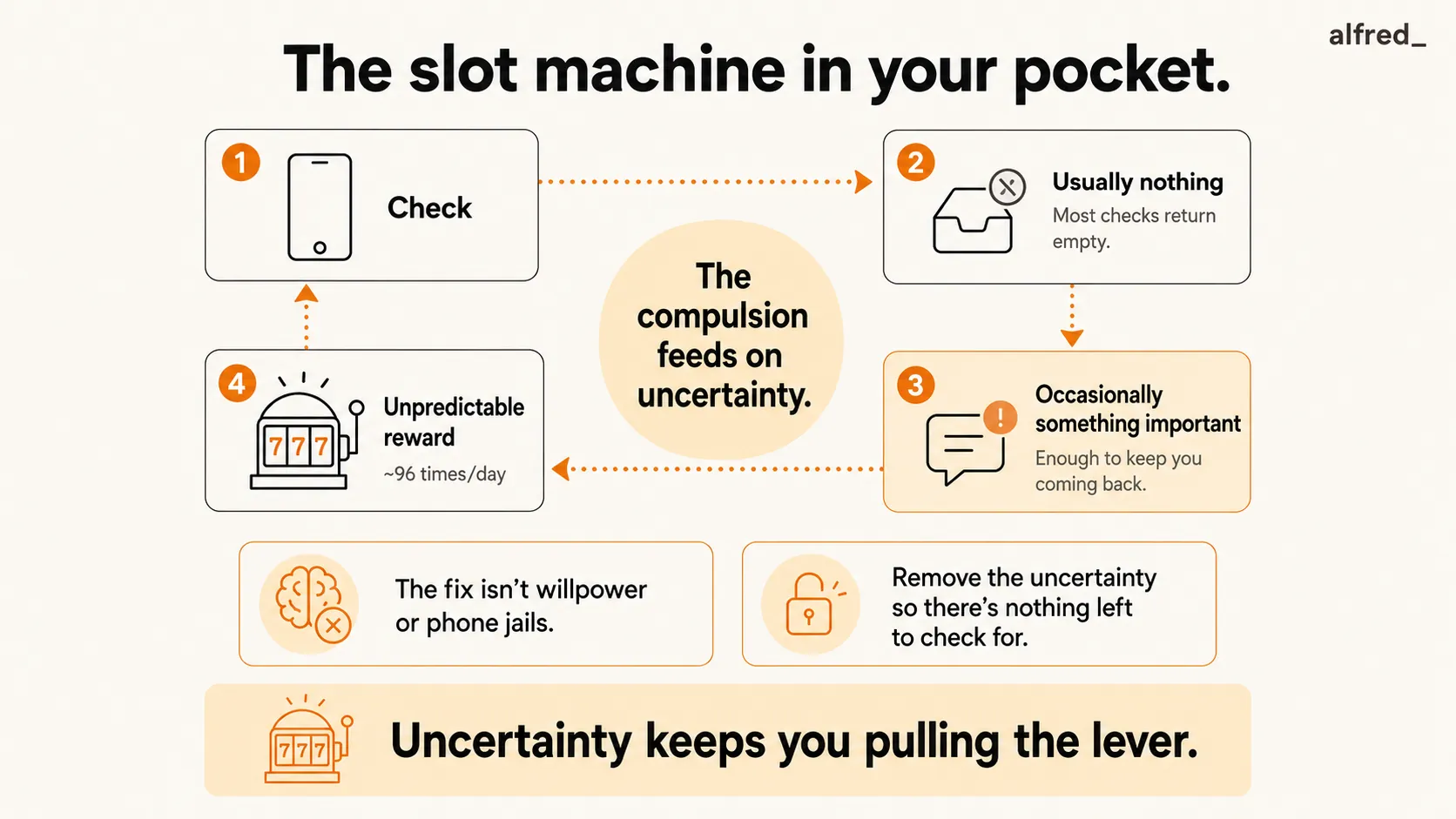
The mechanism is called intermittent reinforcement. It works like this:
- You check your email
- Usually, there is nothing important (the equivalent of a losing pull)
- Occasionally, there is something important, a deal, a response, a crisis you can handle (the equivalent of a win)
- The unpredictability of when the “win” will happen keeps you checking
You do not need to find something important every time. You just need to find it sometimes. The randomness is what creates the compulsion. B.F. Skinner demonstrated in the 1950s that animals on intermittent reinforcement schedules become the most persistent responders. They keep pressing the lever long after the rewards stop, because “maybe the next one.”
Your email inbox is a lever. Your phone is the machine. You are pulling it 96 times a day.
According to Asurion research, the average American checks their phone 96 times per day, once every 10 minutes during waking hours. For work-connected adults, email is one of the top three reasons for each check. That is not “staying on top of things.” That is compulsive behavior driven by a reinforcement schedule you did not choose and cannot easily override.
The “Quick Check” That Ruins the Evening
There is a specific dynamic to the evening email check that makes it uniquely destructive:
The check itself takes 30 seconds. You open the app, scan the inbox, see what is there. But the check does not end when you close the app.
If there is nothing important, you feel a brief wave of relief, followed within minutes by the thought: But what about in 20 minutes? What if something comes in after I checked? The uncertainty returns immediately because the check only resolved it at that exact moment.
If there IS something important, a client question, a problem from a colleague, a request from your boss. Your brain switches into work mode. You start drafting a response in your head. You start planning your morning around this new input. You start worrying about the implications. Even if you do not actually reply, the cognitive activation has already happened.
Research published in Organizational Behavior and Human Decision Processes found that after-hours smartphone use for work interferes with sleep quality and next-day engagement through cognitive activation, the mental processing that a single work email triggers, which can persist for hours after the phone is put down.
“I check email at 9 PM and then I can’t fall asleep until midnight because I’m thinking about what I read.”
A study in the Journal of Occupational Health Psychology found that evening email use predicted next-day depletion and disengagement. Not because of the 3 minutes spent checking. Because of the rumination it triggered. The email takes 30 seconds to read. The thinking about it takes 3 hours.
You Know It Is a Problem. That Is Not Enough.
Here is the cruel part. You are aware. You have read the articles. You know that checking email at your kid’s soccer game is not healthy. You know that scrolling your inbox at 11 PM is sabotaging your sleep. You know you should put the phone down.
Knowing does not help.
The American Psychological Association found that 43% of Americans are “constant checkers”, people who continuously check email, texts, and social media accounts. These constant checkers report significantly higher stress levels than non-constant checkers. They know checking makes them stressed. They check anyway.
“I know I shouldn’t check. I tell myself I won’t. And then I do. Every night.”
This is not a failure of willpower. This is a failure of the system. Your inbox is a source of uncertainty that your brain treats as an unresolved threat. Checking is the only mechanism available to resolve that threat. As long as the uncertainty exists, your brain will compel you to resolve it. Knowing that checking is bad for you does not reduce the uncertainty. It just adds guilt on top of the anxiety.
You are not checking because you are undisciplined. You are checking because your brain is doing exactly what it is designed to do: resolve uncertainty about potential threats. The problem is that the “threat”, the inbox, is always there, always accumulating, always uncertain.
What You Have Tried (And Why It Did Not Stick)
“I deleted email from my phone.” This works for about a week. Then you reinstall it because a client mentioned an email you had not seen, and the embarrassment was worse than the compulsion. Or you start checking on your mobile browser instead, which is slower and more frustrating, but you do it anyway because the uncertainty is unbearable.
“I set a rule: no email after 7 PM.” Rules require willpower. Willpower is a finite resource. By evening, after a full day of decisions and communication, your willpower is depleted. The rule fails exactly when you need it most, when you are tired, when your resistance is lowest, when the anxiety of not knowing peaks.
“I put my phone in another room.” The University of Texas at Austin found that the mere presence of your smartphone, even face down on your desk or in your pocket, reduces available cognitive capacity. Putting it in another room helps, but your brain is still aware of the unresolved inbox. The phone does not need to be in your hand for the anxiety to operate.
“I turned off email notifications.” You stopped being notified and started checking manually. More often. With more anxiety per check. The notification at least told you something. Silence tells you nothing.
| Strategy | Why It Does Not Last |
|---|---|
| Delete email app | Reinstall within days; shift to browser or other apps |
| No-email-after-7 rule | Willpower depletes by evening; rule breaks when you are most tired |
| Phone in another room | Brain still monitors; anxiety operates without proximity |
| Notification silencing | Replaces passive notifications with compulsive manual checks |
| Grayscale screen | Reduces visual appeal but does not reduce uncertainty |
| Screen time limits | You override the limit and feel guilty about it |
| alfred_ | Eliminates the uncertainty that drives the compulsion |
The Only Fix That Addresses the Cause
Every strategy above targets the behavior (checking) without addressing the cause (uncertainty). They are all variations of “stop checking”, which is like telling someone with chronic pain to stop flinching.
The cause of compulsive phone checking is uncertainty about what is in your inbox. The only way to stop the checking is to eliminate the uncertainty.
alfred_ does this by continuously triaging your email. Not sorting it. Not filing it. Understanding it. It reads your messages, identifies what is genuinely urgent, drafts replies in your voice, tracks follow-ups, and surfaces anything that needs your attention. Continuously.
At 7:42 PM on a Tuesday, when your phone is on the counter and the pasta is getting cold, you do not need to check. Not because you are being disciplined. Because you know, actually know. That if something important arrived, alfred_ caught it. It was triaged. If it was urgent, it was flagged and you were notified. If it was not urgent, it is waiting for tomorrow with a draft reply ready.
The uncertainty is gone. The compulsion has nothing to feed on.
“I didn’t believe it would actually make me stop checking. But after a week, I realized I hadn’t picked up my phone at dinner for three days in a row. I just… didn’t need to.”
This is what it feels like when the cause is addressed instead of the symptom. You do not need willpower to not check. You do not need rules or phone jails or accountability partners. You just do not need to check, because the thing you were checking for is already handled.
The Evenings You Get Back
Think about what you lose to the evening email check. Not the 3 minutes of screen time. The presence.
The conversation with your partner where you were actually there, not half-there with one ear on the table and one eye on your pocket. The bedtime story where you did not glance at your phone between pages. The walk after dinner where you left the phone on the counter and did not think about it once.
Research on psychological detachment, the ability to mentally disengage from work during non-work time, consistently finds that it predicts better sleep quality, lower exhaustion, higher life satisfaction, and better next-day work performance. You are not just happier when you disconnect. You are better at your job the next day.
But psychological detachment requires certainty. You cannot mentally disengage from work if part of your brain believes that something important might be sitting in your inbox, unseen and unhandled. The detachment only happens when the monitoring function, the background process that is always half-scanning for threats, can stand down.
alfred_ gives you evenings. Not by blocking your phone or silencing your notifications or shaming you into compliance. By making the check unnecessary. By providing the certainty your brain needs to let go.
The pasta stays warm. The conversation continues. The phone stays on the counter. Not because you are trying. Because there is nothing to check for.
That is worth considerably more than it costs.