

You know you are the bottleneck. You have known for a while. You might have even said it out loud, to a partner, to a colleague, to yourself at 9 PM while answering the emails that accumulated during the eight hours of meetings you sat through because nobody else could sit through them for you.
“I can’t scale because I’m the bottleneck. And I’m the bottleneck because I’m the one answering all the emails.”
The frustrating part is not that you are busy. Busy is fine. The frustrating part is that you are busy with work that should not require you. Meeting confirmations. Scheduling back-and-forth. Status updates. Client check-ins that are important but routine. Vendor coordination. Internal requests for information that lives in your head and nowhere else.
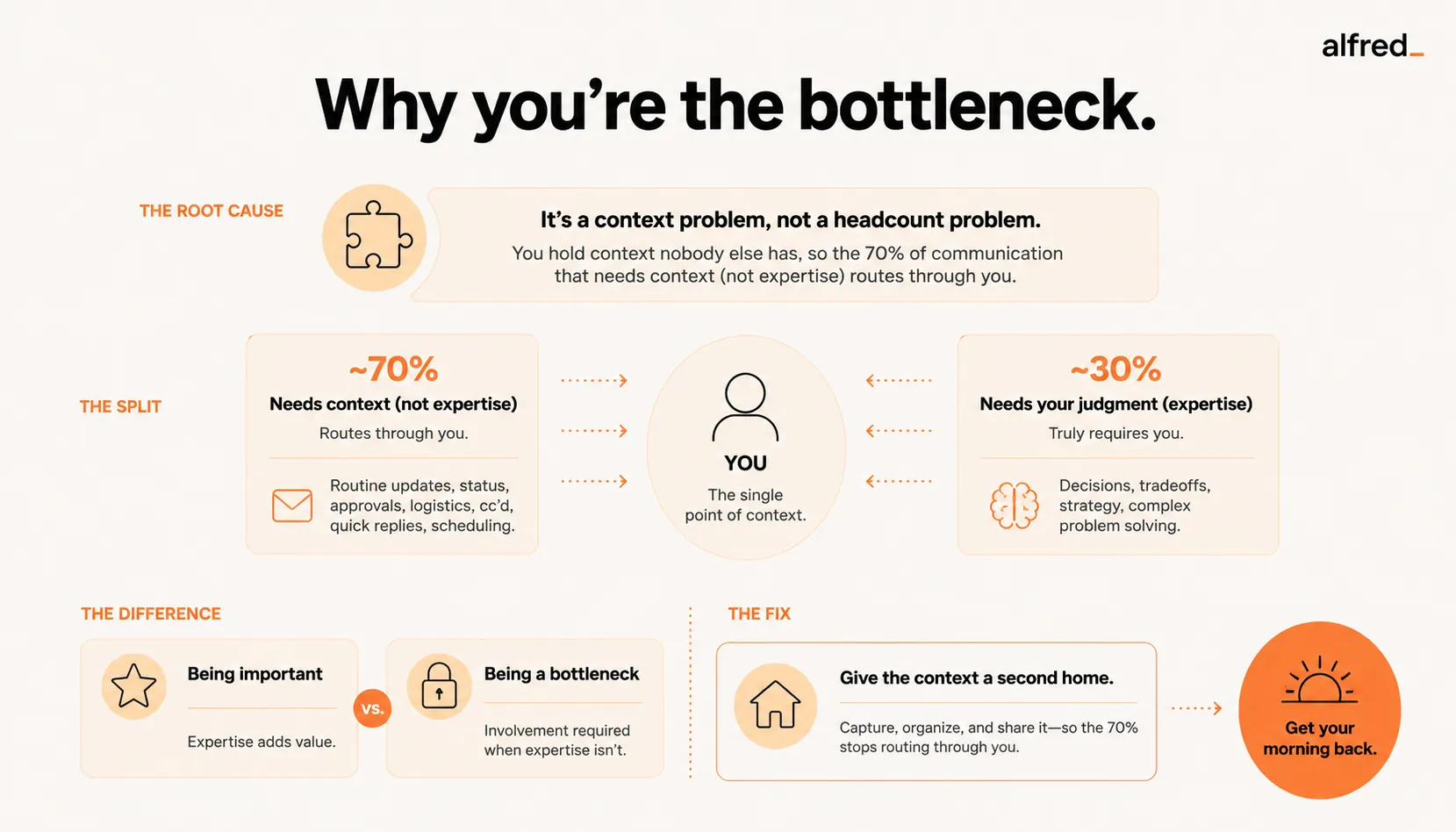
You are not the bottleneck because these tasks are hard. You are the bottleneck because you are the only one who has the context to handle them.
The Context Trap
Every bottleneck has the same root cause: information asymmetry. You know things nobody else knows. Not just the big things, the strategy, the vision, the five-year plan. The small things. The operational context that accumulates over months and years of being embedded in every conversation.
You know that when this client says “let’s circle back,” they mean they are losing interest and you have 48 hours to re-engage. You know that the 2 PM Tuesday slot on your calendar looks open but is actually reserved for the deep work you never get to. You know that the vendor copied on this thread is the same vendor who missed a deadline last quarter and needs to be handled carefully. You know that the proposal your team member drafted uses a pricing model the client rejected six months ago.
This is context. It is not written down anywhere. It cannot be Googled. It lives in your head, and it is the reason every email, every decision, every scheduling question flows through you.
A Harvard Business Review study found that knowledge workers spend 41% of their time on discretionary activities that could theoretically be handled by others. But “theoretically” is doing a lot of work in that sentence. Those activities could be delegated if the delegate had the context. They almost never do.
Why Traditional Delegation Fails
You have tried to delegate. Of course you have. You are not a control freak (or if you are, it is because experience made you one). You have handed your inbox to an assistant, briefed a team member, trained a junior hire. And it worked, for about two weeks.
Then something slipped.
The assistant confirmed a meeting during a conflict that was not on the calendar but that you knew about because it was mentioned in a hallway conversation. The team member sent a routine reply to a client without knowing that the relationship was fragile after a billing dispute last month. The junior hire triaged an email as low priority without knowing that the sender was the CEO’s direct referral.
Each failure was small. Each failure was understandable, the delegate did not have the context. But each failure created cleanup work that exceeded the original task, and each one eroded your confidence in delegation. So you pulled the work back. “It’s just easier if I do it myself” became your mantra.
CEO time-use research suggests that a significant share of executive time is spent on tasks they could delegate. Not because they enjoy those tasks, but because the overhead of delegation, briefing, monitoring, correcting, often exceeds the time the task itself requires. The bottleneck is rational. That does not make it sustainable.
The Growth Ceiling
The bottleneck problem is not just a personal time problem. It is a scaling problem.
When you are a solo practitioner or a founder, being the bottleneck means your business cannot grow beyond your personal capacity to process communication. Every new client adds email volume. Every new project adds coordination overhead. Every new team member adds internal communication. The business grows, but your inbox grows faster.
As described by Brooks’ Law and Metcalfe’s Law, communication complexity grows exponentially with team size. A team of 5 has 10 possible communication channels. A team of 10 has 45. A team of 20 has 190. If all of those channels route through you, adding people does not reduce your bottleneck status. It intensifies it.
“Every time I hire someone to help me, I get more emails, not fewer.”
This is the paradox. You hire to scale. Hiring creates more communication. More communication means more bottleneck. More bottleneck means you cannot take on the strategic work that would actually grow the business. You are trapped.
The Bain & Company study on organizational drag found that the average company loses more than 20% of its productive capacity to unnecessary communication and coordination. For small businesses and solo practitioners where one person is the communication hub, the loss can approach 40-50%.
The Emotional Weight
There is a feeling that comes with being the bottleneck. It is not just exhaustion, although you are exhausted. It is a particular kind of guilt-adjacent anxiety that comes from knowing things are waiting on you.
The email you have not responded to from Tuesday. You know it is there. The follow-up you were supposed to send last week. You know it is late. The scheduling request from a potential client that is sitting in your inbox while the opportunity slowly cools. You know the window is closing. The proposal your team cannot finalize because they are waiting for your feedback. You know they are waiting.
Everything is waiting on you. And you cannot move fast enough.
The American Psychological Association reports that 65% of Americans cite work as a significant source of stress, with workload being the primary factor. But for bottleneck professionals, the stress is not just about volume. It is about the knowledge that your inability to process faster directly impacts other people. Clients wait. Team members wait. Opportunities wait. Projects wait. Revenue waits.
You are not just behind on your own work. You are the reason other people are behind on theirs.
The Indispensability Trap
Here is the darkest irony: the bottleneck problem often starts as a compliment.
“You’re so on top of everything.” “I don’t know what we’d do without you.” “You’re the only one who really understands the full picture.” These statements feel like validation. They reinforce the behavior. If you are the only one who understands the full picture, then you should be the one handling the communication. Right?
Wrong. Being indispensable is not a strength. It is a single point of failure. When you go on vacation, things fall apart. When you get sick, decisions stall. When you try to step back and focus on strategy, the operational vacuum pulls you back in.
Organizational resilience research shows that organizations with single points of failure in communication are significantly more vulnerable to disruption. The indispensable person is also the fragile point, the one whose absence creates cascading delays.
You have probably experienced this. You took a week off and came back to an inbox so deep it took three days to clear. You were sick for two days and the backlog was worse than if you had just worked through the illness. You tried to take an afternoon for strategic thinking and by 3 PM you had 40 unread emails and two team members at your door.
The indispensability trap teaches you that stepping away has a cost. So you stop stepping away. And the bottleneck calcifies.
What Would Actually Fix This
The bottleneck problem has one root cause: you hold context that nobody else has. The solution, then, is not to work harder, hire more people, or find a better productivity system. The solution is to give something else the context.
This is what executive assistants do for senior executives at large companies. The EA absorbs context over time, relationship dynamics, calendar patterns, communication preferences, institutional knowledge, and uses that context to make judgment calls on incoming communication. The EA handles the 70% that needs context but not expertise, and routes the 30% that needs expertise directly to the executive.
The result: the executive stops being the bottleneck. Not because they are less important, but because the context that made them the bottleneck now lives in two places instead of one.
The problem is cost. A skilled EA costs $50,000-85,000 per year. For a solo practitioner, a small firm, or a startup founder, that is often unjustifiable, especially when revenue is still variable. You know you need the help. You cannot afford the help. So you remain the bottleneck.
alfred_ solves the context problem without the cost problem.
alfred_ reads every email. Every one. It builds context continuously. Your communication patterns, your calendar commitments, your relationship history with every contact, your typical response style, your follow-up cadence. It does not need to be briefed. It does not need to be trained for two months before it can handle basic triage. It has context from day one because it has access to the same information you do.
When an email arrives that needs a routine response, scheduling, acknowledgments, status updates, follow-ups, alfred_ drafts it. In your voice. With your context. With awareness of your calendar, your commitments, and the history of the conversation.
When an email arrives that needs your actual judgment, a client concern, a strategic decision, a negotiation that hinges on your expertise, alfred_ flags it and assembles the full context so you can respond in 2 minutes instead of 10.
The result: the 70% of communication that routes through you because of context (not expertise) stops requiring your direct involvement. You remain the decision-maker for the 30% that matters. The bottleneck dissolves, not because you are less involved, but because the involvement is now proportional to the value you add.
The Day You Stop Being the Bottleneck
Here is what changes.
Your team stops waiting on you for routine approvals because the routine communication is handled. Your clients stop experiencing delayed responses because the response cycle no longer depends on when you happen to open your inbox. Your schedule stops being consumed by email because the email volume that reaches you dropped from 121 to 30-40 items that genuinely need your attention.
You have 3-4 hours back. Not 3-4 hours of free time, 3-4 hours of capacity for the work that actually grows your business. The strategic thinking. The relationship building. The product development. The creative work. The things you were doing before you became the bottleneck.
“I just want to do the work, not manage the communication about the work.”
You can hire that next client without worrying that the email volume will bury you. You can take a vacation without coming back to a disaster. You can step away for an afternoon of strategic thinking without the inbox punishing you for it.
The bottleneck was never about your capacity. It was about context, context that lived in your head and nowhere else. alfred_ gives that context a second home.
You were not meant to be the bottleneck. You were meant to be the person whose judgment makes the whole thing work. It is time to let something else handle the plumbing so you can get back to the architecture.
For the concrete playbook, the specific moves to unblock yourself this quarter, read the companion piece: AI Assistant to Stop Being the Bottleneck. This post explains why you’re the bottleneck. That one covers how to stop.