

You know you’re the bottleneck. That’s what makes it so frustrating.
Every client email goes through you. Every scheduling request. Every follow-up. Every “quick question” that requires fifteen minutes of context. You know, intellectually, clearly, painfully. That being the single point of contact for everything is what’s keeping your business from growing. You’ve read the articles about delegation. You’ve thought about hiring. You’ve probably tried it.
And yet here you are, answering emails at 11 PM on a Tuesday, because the last time someone else tried to represent you in writing, it didn’t go well.
“I can’t scale because I’m the bottleneck. And I’m the bottleneck because I’m the one answering all the emails.”
The Paradox That Built Your Business and Keeps It Stuck
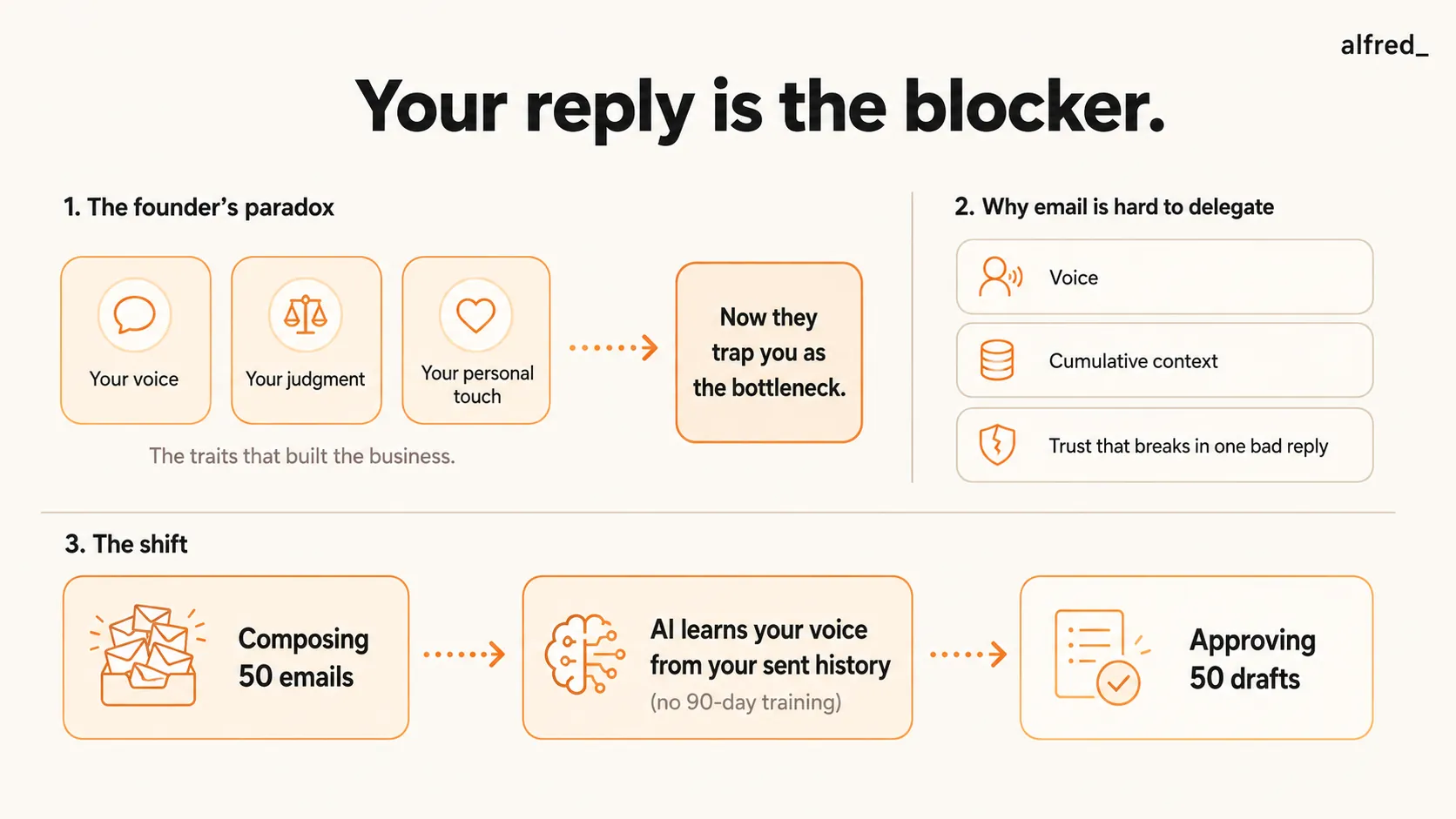
The traits that made you successful are the same ones that trap you.
Your attention to detail. Your personal touch with clients. Your refusal to send a mediocre email. These are the reasons people chose you over the competition. They’re why clients stay. They’re the foundation of every relationship that drives revenue.
They’re also the reason every email has to go through you, your business can’t grow past your personal bandwidth, and you work 60-80 hour weeks while revenue plateaus.
75% of entrepreneurs have limited Delegator talent, according to Gallup. Not because they’re control freaks, because they’ve learned from experience that nobody does it the way they do. And with email specifically, “the way you do it” isn’t a preference. It’s your professional reputation, written down, sent to the people who pay you.
“If I could outsource just the email triage I would pay a lot of money for that.”
Here’s what the data says about what that bottleneck costs: CEOs who delegate effectively generate 33% higher revenue, an average of $8 million versus $6 million (Gallup). High-delegating CEOs saw 1,751% company growth over three years, 112 percentage points higher than founders who held everything themselves.
You’re not just tired. You’re leaving money on the table. And you know it.
Why Email Delegation Is Uniquely Hard
You can delegate accounting to a bookkeeper. You can delegate scheduling to a coordinator. You can hand off project management to someone with a Gantt chart and reasonable judgment. These tasks transfer because they follow rules, have clear inputs and outputs, and don’t carry your voice.
Email is different. Email delegation means delegating your voice, your judgment, and your relationships, the three things that are hardest to transfer and most damaging if transferred badly.
Voice is invisible until it’s wrong
Your clients know how you write. They know your cadence, whether you open with “Hi Sarah” or “Hey Sarah” or just “Sarah, “. They know whether you use exclamation points or not. Whether you sign off with “Best” or “Thanks” or just your name. These micro-choices form a communication fingerprint. When it changes, people notice. They may not say anything. But the feeling shifts, from “I’m talking to the person I hired” to “something is different.”
You can’t teach voice in a document. Templates capture format, not feel. Style guides capture rules, not judgment. The part of email that makes clients feel attended to, that’s in your head, and it comes out through your fingers, and it’s almost impossible to articulate explicitly enough for someone else to reproduce.
Context is cumulative
“Reply to Sarah about the project” requires knowing which project, what stage it’s at, what Sarah’s concerns were last week, what you promised on the last call, what the contract says about timelines, and what you know about Sarah’s communication style that you’ve picked up over months of back-and-forth.
This context lives in your head. Not in a CRM. Not in a shared doc. In the accumulated experience of hundreds of email exchanges that have given you an intuitive sense of how to handle each relationship. Transferring that to another person isn’t a training task. It’s months of shadowing, making mistakes, and learning from corrections.
Trust breaks in one email
You’ve probably lived this. You hire a VA. You spend weeks training them. They handle routine emails adequately. Then they send a reply to your biggest client that misses a nuance, wrong tone, missed context, an answer that was technically correct but felt off. The client doesn’t complain. They just feel slightly less confident in you.
“I want someone to just… handle it. Not an app. Someone with judgment.”
And that’s the core desire: judgment. Not speed. Not sorting. Not filters. Judgment about what matters, what tone to use, what to escalate, and what to handle quietly. That’s what you provide when you answer every email yourself. And it’s what you’ve never been able to replicate in another person, at least not without months of investment and significant risk.
The 90-Day Training Trap
The VA industry is honest about the timeline: 90 days before a virtual assistant is effective at email.
-
Days 1-30: Learning your basic patterns. Which emails are urgent. Who your key clients are. Your standard responses for common questions. During this phase, you’re doing more work, answering email plus training someone to answer email.
-
Days 31-60: Handling routine messages. The scheduling confirmations. The “thanks, got it” replies. The straightforward questions with clear answers. You’re still handling everything important, plus reviewing what they write.
-
Days 61-90: Starting to handle nuanced communication. Client follow-ups. Sensitive topics. Emails that require reading between the lines. This is where most delegations fail, the VA’s emails are adequate but not you. Clients can tell.
And after 90 days, if it works? Great. But VAs leave. They get better offers. They move on. And when they do, the knowledge walks out the door. You start over. Another 90 days. Another trust ramp. Another stretch of doing double work while you train the replacement.
“I missed a follow-up. Lost the deal. It was in my inbox the whole time.”
Meanwhile, during those 90 days and beyond, the emails that are “too important to delegate” still pile up. You’re still the bottleneck for the hardest 80% of communication. The VA handles the easy 20%, which was never the problem.
The Math That Traps You
Working 60-80 hour weeks. Revenue has plateaued. You’re maxed on capacity. Every new client means more email. More email means more of your time. You can’t grow revenue without growing your client load. You can’t grow your client load without growing your email volume. You can’t grow your email volume without growing yourself.
You can’t grow yourself. You’re already stretched to breaking.
28% of the average workweek goes to email for knowledge workers. For a founder who is the primary client contact, it’s higher. The founder’s inbox isn’t just communication. It’s the nervous system of the entire business. Strategy requests, client updates, vendor negotiations, team questions, scheduling, follow-ups. Everything flows through you.
A 100-person company loses $420,000 per year to miscommunication and poor email handling. For a solopreneur or small founder, the cost isn’t measured in company-wide losses. It’s measured in the ceiling you hit because you can’t be in more places at once.
How 5 Approaches Handle the Bottleneck
| Approach | Price | Learns Your Voice? | No Training Period? | Always Available? | Key Limitation |
|---|---|---|---|---|---|
| Senior VA | $2,700–$9,600/mo | After 90 days | No, 90 day ramp | 8 hrs/day | Cost, turnover, training restart |
| Superhuman | $30/mo | No | N/A | While you use it | You're still the one writing every email |
| SaneBox | $7–$36/mo | No | N/A | Background filtering | Sorts mail; doesn't write replies or reduce bottleneck |
| Email templates | Free | Static, not adaptive | No templates to write | N/A | Covers 20% of replies; 80% need judgment |
| alfred_ | $29.99/mo | Yes, from your sent email history | Yes, immediate | 24/7 | Requires Gmail or Outlook; you still approve |
Hiring a senior VA
The “right” answer in every business book. And for established businesses with revenue to support it, a great VA is genuinely life-changing. But the math: $2,700-$9,600/month, 90-day ramp, trust building measured in months, and the knowledge walks out the door if they leave. For founders in the $150K-$500K revenue range, the cost represents a meaningful percentage of profit, and the 90-day investment of double-work happens at exactly the stage when you’re most time-starved.
Superhuman
Makes you a faster bottleneck. AI shortcuts, keyboard navigation, split inbox. You move through email faster than ever. But the work is still yours. Every reply, every decision, every draft. Superhuman makes the bottle narrower and faster, but you’re still the only thing that fits through it. At $30/month, you’re paying for speed, not relief.
SaneBox
Reduces noise. Newsletters go to @SaneLater. Low-priority senders get filtered. Your inbox is quieter. But SaneBox doesn’t write replies. It doesn’t learn your voice. It doesn’t draft responses. The important emails, the ones that make you the bottleneck, are still sitting there, waiting for you. The queue is shorter. You’re still the only one processing it.
Email templates and canned responses
Cover the predictable 20%, the meeting confirmations, the “thanks, received” replies, the FAQ answers. The other 80% requires judgment, context, and your voice. Client communication isn’t template-shaped. The email that actually creates the bottleneck is the one that requires reading a thread, understanding the subtext, and crafting a response that maintains a relationship. No template handles that.
alfred_
This is where the approach fundamentally changes.
alfred_ doesn’t need 90 days to learn your voice. It learns from the emails you’ve already sent, thousands of them. Your vocabulary. Your tone. How you write to different recipients. The level of formality you use with new contacts versus longtime colleagues. The way you close emails to your biggest client versus how you respond to a vendor.
Draft replies sound like you, not because you trained an AI with a style guide, but because the AI studied the actual emails you’ve already written. Your communication fingerprint is already in your sent folder. alfred_ reads it.
Drafts never send themselves. You review. You edit if needed. You hit send. The AI does the composing, the part that takes 5-15 minutes per email, multiplied by 30-50 important messages per day. You do the approving, the part that takes 30 seconds.
The bottleneck breaks because the thing that was uniquely yours. Your voice, is no longer trapped in your head. It’s learned. It’s replicated. It scales.
What Changes When Your Voice Scales
“I can’t scale because I’m the bottleneck. And I’m the bottleneck because I’m the one answering all the emails.”
Read that again, but change the last part: And I’m the bottleneck because I was the only one who sounded like me.
alfred_ at $29.99/month versus a senior VA at $2,700-$9,600/month. No 90-day training period because the AI trains itself on your existing email history. No turnover risk because software doesn’t quit. No trust gamble because nothing sends without your approval. Available 24/7 instead of 8 hours per day.
You go from processing 50 emails per day yourself to reviewing 50 drafts per day. The work shifts from composing to approving. The time shifts from hours to minutes. The bottleneck opens because the constraint. That only you could write emails that sounded like you, is no longer true.
Your clients don’t notice the difference because there isn’t one. The emails sound like you. The tone is right. The context is there. The only thing that changed is that you’re not the one writing every single word.
“I want someone to just… handle it. Not an app. Someone with judgment.”
alfred_ isn’t judgment, that’s still yours. But it’s the next best thing: something that handles the craft of composing so you can focus on the judgment of deciding. Review, approve, send. The work that required 3 hours per day now takes 30 minutes.
Your voice. Your judgment. Your patterns. Without you being the bottleneck.