

It’s 9:14 PM on a Tuesday. You’re on the couch. The TV is on. Your laptop is closed. Dinner was fine. The evening should be yours.
But it’s not. Because ten minutes ago, your phone buzzed with a notification. Not a message directed at you, just a Slack activity notification. Someone on your team posted in a channel. And now a thought has taken root that you can’t shake: they’re working. You’re not.
You don’t open the message. You don’t need to. The damage is already done. You saw the timestamp, 9:04 PM, and your brain did the rest. They’re still working. Your boss probably saw it too. Everyone is going to know you logged off three hours ago. You’re falling behind. You should check in. You should do something. You should at least look productive.
You pick up your phone. You put it back down. You pick it up again. You open Slack. You read the message. It’s nothing, a link to an article, a comment about tomorrow’s meeting. Nothing that needed you. Nothing urgent.
But now you’re in. And you spend the next 40 minutes scrolling, checking, scanning, not because there’s work to do, but because the guilt of not-working has made rest impossible.
“Even when I’m not checking email I’m thinking about what might be in there.”
The Visibility Trap
After-hours work guilt is not about work ethic. It’s about visibility.
Twenty years ago, you left the office at 6 PM and nobody knew what you did after that. You could work at home, you could watch a movie, you could stare at the wall, and your colleagues had no signal either way. Your evening was private.
That privacy is gone. Every modern communication tool broadcasts your activity:
- Slack shows a green dot when you’re online and “last active” timestamps when you’re not
- Email includes send timestamps that colleagues unconsciously register
- Google Docs shows “currently viewing” indicators
- GitHub logs commit times
- Teams shows presence status and last-seen information
These signals were designed for convenience. In practice, they’ve created a surveillance layer where absence is visible. When your colleague sends an email at 8:47 PM, the timestamp tells everyone who sees it: “This person was working at 8:47 PM.” When you don’t send anything after 6 PM, the absence of a timestamp tells a story too, one that your anxious brain interprets as: “This person stopped caring at 6 PM.”
Research confirms this dynamic. A study by Becker, Belkin, Conroy, and Tuskey published in the Journal of Management found that even the mere expectation of after-hours email availability, not actual email use, just the expectation that you should be reachable, was sufficient to cause anxiety, reduce psychological detachment, and degrade well-being for employees and their families. You don’t have to work after hours to suffer from the after-hours culture. You just have to know it exists.
“I see my boss email at 9 PM and my first thought isn’t ‘she’s working late.’ It’s ‘am I supposed to be working late?’”
The Lie About Hours and Output
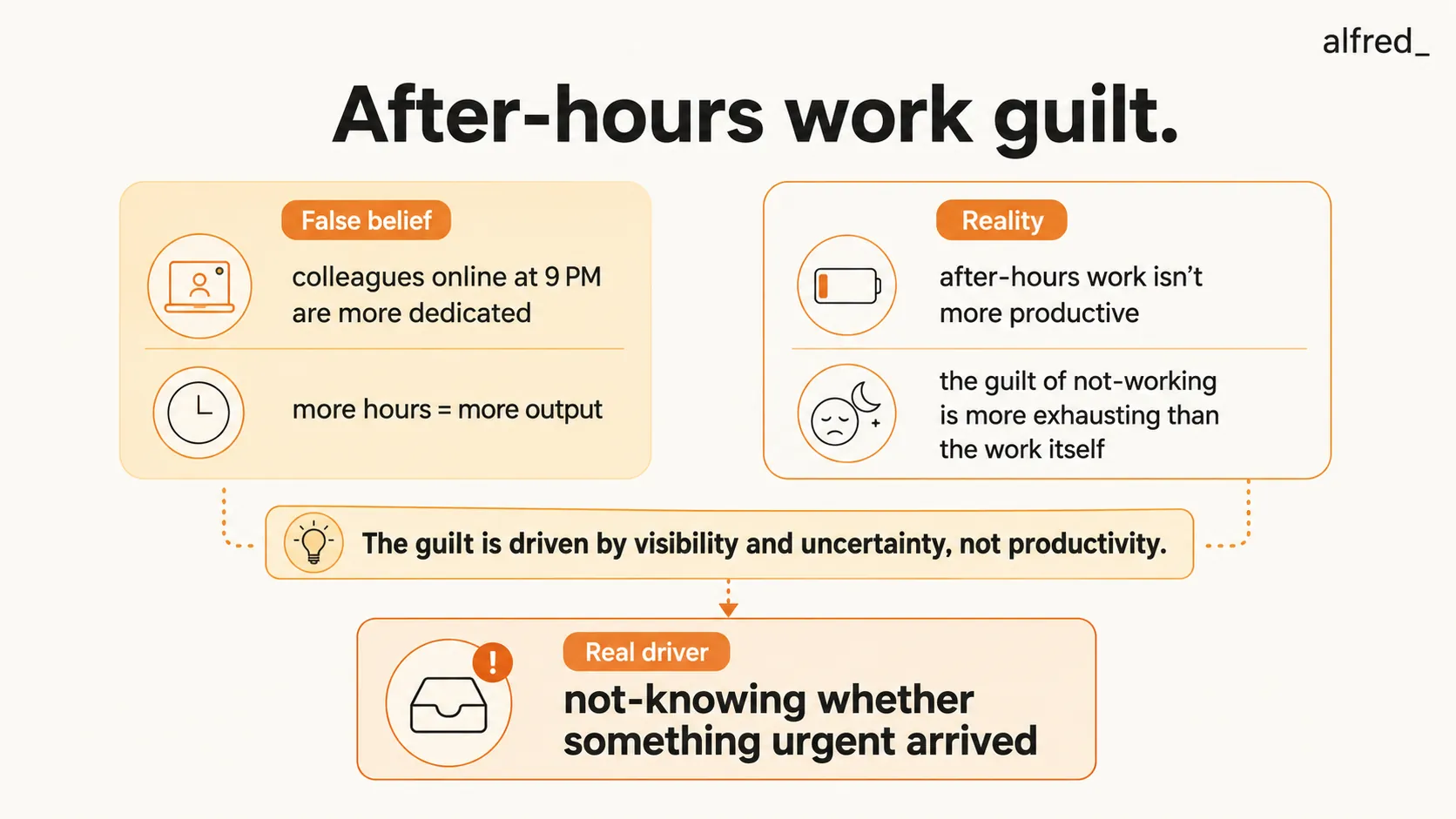
The guilt rests on an assumption so widespread it feels like truth: more hours equals more output. More dedication. More career advancement. More value.
The assumption is wrong. And the data is not ambiguous.
John Pencavel’s landmark 2014 study at Stanford University analyzed detailed productivity data and found a sharp, non-linear decline in output per hour past 50 hours of work per week. At 56 hours, output was measurably lower per hour than at 40. By 70 hours per week, total output was barely higher than at 56 hours, meaning those additional 14 hours produced almost nothing. The relationship between hours and output is not linear. It curves, peaks, and then goes flat.
More striking: Erin Reid at Boston University studied a consulting firm and found that managers could not distinguish between employees who actually worked 80-hour weeks and those who merely pretended to. Employees who quietly worked normal hours but performed well were rated identically to employees who visibly worked long hours. The performance was the same. The visibility was different.
The colleague you see online at 9 PM is not necessarily producing more than you. They may be responding to email they could have answered tomorrow. They may be doing shallow work, the kind that feels productive but doesn’t move anything forward. They may be caught in the same guilt spiral you’re trying to escape, performing work for the audience of the status indicator.
“I realized half my evening ‘work’ was just anxiety-driven busywork. I wasn’t producing anything. I was performing productivity for an audience that wasn’t watching.”
The Guilt Is Worse Than the Work
Here is the cruelest part of the after-hours guilt cycle: the guilt of not working is more exhausting than the work itself.
When you work in the evening, at least you’re doing something. There’s the satisfaction of completing a task, clearing an inbox, moving a project forward. The stress of the work is paired with the reward of progress.
When you sit on the couch feeling guilty about not working, you get neither rest nor progress. Your body is resting but your mind is not. The stress response is active, cortisol is elevated, your attention is fragmented, your thoughts are cycling, without the resolution that would come from either working or truly disengaging. You’re in the worst possible state: consuming energy without producing anything.
Research published in the Journal of Occupational Health Psychology has consistently found that psychological detachment from work, the ability to mentally disengage during off-hours, is one of the most important predictors of recovery, well-being, and sustained performance. Employees who cannot detach show higher emotional exhaustion, worse sleep quality, and paradoxically, worse performance during working hours the next day.
The guilt is not just unpleasant. It’s actively counterproductive. By preventing recovery, it makes you worse at your job tomorrow. The colleague who genuinely disconnected at 6 PM and spent the evening fully present will show up Wednesday sharper, more creative, and more resilient than the one who spent Tuesday night anxiously half-monitoring Slack while pretending to watch TV.
“I’m not resting. I’m not working. I’m just lying here feeling bad about not working. That’s the worst of all three options.”
The Uncertainty Underneath
Peel back the guilt and you find uncertainty.
The guilt doesn’t come from a genuine belief that you should work 14 hours a day. If someone asked you directly, “should knowledge workers be expected to work evenings?”, you’d say no. You know the research. You know it’s unsustainable. You know it leads to burnout.
The guilt comes from not knowing. Specifically:
- You don’t know if something arrived after hours that needed you
- You don’t know if your absence is being noticed and judged
- You don’t know if the people working late are producing things that make your daytime-only output look insufficient
- You don’t know if your client sent a time-sensitive message that’s sitting unanswered
The guilt is uncertainty wearing the mask of work ethic. Your brain isn’t saying “you should work more.” It’s saying “you don’t know if something needs you right now, and the not-knowing is unbearable.”
This is the same uncertainty that drives inbox dread, Sunday Scaries, and compulsive checking. The feeling is always the same: something might be in there that I should know about, and I can’t confirm that there isn’t.
“If I could just know, definitively, that nothing urgent arrived, I could actually relax. The problem isn’t the work. It’s the not-knowing.”
Why “Set Boundaries” Is Incomplete Advice
You’ve read the articles. “Set boundaries.” “Create a shutdown ritual.” “Turn off notifications after 6 PM.” “Communicate your availability.”
This advice isn’t wrong. It’s incomplete. It addresses the behavioral trigger (checking) without addressing the underlying cause (uncertainty). Turning off notifications doesn’t tell you whether something urgent arrived. Setting a boundary doesn’t eliminate the anxiety about what you might be missing behind the boundary. A shutdown ritual helps with the transition out of work mode, but if your brain doesn’t trust that someone is watching while you’re off, the ritual becomes empty, a performance of disconnection that doesn’t produce actual rest.
Boundary-setting only works when something handles the other side of the boundary. An executive who sets boundaries can do so because their executive assistant is monitoring communications and will call if something genuinely can’t wait. The boundary isn’t willpower. It’s trust in a system.
For most knowledge workers, there is no system on the other side of the boundary. You close the laptop and the inbox sits there, unwatched, accumulating, unknown. The boundary is a wall between you and your work with no one guarding the gate. Every boundary-setting article should come with an asterisk: this only works if something is watching while you’re not.
What Actually Makes the Guilt Stop
The guilt stops when the uncertainty stops. When the answer to “is something urgent sitting in my inbox right now?” is not “I don’t know” but “nothing that can’t wait.”
SaneBox ($7-$36/month) filters noise during after-hours, which means the messages that make it through are more likely to be important. But “more likely” isn’t certainty. SaneBox sorts based on sender patterns, not message content. The urgent request from a new contact sails right through to @SaneLater. SaneBox reduces noise; it doesn’t provide the certainty that allows guilt to dissolve.
Superhuman ($30-$40/month) offers a “Send Later” feature so you can compose replies without sending them after hours, maintaining your own boundaries. Useful, but it doesn’t tell you whether other people’s after-hours messages need your attention. You’re still in the dark about what arrived.
Spark and Shortwave offer smart notifications and priority signals, which help surface important messages. But they require you to keep notifications on, which is the opposite of disconnecting, or to periodically check manually, which is the guilt-driven behavior you’re trying to stop.
alfred_ watches your inbox after hours with judgment. Not just filtering by sender. Reading the messages. Understanding context. Determining whether the 8:47 PM email from your client is genuinely time-sensitive or is a follow-up that can wait until morning. If something truly urgent arrives, the kind of thing that would warrant interrupting your evening, alfred_ surfaces it. Everything else is held for your morning briefing.
The guilt dissolves because the uncertainty dissolves. You’re not closing your laptop and hoping nothing important comes in. You’re closing your laptop knowing that someone is watching, and that they’ll tell you if something can’t wait.
The Morning After
People describe the same experience. The first morning after trusting alfred_ to watch overnight.
You wake up. There’s a briefing. Not 17 emails you need to scan with growing anxiety. A briefing. “Two messages arrived after 6 PM. One was the quarterly report from finance, informational, no action needed. One was from your client confirming Thursday’s meeting, draft response ready.” That’s it. The entire overnight period, summarized. No surprises. No buried emergencies. No guilt about what you might have missed.
And then the memory: last night. On the couch. The TV was on. Your phone was in the other room. At some point you noticed you hadn’t thought about work in over an hour. Not because you were trying not to think about it. Because there was nothing to think about. The monitoring function had shut down. The guilt was gone. You were just… watching TV. Being there. Resting.
“I didn’t realize how tired I was from never actually resting until I finally rested.”
The after-hours guilt was never about work ethic. It was never about dedication or ambition or caring about your job. It was about a brain that couldn’t let go because nothing told it that it was safe to let go.
For less than you spend on the coffee you drink to compensate for the sleep the guilt took from you, alfred_ provides the certainty your brain needs to actually recover. Not perform recovery. Not pretend to rest. Actually rest.
The colleague online at 9 PM isn’t more dedicated than you. They’re stuck. You found the way out.