


Everyone who has tried GTD knows the Weekly Review is the part that makes it work, and almost no one keeps doing it. It is the gym membership of productivity systems: agreed to be essential, quietly abandoned by February. The reason is not laziness. The review costs you a real hour today and pays you back in invisible calm next week, and that trade is one the brain is bad at making. Here is Allen’s complete checklist, why the review decays first, and the adaptations that make it sustainable enough to actually survive.
Why the Weekly Review Exists
David Allen’s GTD system is built on a single premise: the mind cannot be trusted to hold commitments without degradation. Every uncaptured task, every open loop, every unresolved commitment occupies working memory. The brain treats these items as “now” because it has no reliable sense of past or future in the system that stores them.
The five steps of GTD (Capture, Clarify, Organize, Reflect, Engage) are the mechanism for externalizing all of this material into a trusted system. But a trusted system degrades without maintenance. Tasks go stale. Priorities shift. New commitments arrive that don’t yet have homes in the system.
The Weekly Review is the maintenance ritual that keeps the trusted system trustworthy. Without it, the system fills with stale items. The lists stop reflecting reality. And a system that doesn’t reflect reality is worse than no system, because it generates anxiety without providing the relief of closure.
“If you’re not really doing a weekly review, you’re doing a weekly review all the time but never really doing it. You’re constantly thinking about what you should be thinking about and can’t get that monkey off your back until you actually sit down and finish the thinking.”
David Allen, Getting Things Done
The Structural Problem: Climbing the Bank
The Weekly Review requires something that most people’s working week is specifically designed to prevent: stepping outside execution mode into evaluation mode.
The metaphor Allen uses is useful: most people spend the workweek “in the river,” reacting to inputs, responding to requests, processing the current. The Weekly Review requires climbing the bank and looking at the river from above. You are no longer in the flow. You are examining it.
That shift is cognitively uncomfortable for a specific reason: it doesn’t feel productive. You’re not finishing tasks during a Weekly Review. You’re looking at tasks. You’re not answering emails. You’re reviewing lists. The tangible output is invisible (a better-organized system that will reduce anxiety for the next seven days), but the immediate sensation is of not getting things done while you sit and review.
This is why the review gets skipped consistently. Not because it doesn’t work, but because the cost is immediate (an hour of non-execution) and the benefit is delayed (a week of reduced cognitive noise).
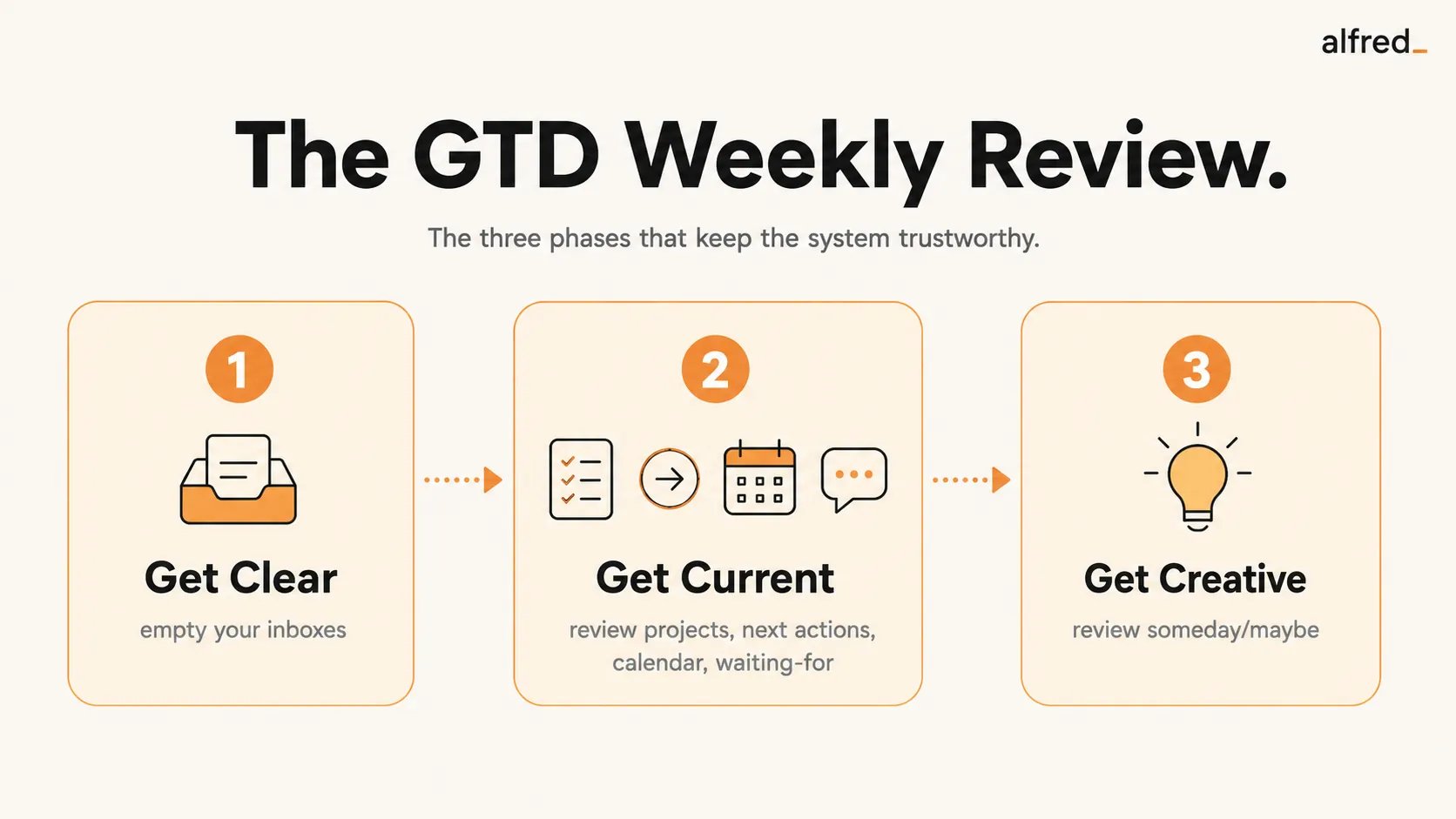
Allen’s Complete Checklist: Three Phases
Allen structures the Weekly Review into three sequential phases. Each has specific sub-steps from the official GTD Weekly Review document.
1. Get Clear
The goal: empty every collection point. Nothing is left in an inbox (digital or physical) at the end of this phase.
- Collect all loose papers and physical materials into your inbox
- Process all notes: meeting notes, journal entries, scraps written during the week
- Empty all inboxes (digital and physical) by processing to zero
2. Get Current
The goal: bring every list up to date so the system reflects current reality.
- Review past calendar in detail: any unresolved items, follow-ups, reference data from last week?
- Review upcoming calendar (next 1–4 weeks): any preparation items needed?
- Review all project lists: are completion statuses current? Does each project have a next action?
- Review Waiting For list and follow up on anything that’s been waiting too long
- Review Someday/Maybe list and activate any items that are now relevant
3. Get Creative
The goal: look beyond the current horizon. Check alignment with longer-term goals and capture anything new.
- Review higher horizons: goals, values, purpose. Are current projects aligned with where you want to go?
- Brainstorm: any new projects or commitments worth capturing?
- Capture anything triggered: new ideas, emerging concerns, latent commitments
3 phases
Get Clear, Get Current, Get Creative: Allen's three-phase structure for the GTD Weekly Review
David Allen, Getting Things Done (Penguin, 2001)The Mind Sweep
The mind sweep is GTD’s technique for emptying psychic RAM in a single session. You write down, without editing or judging, every item that has your attention: projects, concerns, errands, creative ideas, personal commitments, nagging thoughts, things you’ve been meaning to do, things you’ve been avoiding.
The goal is to empty working memory completely. A thorough first mind sweep, for someone who has never done one, commonly produces a hundred or more items. This is often shocking. The mind has been silently carrying that weight without the person’s awareness.
After the first mind sweep, subsequent sweeps are shorter because the system has captured the major inventory. The weekly mind sweep during the Get Creative phase typically produces 5–20 items: the new things that arrived during the week and haven’t yet been fully processed.
100+ items
What a thorough first GTD mind sweep commonly surfaces: the inventory of open loops in working memory that most people have been silently carrying
David Allen, Getting Things Done (Penguin, 2001)How Long It Takes
Allen’s full Weekly Review, done properly, typically takes 1 to 3 hours. This is why people resist it. An hour to three hours is a significant block of time for a weekly ritual. The investment seems disproportionate to the output.
Allen’s counter: the investment compounds over time. A system that is consistently maintained produces a week of reduced cognitive noise, fewer dropped commitments, faster morning planning, and the specific psychological relief of knowing that nothing important is slipping through. Quantified across a full year, the hours invested in weekly reviews are smaller than the hours lost to anxiety, re-planning, and dropped balls in a system without maintenance.
The other counter: the review gets faster with practice. The first several reviews are slow because the system is being built. Once the system reflects reality and the review is primarily maintenance, experienced GTD practitioners complete thorough reviews in 60–90 minutes.
1–3 hours
Time Allen's full Weekly Review typically takes, an investment that compounds invisibly over weeks into a consistently trustworthy system
David Allen, Getting Things Done (Penguin, 2001)Adaptations: Newport and Hyatt
Allen’s full checklist is not the only approach. Two prominent practitioners have developed shorter, adapted versions that sacrifice completeness for sustainability.
Cal Newport’s Weekly Plan
Newport’s adaptation is shorter (approximately 30 minutes) and forward-looking rather than checklist-driven. Where Allen’s review is primarily retrospective (processing last week) and systemic (updating every list), Newport’s version is primarily narrative and prospective.
Newport assigns every weekday a broad theme or task type for the coming week. He reviews all commitments to check for over-scheduling and integration with his time-blocking practice. The review is integrated directly with building next week’s time blocks. The outcome is a populated calendar, not just an updated system.
Newport’s version is less thorough than Allen’s but more connected to execution. The tradeoff: it may miss system-maintenance issues that Allen’s checklist catches.
Michael Hyatt’s Ideal Week
Hyatt introduced the “ideal week” concept, a template describing what a perfectly structured week looks like at the highest level, which is then reviewed and adapted against the actual upcoming week. The ideal week is a normative standard; each week’s review measures the coming week against that standard.
Hyatt’s Full Focus Planner builds this weekly review into a physical artifact, giving the ritual a dedicated physical space. The physical object creates a context shift: the act of opening the planner signals that you are in review mode, not execution mode.
The Failure Mode: System Decay
When the Weekly Review is skipped consistently, the GTD system decays. Tasks go stale. New commitments pile up without being captured. The Waiting For list accumulates items that were never followed up. The Someday/Maybe list fills with things that either should be active projects or should be deleted.
The decayed system is worse than no system. A pile of tasks that no longer reflects reality generates the same anxiety as an empty list (you can’t trust it) but without the benefit of simplicity. You now have a complex system that doesn’t work, plus the overhead of maintaining it.
Allen’s specific diagnosis: skipping the review means you’re “doing a weekly review all the time but never really doing it.” The open loops stay open. The mental inventory keeps accumulating. The monkey stays on your back, not because the system failed but because the maintenance ritual was abandoned.
Why “Get Clear” Is the Part That Breaks
Look at what makes the review a one-to-three-hour wall: the Get Clear phase. Empty every inbox, process every note, get to zero. For most people that single step is the bulk of the time and nearly all of the dread, because a week of unprocessed email is a mountain by Friday. When the review gets skipped, it is usually because the inbox got too big to face. The maintenance ritual decays at exactly the point where the highest-volume source of open loops piles up.
alfred_ keeps that mountain from forming. By triaging the inbox continuously, clarifying what needs action versus what is noise, and handling routine replies as they arrive, it does the Get Clear work across the week instead of dumping it on your Friday. The review you sit down to is then mostly Get Current and Get Creative, the genuinely reflective parts, on a system that is already close to clear. The ritual survives because the step that used to break it is no longer yours to grind through alone.