

It is the smallest rule in all of productivity, and one of the most misused. If something takes less than two minutes, do it now. Stated like that, it sounds like permission to react to everything the moment it lands, and that is exactly how most people break it, shredding their focus into a day of tiny immediate responses. David Allen meant something far more specific and far more disciplined. Here is the exact rule, the precise context it was built for, and the failure mode that turns this productivity booster into sophisticated procrastination.
The Exact Formulation
The Two-Minute Rule appears in David Allen’s Getting Things Done (2001), in the Clarify stage of the GTD workflow: the step where you process each captured item and decide what it means and what to do about it.
“If an action will take less than two minutes, it should be done at the moment it’s defined.”
David Allen, Getting Things Done (2001)
Allen’s reasoning:
“The rationale for the two-minute rule is that it’s more or less the point where it starts taking longer to store and track an item than to deal with it the first time it’s in your hands.”
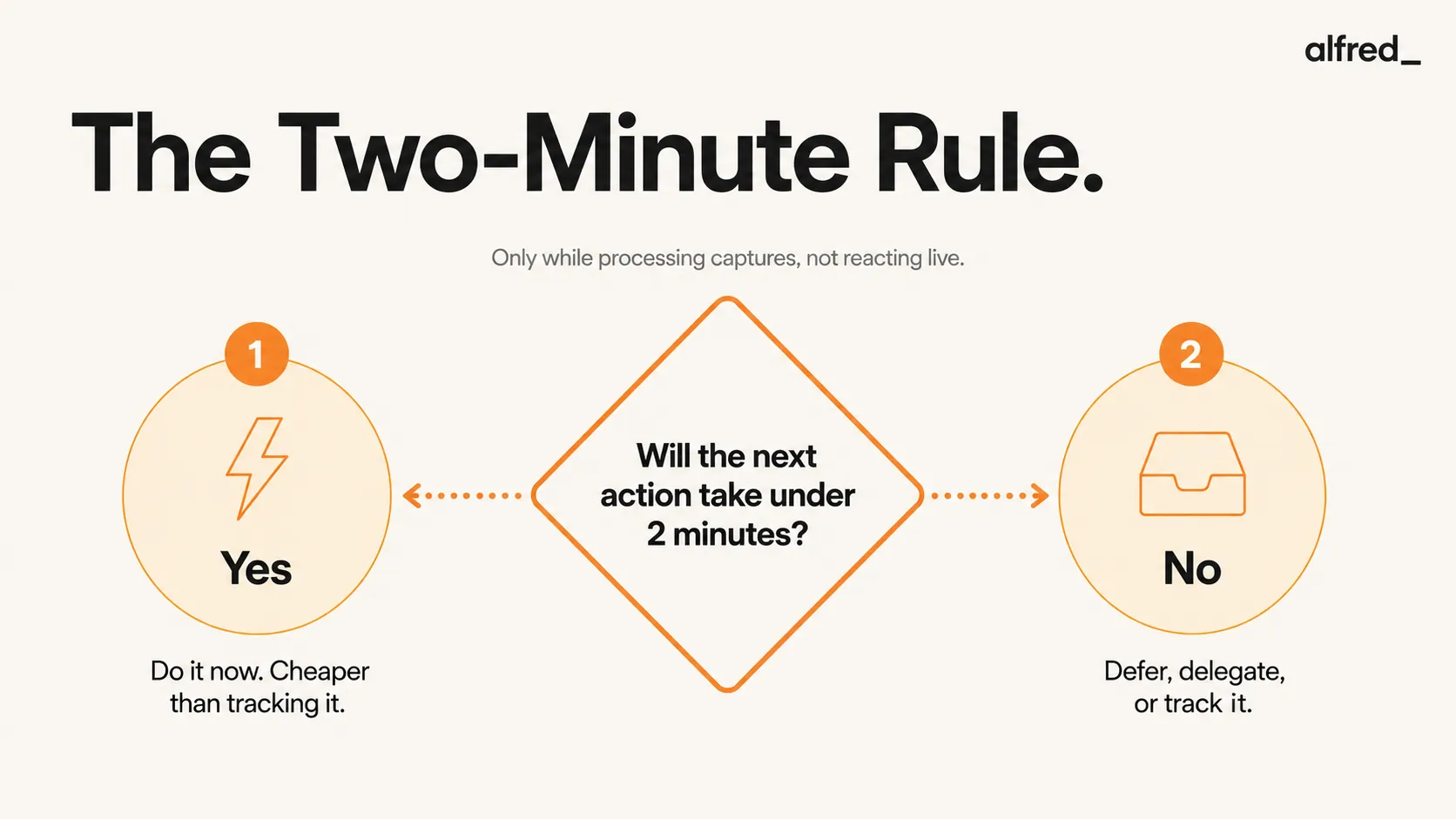
The rule is a decision heuristic, not a philosophy. It operates at a specific step in a specific workflow: when you are processing captured items, if the next action requires less than two minutes, execute it immediately rather than adding it to a list for later.
Why Two Minutes
Allen chose two minutes as an empirical approximation of the crossover point: the moment where the overhead of the GTD organizational system (writing the task down, placing it on a list, reviewing it in a weekly review, deciding to act on it, and then acting on it) equals or exceeds the time the task itself takes.
The math: if writing a task into your system, reviewing it at your weekly review, finding it later, re-reading it, re-deciding to do it, and then doing it takes five minutes of cumulative system interaction (and the task itself takes two minutes), you are spending 250% overhead to manage a task that should just be done.
Allen acknowledges the threshold isn’t universally two minutes. The right number depends on your system and context. He suggests raising the threshold to five minutes if you are in a dedicated processing session with no other obligations. He recommends applying it strictly at two minutes in most normal contexts because the tendency to defer is strong and the threshold prevents rationalized avoidance.
< 2 minutes
the threshold below which GTD's system overhead (capture, organize, review, decide, act) costs more time than the task itself
David Allen, Getting Things Done, 2001The Behavioral Problems It Solves
The Two-Minute Rule addresses three specific behavioral failure modes:
1. Task avoidance through “I’ll handle it later”
Small tasks are easiest to defer precisely because they don’t feel urgent. Writing a reply, confirming a meeting, forwarding a document: none of these feel pressing enough to do right now, so they get deferred. The Two-Minute Rule makes deferral more cognitively expensive than action: if you add the task to a system, you’ll encounter it again in your weekly review, re-read it, re-decide to defer it, and eventually do the two minutes of work you could have done immediately. Deferring a two-minute task often multiplies its total system cost by 3–5x.
2. Psychic weight from accumulated small tasks
Allen’s theory of “psychic RAM” (the cognitive overhead of open loops maintained in working memory) applies as much to small tasks as to major projects. “Reply to John’s message” or “approve this invoice” each generates a low-level background demand on attention disproportionate to its actual size. Clearing sub-two-minute tasks immediately keeps them from entering the open-loop pool at all. They never become psychic overhead because they never remain incomplete.
3. Over-systematizing small work
Some practitioners build elaborate organizational systems that add more overhead than the tasks they manage. For sub-two-minute work, the most efficient system is no system at all: just doing it. The Two-Minute Rule is a release valve that prevents the GTD infrastructure from being applied to work that doesn’t need it.
The Critical Context: Processing Sessions, Not Reactive Response
This is the most commonly misunderstood aspect of the rule. Allen designed it specifically for processing contexts: dedicated sessions where you are clearing your inbox, reviewing captured items, or going through your collection points. It was not designed for reactive use during work.
The correct context: you sit down to process your email inbox. For each message, you ask “what is the next action?” If the answer is something you can do in under two minutes, you do it immediately and move to the next message. This clears an enormous amount of email quickly without creating a growing backlog of tiny tracked tasks.
The incorrect context: you are doing deep work on an important project when a Slack message arrives. Applying the Two-Minute Rule to justify immediate response means you have broken your focus session to handle a two-minute task, generating attention residue that impairs the work that follows. Cal Newport identifies exactly this misapplication as a productivity trap.
The Failure Mode: Sophisticated Procrastination
The Two-Minute Rule can function as a sophisticated procrastination tool when misapplied. Practitioners who invoke it to justify immediate action on every incoming message, request, or email throughout the workday are using it outside its intended context, trading focused work for a series of two-minute reactive responses.
The failure pattern looks like: email arrives → “this will take less than two minutes” → reply immediately → email arrives → repeat. The result is a day spent in reactive two-minute loops with no time for the deep work that actually requires extended focus.
Allen’s original design prevents this by placing the rule inside a designated processing session (a bounded time block for clearing communications), rather than as a real-time filter on all incoming work. The two-minute rule applied during a 30-minute email processing block is radically different from the two-minute rule applied throughout the entire workday.
Applied to Email Specifically
Allen applies the rule explicitly to email processing in Getting Things Done. When processing your inbox during a designated session:
- Short confirmation emails → reply immediately
- One-line questions → answer immediately
- “FYI” messages requiring acknowledgment → acknowledge immediately
- Quick approvals → approve immediately
- Messages requiring research, thought, or coordination → organize for later action
This is why inbox-zero practitioners who apply the rule effectively tend to spend less total time on email: not because they respond less, but because they batch processing and execute all sub-two-minute items in a single session rather than letting them accumulate and re-encounter them repeatedly.
When the Two-Minute Tasks Are Someone Else’s Job
The rule’s whole premise is that a sub-two-minute task is cheaper to do than to track. True, but it quietly assumes you are the one who has to do it. Most of those tasks live in your inbox: the quick confirmation, the one-line answer, the FYI acknowledgment, the fast approval. Even handled well in a batched session, that is still your two minutes, dozens of times a week, on work that requires almost none of your judgment. And the recurring ones, the same small request every day, are pure overhead the rule can only make slightly less painful.
alfred_ is where those tasks stop being yours. It triages the inbox and drafts the routine replies, so the confirmations and one-line answers are already prepared for a glance-and-send, and the recurring small requests are handled as a pattern rather than re-done by hand each time. Allen’s own guidance points here: for tasks that keep recurring, the real fix is a system that prevents them from needing your attention at all. The two-minute rule clears the small stuff efficiently. alfred_ keeps most of the small stuff from reaching your two minutes in the first place.