


The Original Experiment
Martin Seligman and Steven Maier published “Failure to escape traumatic shock” in the Journal of Experimental Psychology in 1967 (74, 1–9). The experiment used three groups of dogs. The first group received escapable shocks, where the dog could terminate the shock by pressing a lever. The second group received inescapable shocks, identical in intensity and timing to the first group but with a lever that had no effect. The third group received no shocks.
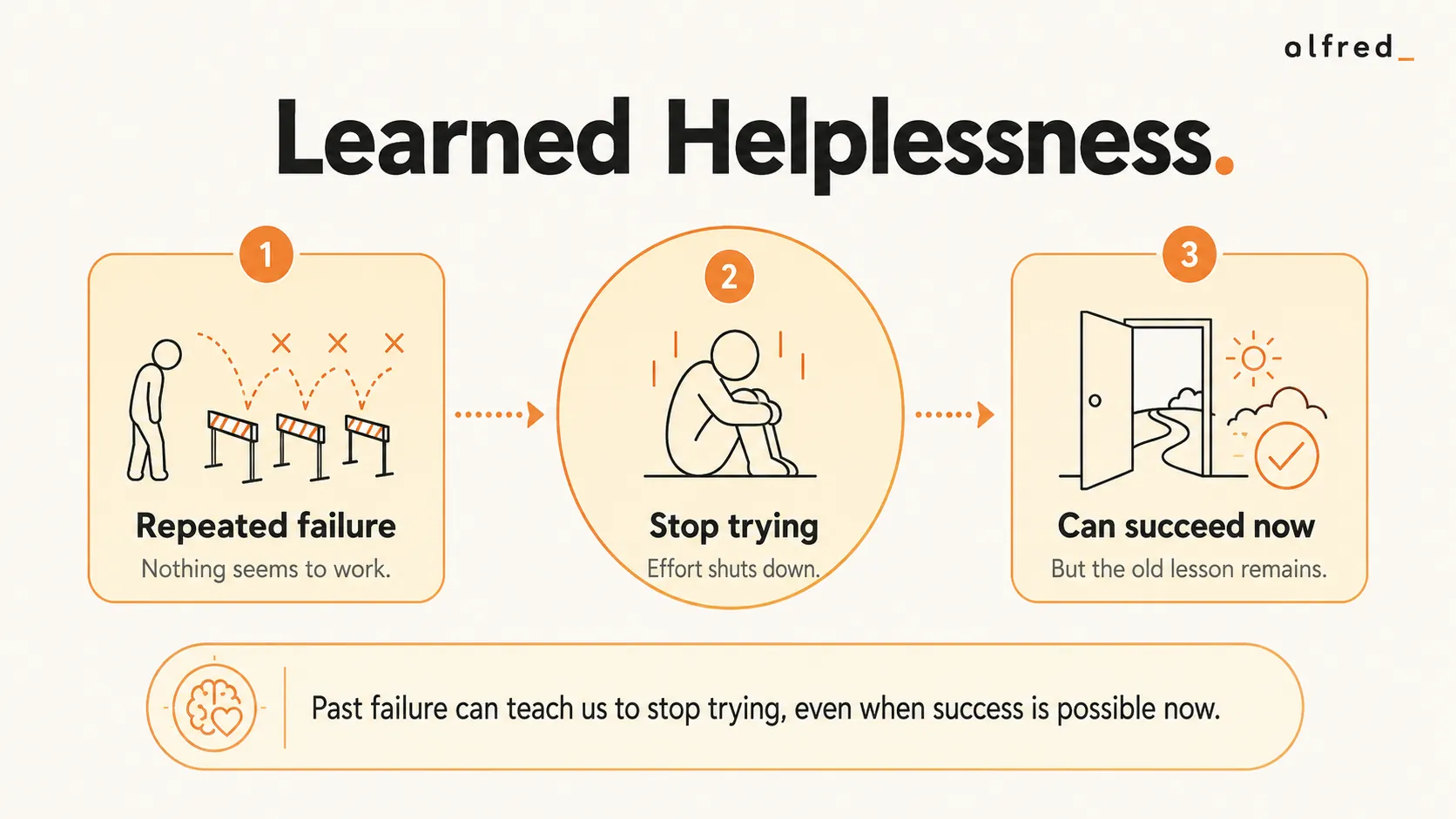
All dogs were then tested in a shuttle box where they could escape a shock by jumping a low barrier. Dogs from the first group (escapable shocks) and the control group (no shocks) quickly learned to jump the barrier. But approximately two-thirds of the dogs from the inescapable shock group showed a dramatically different pattern: they lay down passively, whimpered, and accepted the shocks rather than attempting escape.
2/3 of dogs
Approximately two-thirds of dogs exposed to inescapable shocks in the first phase failed to escape in the second phase where escape was possible, passively accepting the shock despite the visible escape route. Control dogs escaped nearly immediately.
Seligman, M.E.P. & Maier, S.F. (1967). Journal of Experimental Psychology, 74, 1–9.The interpretation was that the inescapable shock group had learned, during the first phase, that their responses had no effect on the outcomes. This learned expectation of uncontrollability transferred to the new situation, where it was no longer accurate. The dogs did not try to escape because they had learned that trying was useless, and this learning persisted even when the contingency changed.
The Human Extension: Attribution Theory
Seligman, working with Lyn Abramson and John Teasdale, extended learned helplessness to human depression and achievement settings in “Learned helplessness in humans: Critique and reformulation” (Journal of Abnormal Psychology, 1978, 87(1), 49–74). The reformulated model added attribution dimensions to explain why some people show more pervasive helplessness than others.
Three attributional dimensions determine how widespread learned helplessness becomes after failure:
- Internal vs. external. Attributing failure to internal causes (“I’m not capable”) produces helplessness about future performance; external attribution (“the system was broken”) preserves efficacy.
- Stable vs. unstable. Attributing failure to stable causes (“I never perform well under pressure”) predicts persistent helplessness; unstable attribution (“I was poorly prepared this time”) predicts recovery.
- Global vs. specific. Attributing failure to global causes (“I’m not good at this kind of work”) generalizes helplessness across domains; specific attribution (“I didn’t know this particular content area”) contains it to the failure context.
Organizational Applications
- Environments that produce helplessness. Organizations can inadvertently create learned helplessness conditions through repeated feedback that is disconnected from performance (arbitrary reward and punishment), decisions that override employee input without explanation, and failure cultures where visible mistakes are disproportionately consequential. Each of these teaches employees that their responses, including effort, initiative, and quality, are not reliably connected to outcomes, which reduces the motivation to try.
- Recovery through controllability restoration. The cure for learned helplessness is not encouragement but demonstrated controllability: experiences where the person’s actions produce predictable, positive outcomes. This is why “just try harder” fails as a helplessness intervention: it targets motivation without addressing the underlying belief about response-outcome contingency. Effective recovery requires engineering tasks where effort reliably produces observable results, starting with small-scope, high-controllability assignments.
- Feedback attribution framing. How failure is framed matters for whether it generalizes into helplessness or remains task-specific. Feedback that attributes failure to specific, unstable, external factors (“the brief was incomplete, let’s fix that and try again”) contains the helplessness response. Feedback that attributes failure to stable, internal, global factors (“this isn’t your strength”) generalizes it. The attribution dimensions from Abramson et al. (1978) are a useful framework for constructing feedback that preserves agency.