


You are in a meeting, half-listening, because some part of your mind is still holding the email you have not answered, the decision you have not made, and the three things you promised someone last week. That low background hum is not a character flaw. It is your brain doing the job David Allen says it was never built for: storing open loops instead of having ideas. Getting Things Done is the system designed to move that weight out of your head and into something you can actually trust. Here is the full method, the keystone step almost everyone skips, and the specific reason it tends to fall apart at the executive level.
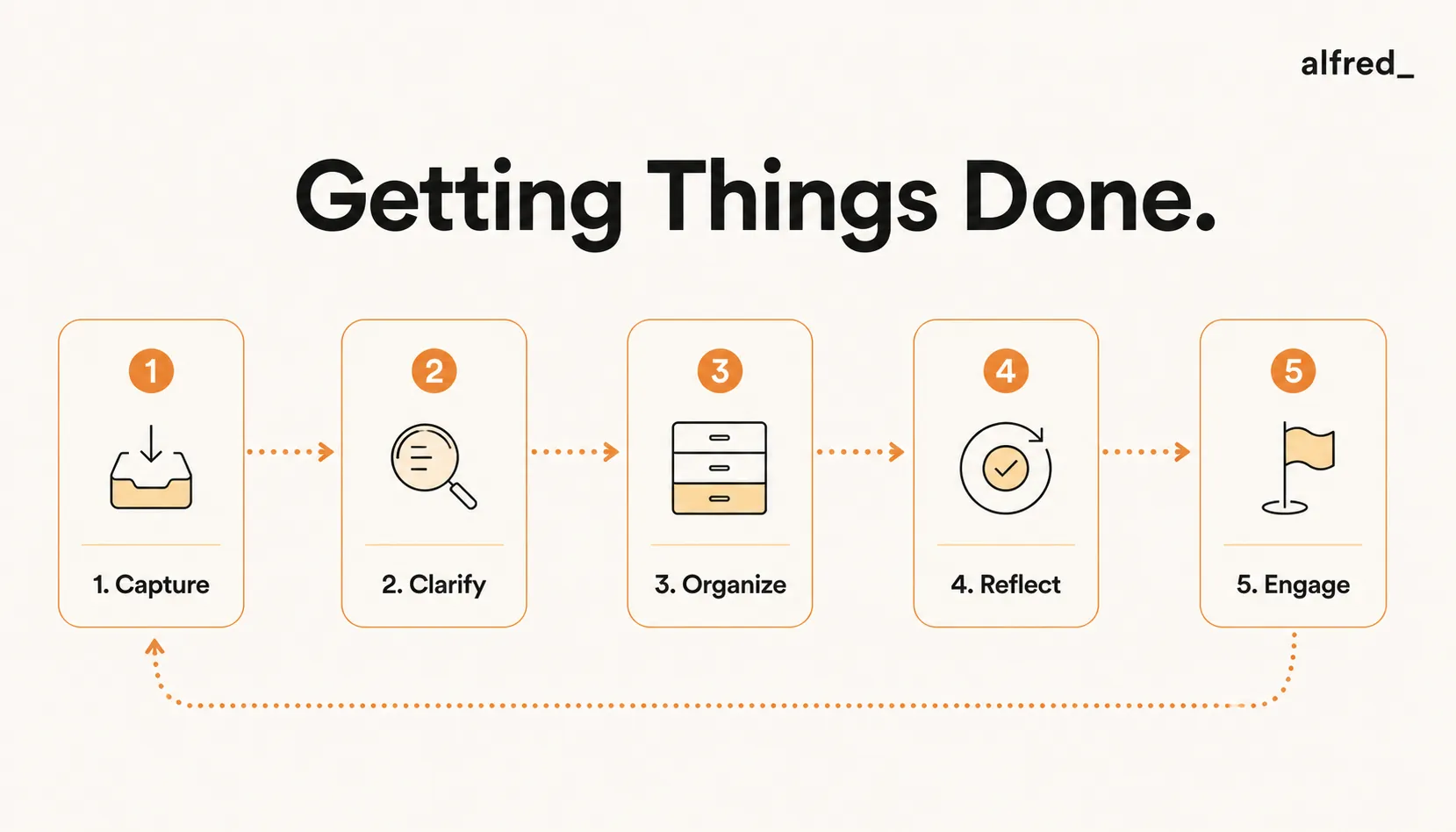
The Central Insight: Psychic RAM
David Allen’s central psychological claim, from Getting Things Done (2001):
“Your mind is for having ideas, not holding them.”
The mechanism Allen calls “psychic RAM”: every open loop (an unresolved task, an unwritten intention, an unprocessed commitment) occupies working memory. The brain, having no reliable sense of past or future in this system, treats everything it holds as “now.” Allen writes:
“Ask any psychologist how much of a sense of past and future that part of your psyche has (the part storing the list you dumped): zero. It’s all present tense in there.”
This creates a cognitive tax Allen describes as “psychic weight.” Every uncaptured commitment (the email you meant to send, the decision you haven’t made, the project you know you need to start) runs as a background process in working memory. It consumes attention whether or not you’re actively thinking about it.
Allen’s insight is that the solution is not better memory or stronger discipline. It’s extraction. Move everything out of your head and into a trusted external system. Once the system is trusted, the brain stops trying to hold and remind, and the psychic weight lifts.
The Five Steps: Allen’s Exact Language
- Capture: Write, record, or gather any and everything that has your attention into a collection tool: inbox, notepad, digital capture device. The goal is complete extraction: nothing left in psychic RAM that isn’t captured somewhere.
- Clarify: Process what each item means: Is it actionable? If yes, what is the next action? Does it belong to a project? If not actionable, it’s either reference material, someday/maybe, or trash. Nothing stays in the inbox unclarified.
- Organize: Park reminders in appropriate places: project lists, calendar, reference files, someday/maybe list, waiting-for list. Each category has a home. Nothing floats.
- Reflect: Update and review all pertinent system contents to regain control and focus. The Weekly Review, Allen’s keystone habit, lives here. Without regular reflection, the trusted system degrades into an anxiety-producing list of stale items.
- Engage: Use your trusted system to make action decisions with confidence and clarity. The preceding four steps exist to make this one frictionless: when you open your system to decide what to do, the decision is already made.
5 steps
Capture, Clarify, Organize, Reflect, Engage: Allen's complete workflow for a trusted external productivity system
David Allen, Getting Things Done (revised edition, 2015)“Next Physical Action”: Why the Exact Phrase Matters
The most important operational concept in GTD is not the inbox or the filing system. It’s “next physical action.” Allen is deliberate about the language. Not “next step.” Not “action item.” The next physical action.
Allen’s argument: most to-do lists fail because they capture outcomes or topics, not actions. “Bank” is not an action. “Fix the shower” is not an action. “Prepare the Henderson report” is not an action. Each of these forces the brain to re-encounter the decision cost every time it sees the list item: what specifically needs to happen? Who needs to be called? Where does this start?
The next physical action is the specific, observable, concrete thing a body does next: “Call the plumber at (555) 208-3401 to schedule a repair estimate.” “Open the Henderson folder and review Q3 numbers before drafting the executive summary.”
The specificity collapses ambiguity. When the item is concrete, execution is immediate. When the item is vague, execution requires a re-decision every time, and re-decision is exactly the kind of friction that causes avoidance and procrastination.
The clarifying question Allen recommends at every step of processing: “What is the next physical action required to move this forward?” If you can’t answer it specifically, the item isn’t ready to be on your action list.
The Weekly Review: The Keystone That Most People Skip
Allen’s Weekly Review is the most important and most-skipped component of GTD. Without it, the trusted system degrades within weeks. The review has three phases:
Get Clear
Process all physical and digital inboxes. Capture loose papers and stray notes. Empty everything into the processing workflow.
Get Current
Review past calendar for unresolved items and follow-ups. Review upcoming calendar. Review all project lists for completion status and next actions. Review waiting-for list. Review someday/maybe list.
Get Creative
Review higher-level commitments: goals, values, purpose. Brainstorm: any new projects or commitments worth capturing?
“If you’re not really doing a weekly review, you’re doing a weekly review all the time but never really doing it. You’re constantly thinking about what you should be thinking about and can’t get that monkey off your back until you actually sit down and finish the thinking.”
The structural problem is that the Weekly Review requires stepping outside execution mode into evaluation mode. Most professionals spend their workweek “in the river,” reacting to inputs. The Weekly Review requires climbing the bank and looking at the river from above. That shift is cognitively uncomfortable and doesn’t feel productive even when it is.
When the review is skipped consistently, the trusted system degrades into an anxiety-producing list of stale items, which is actively worse than no system, because it generates guilt without providing clarity.
The Mind Sweep: What a Full Capture Actually Looks Like
Allen’s “mind sweep” is the technique for capturing every open loop in a single session. You write down, without editing, every item that has your attention: projects, concerns, errands, creative ideas, personal commitments, nagging thoughts, things you should do, things you’ve been avoiding, things other people expect from you.
The goal is to empty psychic RAM completely. Allen’s estimate: a thorough first mind sweep produces 100–200 items. Most practitioners are surprised. The list is longer than they expected, and the surprise itself is informative. Everything on that list was running as a background process.
The mind sweep is not a task list. It’s a cognitive extraction. Items on it range from “buy milk” to “decide on the company’s five-year strategy,” all treated equally at this stage, because the brain does not prioritize before capturing. Everything gets out first; processing happens next.
100-200 items
what a thorough first mind sweep typically produces: the full inventory of open loops running as background processes in working memory
David Allen, Getting Things Done (2001)The Surprising Detail: Allen’s Martial Arts Background
Allen was a martial arts practitioner and spent years studying karate. The concept of “mind like water” (the ideal state of GTD, where your mind responds to inputs with appropriate force and then returns to calm) is explicitly borrowed from martial arts philosophy, not productivity science.
The metaphor is precise: if you throw a pebble into still water, the ripples are proportional to the pebble. The water doesn’t overreact or underreact. A mind operating through a trusted GTD system responds to inputs proportionally: it handles what needs handling, releases what doesn’t, and returns to clarity. A mind cluttered with open loops is like water that never settles: every new input creates chaos in a system that’s already disturbed.
Where GTD Breaks Down for Executives Specifically
The pattern is consistent: GTD tends to take hold among individual contributors but lapses among senior executives within a few months. That’s not a discipline failure. It’s a structural mismatch.
GTD was designed for individual-contributor productivity. Its power is in converting ambiguous commitments into concrete next physical actions. But for executives whose effectiveness multiplies through other people, the “next physical action” model breaks down. The next action is often “think strategically” or “coach the team” or “decide the direction,” all of which resist the concrete-action framework.
“Think strategically about the market positioning” cannot be captured as a next physical action in the way Allen intends. It is cognitively complex, context-dependent, and cannot be completed by a single physical action. It requires a protected block of uninterrupted thinking time, which is a scheduling problem, not a capture problem.
A second structural problem: GTD’s complexity is a failure point. The system has enough moving parts (multiple lists, contexts, the weekly review, the someday/maybe list, the waiting-for list) that most practitioners implement partial versions. The partial version is less effective than the full version, and the gap between “I’m doing GTD” and “I’m sustaining the full system” is large.
Structural mismatch
GTD's 'next physical action' model was built for individual-contributor work; executive work (thinking, coaching, deciding) often can't be reduced to a single concrete action, which is why the system tends to lapse at the leadership level
alfred_ analysisWhat Executives Can Take From GTD Without the Full System
Even if the full GTD system isn’t sustainable at the executive level, several of its components provide outsized value when adopted independently.
The mind sweep, even done monthly rather than weekly, dramatically reduces the psychic weight of uncaptured commitments. The “next physical action” question applied at every meeting ensures that discussions produce concrete outcomes rather than vague agreements. The weekly review, even in abbreviated form, creates the clarity between execution mode and evaluation mode that most executives desperately need.
The core insight, “your mind is for having ideas, not holding them,” applies unconditionally regardless of role. The executive who hasn’t externalized their commitments is carrying a cognitive load that degrades the quality of every decision they make. That cost is invisible until the system is trusted enough to be released.
Where Most of the Open Loops Actually Come From
Notice where GTD’s hardest work concentrates. Capture, Clarify, and Organize are mostly applied to one source above all others: the inbox. Every unprocessed email is an open loop generating psychic weight, and the reason the system decays is that email arrives faster than most people can clarify it into next actions. The trusted system stops being trusted the moment the inbox outruns the processing.
This is the part alfred_ takes off your hands. It reads what arrives, clarifies it into what actually needs a decision versus what is reference or noise, drafts the routine replies, and tracks what you are waiting on, which is Capture, Clarify, and Organize running continuously on the highest-volume source of loops you have. You still do the thinking GTD reserves for you: the strategic blocks, the judgment, the engage step. But the relentless inbox triage that quietly breaks the system between weekly reviews is handled, so the system you open is actually current and actually trustworthy, which is the entire point Allen was making.