


The 1908 Experiment
Robert Yerkes and John Dodson published “The relation of strength of stimulus to rapidity of habit-formation” in the Journal of Comparative Neurology and Psychology in 1908 (18, 459–482). The experiment trained mice to choose the lighter of two chambers in a brightness discrimination task, using electric shocks of varying intensities to incentivize correct choices.
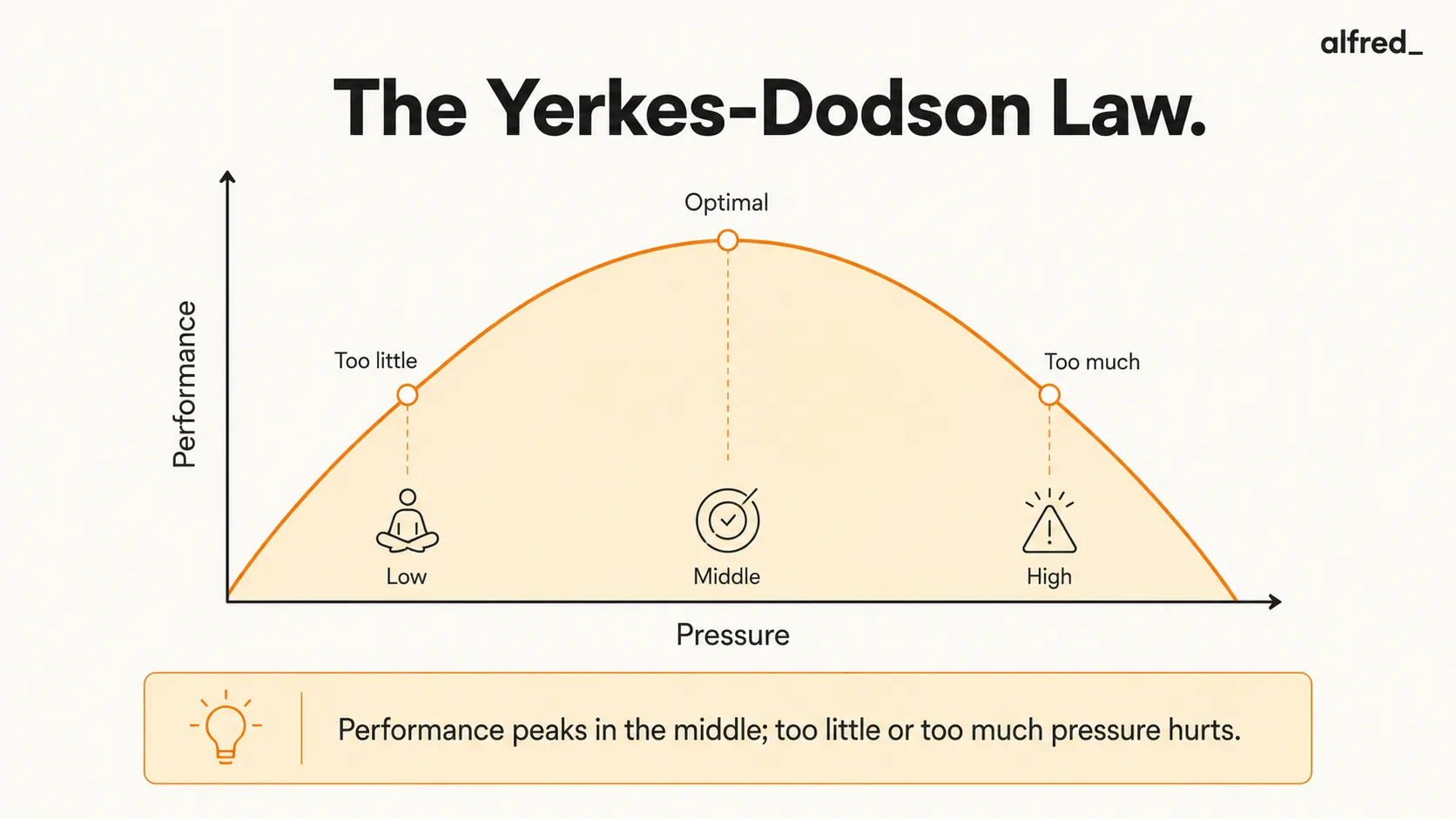
The results showed that intermediate shock levels produced faster habit formation (learning) than either very low or very high shocks. Very low intensity shocks produced insufficient motivation; very high intensity shocks produced interference: the animals were too agitated to learn effectively. The inverted-U relationship between stimulus intensity (as a proxy for arousal) and learning speed was the primary finding.
Task complexity matters
The secondary finding from Yerkes and Dodson's 1908 experiment is the most practically important: the optimal arousal level was lower for complex discrimination tasks than for simple ones. High arousal facilitates simple tasks; it interferes with complex ones requiring nuanced judgment.
Yerkes, R.M. & Dodson, J.D. (1908). Journal of Comparative Neurology and Psychology, 18, 459–482.The secondary finding, that optimal arousal was lower for more difficult discrimination tasks, is now the most cited aspect of the law. The original paper used task complexity operationally: easier tasks (coarser brightness distinctions) tolerated higher arousal before performance declined; harder tasks (finer distinctions) required lower arousal for peak performance.
The term “Yerkes-Dodson law” and its application to human performance, stress, and working conditions came much later. The original paper was a behavioral experiment on mice that did not explicitly invoke “arousal” in the modern sense. The generalization to human performance in organizational and clinical contexts is an extrapolation, though one supported by a substantial body of subsequent research.
Applying the Curve: Simple vs. Complex Work
The task-complexity qualifier is the most practically important feature of the Yerkes-Dodson law. It predicts that the same level of arousal that improves performance on routine tasks will impair performance on complex tasks:
- Routine, well-practiced tasks. For tasks that are simple, well-rehearsed, or require primarily physical output rather than complex judgment (data entry, physical exercise, repetitive workflows), higher arousal tends to improve performance. Deadline pressure on administrative tasks, a competitive environment for a practiced skill, or the urgency of a clear and simple objective often produces better output.
- Complex, novel, or judgment-intensive tasks. For tasks requiring creative problem-solving, strategic thinking, nuanced communication, or integration of multiple variables (developing a product strategy, navigating a difficult conversation, writing an analytical memo), high arousal impairs performance. Prefrontal cortex function, which supports flexible thinking, working memory, and executive control, is particularly sensitive to cortisol and other stress hormones associated with high arousal.
- The cognitive narrowing effect. High arousal narrows attention to the most salient stimuli, an adaptive response to genuine threat but a liability in complex cognitive work where the relevant information may be distributed across multiple signals, not concentrated in the most salient one. High-pressure conditions tend to produce more focused, less flexible thinking: better for executing under fire, worse for diagnosing ambiguous problems.
Professional Implications
- Deadline calibration. The Yerkes-Dodson curve suggests that the right deadline strategy differs by work type. Tight, high-pressure deadlines may improve output on execution tasks but will reduce quality on analytical and creative work. Building buffer before high-stakes, complex deliverables (strategic presentations, important proposals, complex decisions) exploits the lower end of the arousal curve where complex thinking is most effective.
- Chronotype and optimal work scheduling. Personal arousal levels vary across the day in ways that interact with the Yerkes-Dodson law. High-arousal morning periods (for morning chronotypes) may be better matched to complex, judgment-intensive work than to routine administrative tasks. The implication is scheduling complex cognitively demanding work during the period of moderate, natural arousal: not the extreme low (too under-stimulated) or extreme high (too distracted by alertness).
- Pressure and meeting performance. High-stakes meetings (board presentations, difficult client conversations, executive reviews) produce high arousal in participants. This is well above optimal for complex, judgment-dependent performance. Preparation that makes the content more automatic (reducing the cognitive load during the meeting) shifts the task toward the “simpler” end of the complexity spectrum, making higher arousal more manageable.