

The most widely used focus method in the world started as a bet a failing student made with a tomato-shaped kitchen timer. That humble origin is part of why it works: it is almost insultingly simple, twenty-five minutes on, five off, and there is real research showing it holds up. But it is also why so many people misapply it, reaching for a focus timer on exactly the kind of deep, immersive work it is worst suited to. Here is the exact technique, the evidence behind the numbers, and the honest account of when it helps and when it quietly hurts.
The Origin Story
In September 1987, Francesco Cirillo was a first-year university student in Rome, struggling to study for a sociology exam. Unable to maintain concentration, he made himself a direct challenge: could he stay focused for just 10 minutes?
He grabbed the first timer he could find in his kitchen: a tomato-shaped kitchen timer. “Pomodoro” is the Italian word for tomato. That initial experiment evolved through the late 1980s and 1990s as Cirillo developed the method personally, then introduced it to software development teams he mentored. His first clients laughed at the name. Then one team tried it. It worked, and the technique spread virally through software development communities before entering the mainstream productivity conversation.
The surprising detail: Cirillo registered “Pomodoro” as a trademark. There is an official website (pomodorotechnique.com) and an official book, The Pomodoro Technique (2006/2013), which describes the method in considerably more detail than most summaries cover, including guidance on handling interruptions, estimating task counts, and using pomodoros as a planning unit rather than just a focus timer.
The Exact Mechanics
The method is precise in its structure. Every element has a specific role.
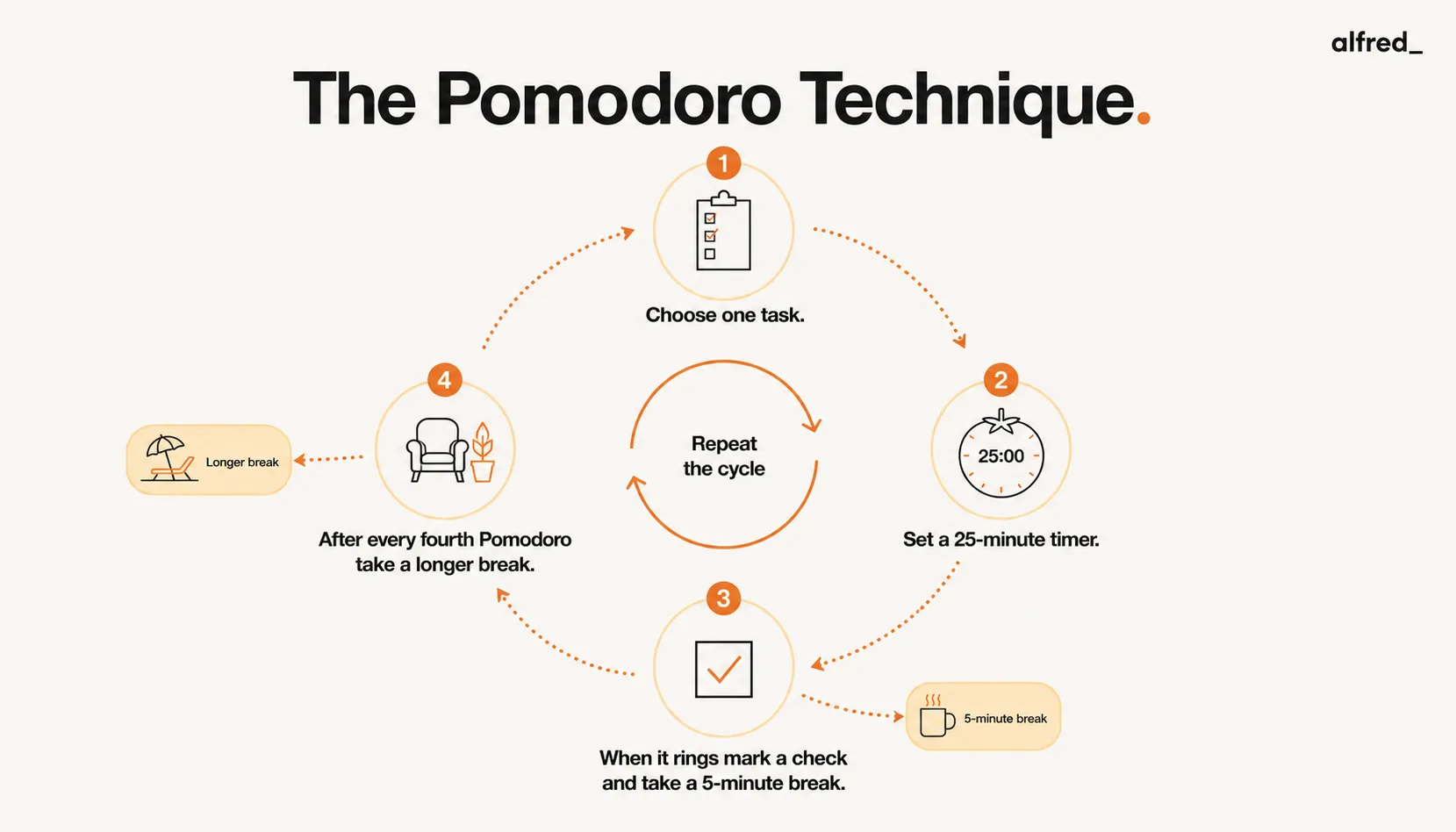
1. Choose a single task
Select one task to work on. The Pomodoro Technique is incompatible with multitasking by design: each interval is assigned to exactly one item.
2. Set the timer for 25 minutes
Work on the task with full focus for 25 minutes. No interruptions: not email, not messages, not “just a quick look” at anything else. If an internal distraction arises, write it down on a notepad and return to work.
3. When the timer rings, put a checkmark on paper
One completed pomodoro = one checkmark. Take a 5-minute break. The checkmark is not incidental: it creates a record and provides a sense of progress.
4. After every 4 pomodoros, take a longer break
After completing 4 consecutive pomodoros, take a 15–30 minute break. This is the recovery cycle that prevents fatigue accumulation across a full workday.
5. Handle interruptions definitively
If interrupted during a pomodoro, you have two options: defer the interruption (inform the interrupter and get back to work) or abandon and restart the pomodoro. A partially completed pomodoro does not count.
The Pomodoro as a Unit of Measurement
The underappreciated dimension of the Pomodoro Technique is its use as a planning unit. One pomodoro is 25 minutes of focused work. Before a project begins, you estimate how many pomodoros it will take. After it’s done, you review how accurate the estimate was.
“This project will take 8 pomodoros” is a fundamentally different planning statement than “this will take a few hours.” The pomodoro unit is concrete, calibratable, and reality-testable. Most professionals systematically underestimate how long tasks take. Kahneman and Tversky documented this as the planning fallacy. Pomodoro-based estimation creates a feedback loop that improves planning accuracy over time.
The technique also makes visible how many pomodoros a day actually produces. Most people who track this are surprised: a day that felt productive might yield only 6–8 pomodoros of actual focused work. The rest (the meetings, the context switching, the email, the interruptions) consumes the remainder. That visibility is itself a productivity intervention.
Why Those Numbers: The Research
Cirillo chose 25 minutes empirically: it was the interval that worked for him as a student. He didn’t derive it from cognitive science; he found it through trial and error. The science has since validated the general logic, if not the specific number.
The brain can maintain optimal focus for roughly 20–45 minutes before fatigue accumulates. The 25-minute interval sits in the middle of this range. A 2025 scoping review in BMC Medical Education examined the Pomodoro Technique’s effects on focus and performance in detail:
2025 Scoping Review Findings:
Pomodoro users showed significantly higher focus scores (8.5 ± 1.2) versus non-Pomodoro controls (6.2 ± 1.5). Performance scores: 82% ± 6% (PT users) vs. 70% ± 8% (controls). Negative correlation between Pomodoro Technique use and fatigue/distraction levels (r = -0.55).
The r = -0.55 correlation between technique use and fatigue/distraction is particularly notable. It suggests the structured break cycle is doing real work in preventing cognitive fatigue, not just the focus intervals.
82%
average performance score for Pomodoro Technique users versus 70% for controls, from a 2025 scoping review measuring focus, performance, and fatigue
BMC Medical Education scoping review on the Pomodoro Technique, 2025Who the Pomodoro Technique Does Not Work For
The Pomodoro Technique is at fundamental odds with flow states. This is not a minor caveat: it is the central limitation of the method.
For creative workers, programmers doing complex problem-solving, writers in deep immersion, and researchers building on accumulated context, the 25-minute timer is an intrusion that destroys value rather than creates it. Flow state (Csikszentmihalyi’s term for complete absorption in a challenging task) typically requires 15–20 minutes just to enter. A 25-minute timer interrupts flow before it can compound.
The technique is optimized for resisting distraction during task execution: it works by making distraction resistance explicit and time-bounded. This is valuable when distraction is the primary problem. But when the primary problem is getting deeply into complex, novel work, the technique’s interruption structure actively impedes the goal.
The technique is also poorly suited for:
- Collaborative work: You cannot tell a colleague to come back in 18 minutes because you’re mid-pomodoro.
- Client-facing roles: Client service is structurally interrupted. The technique assumes control over your environment that these roles don’t have.
- Creative roles with variable rhythm: Some creative states last 90 minutes; others 12. A fixed 25-minute interval doesn’t map to creative rhythm.
- Executive coordination work: Responding, deciding, and influencing in real-time conflicts with 25-minute lockdowns.
25 minutes
one pomodoro: the core work interval Cirillo chose empirically as a university student in 1987, later validated by research showing brain focus peaks at 20-45 minutes
Francesco Cirillo, The Pomodoro Technique (2006/2013)When to Use It and When Not To
The Pomodoro Technique is most effective for:
Work where distraction is the primary obstacle: email processing, administrative tasks, data entry, writing when you know what you want to write but avoid starting, studying defined material, code reviews. Any work where the content is clear and the problem is getting and staying started.
It is least effective for:
Work where depth is the primary requirement: original research, novel problem-solving, creative synthesis, strategic thinking, complex coding. Any work where the quality of output depends on extended, uninterrupted immersion.
A practical heuristic: if you could hand the task to a reasonably skilled substitute and they’d produce similar output, the Pomodoro Technique probably helps. If the task requires your specific accumulated context and your specific depth of engagement, the technique’s interruptions may cost more than they save.
The Pomodoros You Never Get to Run
The technique quietly exposes an uncomfortable number: track your pomodoros honestly and a day that felt full often yields only six or eight intervals of real focused work. The rest is eaten by exactly what the method tells you to shut out, email, interruptions, the context switching between them. The timer protects the twenty-five minutes once you start, but it does nothing about the reason you keep not starting, which is an inbox that will not stop demanding triage.
That is the part alfred_ handles. It works the channel the Pomodoro Technique can only ask you to ignore: triaging email as it arrives, drafting routine replies, and surfacing only what genuinely needs you, so the interruptions that fragment your day into half-pomodoros stop arriving in the first place. The technique gives structure to focus once you are in the chair. alfred_ clears the noise that was keeping you out of it, which is how six pomodoros a day becomes the twelve you always assumed you were getting.