

A productivity method simple enough to explain in fifteen minutes, that a steel magnate paid the equivalent of roughly $540,000 to learn, and that has survived a century without changing a word. It sounds like a tall tale, and parts of it probably are. But the method underneath the legend is real, and it solves the one problem most to-do lists never touch: not what to capture, but what to actually do first when the day starts. Here is the exact six-step system, why the constraint is the whole point, and the three places it quietly fails.
The Origin Story
In 1918, Charles M. Schwab, then president of the Bethlehem Steel Corporation, the largest shipbuilder and second-largest steel producer in the United States and one of the wealthiest men in the world, arranged a meeting with Ivy Lee. Lee was a well-regarded consultant and, crucially, a public relations pioneer rather than a time management theorist.
The exchange, as documented in Scott M. Cutlip’s The Unseen Power: Public Relations: A History (pp. 118–119), went roughly as follows:
The exchange, as documented:
Schwab: “Show me a way to get more things done.”
Lee: “Give me 15 minutes with each of your executives.”
Schwab: “How much will it cost?”
Lee: “Nothing. Unless it works. After three months, you can write me a check for whatever you feel it’s worth to you.”
After three months, Schwab was so satisfied he wrote Lee a check for $25,000, equivalent to roughly $540,000 in 2026 dollars.
A critical note on source authenticity: the earliest traceable reference to this story dates to the 1960s, not 1918. Many sources misdate the meeting to 1905. Cutlip’s history provides the 1918 date, but the exact dollar amount and dialogue have been embellished over decades of retelling. Treat this as narrative tradition with a documented origin, not a verbatim transcript.
The Surprising Detail: Lee Was a PR Man, Not a Productivity Guru
Ivy Lee’s primary historical legacy has nothing to do with task lists. He invented modern public relations as a professional discipline, managing communications for Standard Oil and handling crisis management for robber barons at a time when corporations faced intense public scrutiny. He pioneered the idea that corporations should communicate proactively with the press rather than stonewalling.
The Ivy Lee Method was a side product, almost an offhand consulting tip, from a man whose main work was industrial crisis communications. That this incidental advice became one of the most cited productivity frameworks in history says something both about the power of the method and about the way origin stories travel.
The Exact Six-Step Method
The method Lee taught to Schwab’s executives is not complicated. Its power is in its constraints, not its complexity.
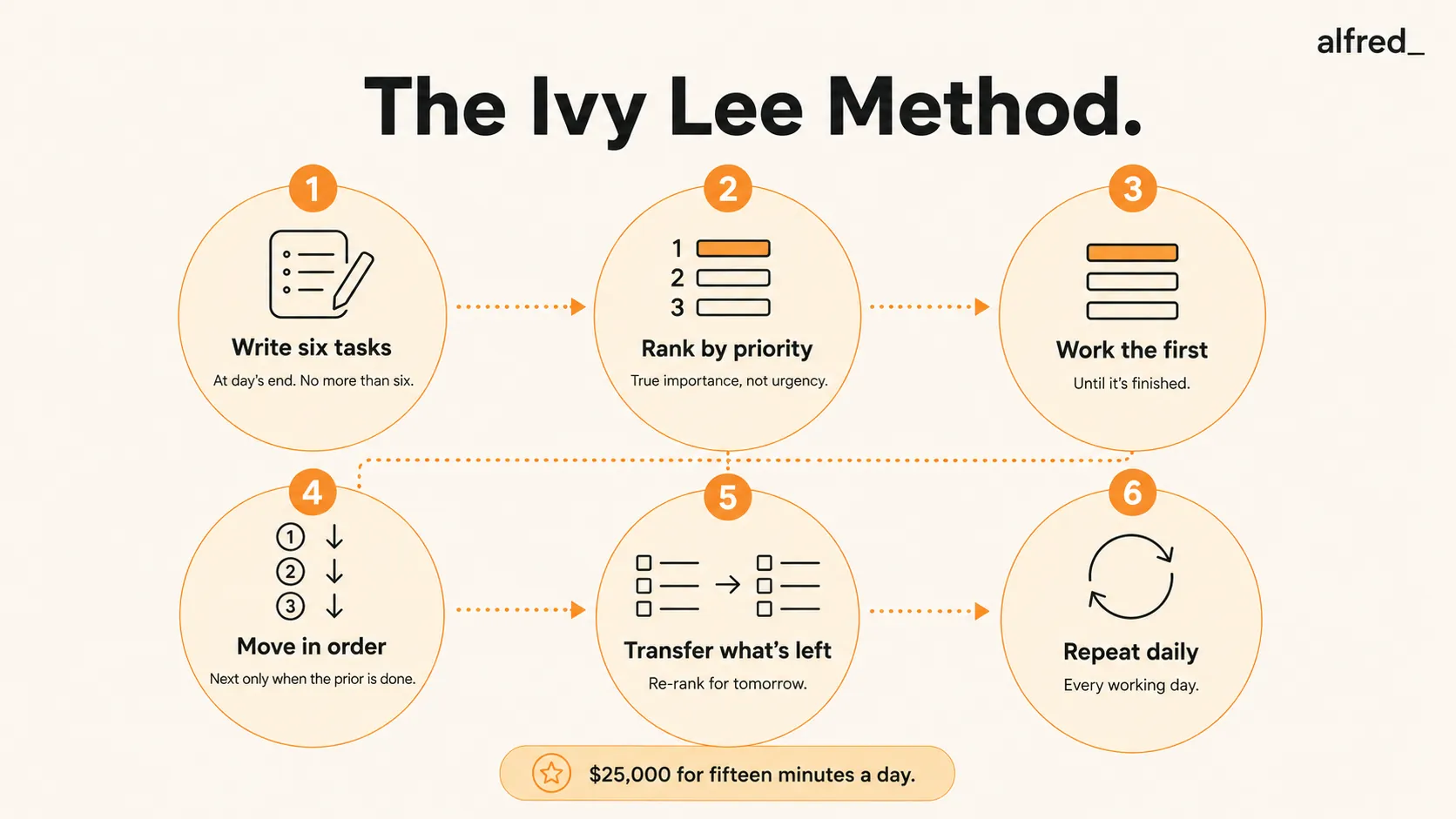
- Write down six tasks: At the end of each workday, write down the six most important tasks you need to accomplish tomorrow. No more than six.
- Rank them in order of true priority: Rank those six tasks in order of genuine importance: not urgency, not ease, not the one your boss last mentioned. True priority.
- Work only on the first task until it is finished: When you begin work the next day, focus only on the first task. Work until it is finished before moving to the second.
- Move through the list in order: Approach the rest of your list in the same way. Move to the next task only when the prior one is complete.
- Transfer unfinished items: At the end of the day, move any unfinished items to a new list of six for the following day, re-ranked by current priority.
- Repeat every working day: The ritual is daily. Not weekly, not on high-stakes days. Every working day, the same fifteen-minute planning habit at day’s end.
Why “Only Six” Is the Constraint That Makes It Work
Lee’s core premise was not that you literally cannot do more than six things. It’s that if you cannot identify the six most important things, you haven’t done the cognitive work of prioritization. The constraint forces the decision.
Most people operating with unlimited to-do lists suffer from decision paralysis at the moment of execution. The list is there, but where to begin? The brain evaluates, re-evaluates, and skips to the easiest item rather than the most important. The unlimited list optimizes for capture; it does nothing for execution.
The six-task limit solves this by moving the prioritization decision to the previous evening, when the pressure is lower, the day’s chaos has settled, and you can think clearly about what actually matters. When you wake up the next morning, the decision is already made. Execution is the only remaining task.
There is nothing mathematically sacred about the number six. Practitioners who adapt the method use anywhere from three to seven. The consistent finding is that the cap itself is the mechanism, not the specific number. Once your list has a ceiling, you are forced to prioritize rather than accumulate.
$25,000
Schwab's payment to Ivy Lee in 1918, equivalent to roughly $540,000 today, for a fifteen-minute productivity method
Scott M. Cutlip, The Unseen Power: Public Relations: A History, pp. 118-119How It Relates to GTD’s “Next Physical Action”
David Allen’s Getting Things Done, published in 2001 eight decades after Lee’s method, contains the same structural insight at its core. Allen’s “next physical action” concept argues that most to-do lists fail because they capture outcomes or topics rather than actions. “Bank” is not an action. The list item needs to be the specific, concrete, observable thing a body does next.
Lee’s method implicitly requires the same thing. You cannot meaningfully rank “finish the Henderson project” against “prepare board materials” until you’ve clarified what specifically needs to happen with each. The nightly planning ritual forces that clarification, even if Lee never formalized it in Allen’s vocabulary.
The Ivy Lee Method can be understood as GTD’s “engage” phase (the point of execution) without the full capture-clarify-organize infrastructure GTD requires. It is simpler, which makes it more accessible and more fragile in different ways.
Where the Method Breaks Down
The Ivy Lee Method has three structural failure modes that its advocates rarely acknowledge. Understanding them is more useful than pretending they don’t exist.
1. It assumes stable priorities
The method assumes that the priorities you set the night before are still valid at 9 AM. In high-interruption roles such as operations, customer support, crisis management, and roles with external dependencies, today’s number one may be completely invalidated by an overnight email. The method has no mechanism for handling priority inversion.
2. It has no unit for effort
Ranking tasks by importance is meaningless when task sizes vary by an order of magnitude. “Send the contract to legal” (fifteen minutes) and “redesign the onboarding flow” (three weeks) cannot sensibly occupy adjacent slots on the same six-item list. Lee’s method has no way to account for this, which means it silently fails on complex, multi-week work.
3. It is not a capture system
Used alone, the Ivy Lee Method will cause important tasks to disappear. If a task has no deadline pressing on it, it may never make the nightly list of six, not because it’s unimportant but because it’s never urgent. Strategic work, relationship-building, and long-horizon projects are systematically underrepresented in a pure execution ritual without a companion review system.
This is why practitioners who sustain the method long-term typically layer it on top of a broader capture system: GTD’s full infrastructure, a weekly review, or simply a running backlog they consult each evening when choosing their six.
6 tasks
the maximum daily list: the constraint that forces genuine prioritization before execution
Ivy Lee Method, as documented in Cutlip's The Unseen PowerWhat Makes It Survive 100 Years
The Ivy Lee Method has been written about continuously since the 1960s without losing its appeal. That persistence is worth examining. Most productivity frameworks become dated; this one hasn’t.
The method survives because it addresses the right problem. The bottleneck in most professional work is not information or capability. It is execution: translating important work into action each day. The method does exactly one thing: it eliminates the decision cost at the moment of execution by moving prioritization to the previous evening.
It also survives because it is complete in itself. There is no software to buy, no notation system to learn, no vocabulary to master. A legal pad and a pen are sufficient. The entire method can be taught in the fifteen minutes Lee charged for it.
The $25,000 story, embellished as it probably is, persists because it encodes the method’s central claim in a memorable form: simple habits have outsized value. That claim turns out to be true.
Making the Six Survive Contact With Your Inbox
The method’s two sharpest weaknesses, named above, are linked: it assumes the priorities you ranked last night are still the right ones at 9 AM, and it is not a capture system, so important work that never turns urgent never makes the list. Both failures route through the same place. Overnight, the inbox fills with things that quietly invalidate your ranked six, and with commitments that should have been on the list but never got captured. You sit down to a clean plan and a contradicting inbox, and the inbox usually wins.
alfred_ closes that gap. It triages what arrived overnight, surfaces the genuinely important shifts instead of letting them ambush your morning, and tracks the commitments that would otherwise slip below the waterline of a six-item list. You still do the ranking, which is the part of the method that matters. But you rank against an accurate picture of what is actually outstanding, so the six you committed to the night before are still the right six when you start, rather than a plan already overtaken by email you have not read yet.
15 minutes
the time Lee asked with each of Schwab's executives to teach the full method
Cutlip, The Unseen Power: Public Relations: A History