

The Mechanism: Inside View vs. Outside View
Kahneman and Tversky’s insight was not that people are optimistic. It is that they are looking at the wrong information. When planning a project, people naturally adopt what Kahneman calls the inside view: they focus on the specific features of this particular plan, think through its steps, and estimate how long each step will take if things go reasonably well.
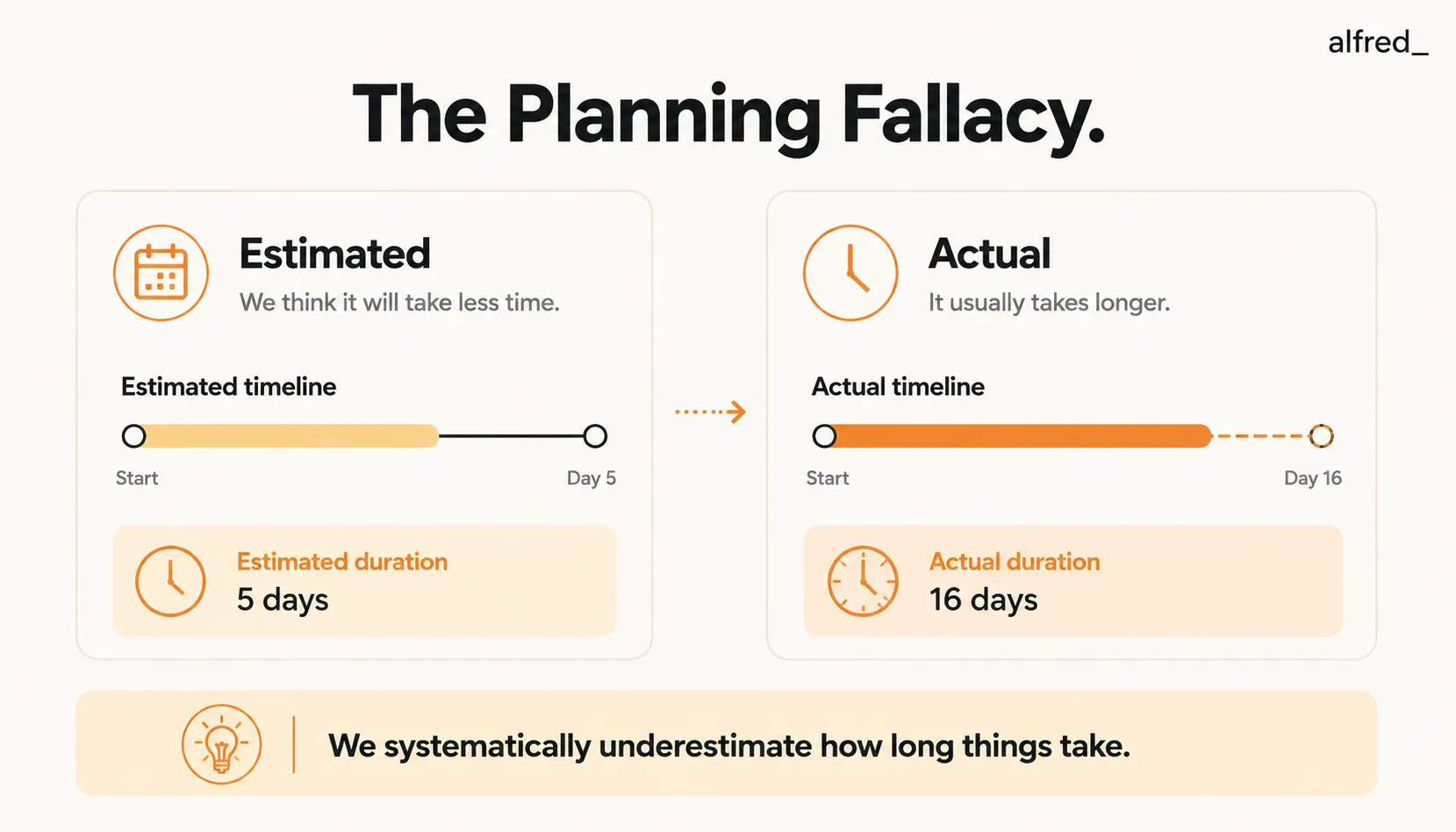
The inside view is not irrational on its face. The problem is that it ignores an entire category of relevant information: the statistical distribution of outcomes for similar projects in the past. How long do projects like this actually take? What proportion come in on time? What is the median overrun?
This is the outside view, and it is almost never consulted during planning, because planners are mentally absorbed in the details of the plan they are building. The result is that even experienced project managers, who have watched dozens of projects run over schedule, underestimate the timeline on the next one.
“The outside view is not natural or intuitive. It is a deliberate act of self-distancing from the plan you are building and looking at what actually happened to similar plans before.”
Daniel Kahneman, Thinking, Fast and Slow (2011)
Hofstadter’s Law
Douglas Hofstadter captured the recursive quality of the bias in Gödel, Escher, Bach (1979):
“It always takes longer than you expect, even when you take into account Hofstadter’s Law.”
The recursion is real. Even people who are aware of the planning fallacy and consciously try to correct for it still underestimate. Knowing about the bias provides some protection, but not immunity. The corrective is methodological, not attitudinal.
Why Intelligence Does Not Help
The planning fallacy is not a product of naivety or inexperience. It affects experts more than novices in many domains, because experts are more capable of constructing detailed, plausible-sounding plans, which only strengthens their confidence in the inside view. The Sydney Opera House, estimated at $7 million and 4 years, took $102 million and 14 years. The Boston Big Dig: estimated at $2.8 billion, final cost $14.6 billion.
The pattern appears in software development, construction, scientific research, policy initiatives, and personal projects with equal consistency. The domain changes; the bias does not.
The Fix: Reference-Class Forecasting
Kahneman’s solution is methodological. Before finalizing any plan, deliberately adopt the outside view:
- Identify the reference class. Find projects that are genuinely comparable: similar scope, team size, domain, and organizational context.
- Find the distribution. What percentage of comparable projects came in on time? What is the median overrun? What is the 80th percentile?
- Start from the median. Use the median outcome for comparable projects as your baseline estimate, then adjust for specific features of this project that make it genuinely different from the reference class.
- Apply an uplift. Even after this adjustment, Kahneman recommends adding a further buffer, because the inside view will still be influencing the “adjustment” step.
The most reliable source of reference-class data is your own organization’s history. Project retrospectives that capture actual vs. estimated timelines for past projects give you a reference class calibrated to your specific context, which is more accurate than industry benchmarks.
Why Plans Feel Right Even When They Are Wrong
The inside view feels rigorous. You have thought about every step. You have accounted for dependencies. The timeline looks tight but achievable. This experience of thoroughness is itself misleading: it signals that you have done the work of planning, not that your plan is accurate. Thoroughness in the wrong frame of reference (inside view) produces confident inaccuracy.
Kahneman describes the planning fallacy as having a neural component: optimism about future timelines involves the suppression of negative scenarios in the amygdala and rostral anterior cingulate cortex. The bias is not merely a reasoning error but has a motivational and emotional substrate that resists correction by insight alone.