

If you can’t find time for deep work anymore, the cause is almost always structural. Your mornings got eaten by shallow work (email, status meetings, reactive coordination) and never recovered. The direct answer: (1) block the same 2–3 hours every morning before anything else fills them, (2) move every meeting to the afternoon (Paul Graham’s “maker vs. manager” principle), (3) use alfred_ to handle email during deep work blocks so inbox anxiety doesn’t pull you out of focus. The rest of this piece is the case and the implementation.
AI Tools That Protect Deep Work
Most “focus” tools solve one piece of the problem. Here’s what each category actually does:
| Tool | What It Does for Deep Work | Price | Main Gap |
|---|---|---|---|
| alfred_ | Triages your inbox during the deep-work block, surfaces only what's truly urgent via morning brief, drafts replies so you're not re-entering shallow work to write them | $29.99/mo | Not a website blocker, pair with Cold Turkey/Freedom |
| Reclaim.ai | Defends focus time by auto-scheduling tasks around meetings, protects recurring routines (lunch, deep work, workout) | $8–18/mo | No email; calendar-only scope |
| Freedom / Cold Turkey | Blocks distracting sites and apps for a set duration, nuclear option for self-interruption | $3–9/mo | Blocks only; doesn't handle what's coming in |
| Motion | Auto-schedules tasks into calendar gaps, auto-replans when meetings shift | $19–29/mo | Calendar-only; no inbox layer |
| Manual (calendar + willpower) | Block-and-hope | $0 | Works for 2 weeks then erodes, the case study everyone lives |
The deep-work protection stack that actually holds: alfred_ for the inbox layer + Reclaim or Motion for calendar defense + Freedom for self-interruption. Most professionals only need alfred_ + a calendar defender because self-interruption drops dramatically once email anxiety is handled.
What Deep Work Actually Is (and Isn’t)
Cal Newport’s definition from Deep Work is precise: “Professional activities performed in a state of distraction-free concentration that push your cognitive capabilities to their limit. These efforts create new value, improve your skill, and are hard to replicate.”
The contrast class, shallow work, is equally important: “Noncognitively demanding, logistical-style tasks, often performed while distracted. These efforts tend to not create much new value in the world and are easy to replicate.”
Most of what fills a professional calendar is shallow: email, status meetings, administrative coordination, check-ins. None of it is useless, but none of it is what makes a professional distinctly valuable. The work that is hard to replicate (the analysis, the writing, the design, the strategy) is deep work. And deep work requires uninterrupted blocks of time that the shallow work calendar systematically destroys.
Peter Drucker arrived at the same conclusion decades earlier: “Concentration is the only hope of becoming the master of time and events instead of their whipping boy.” Drucker’s framing is useful because it locates the problem correctly: it’s not about motivation or willpower. It’s about structural control of time.
The Attention Residue Problem
The most important insight from Newport’s research is not that distraction is bad. It’s that the cost of distraction is much higher than people assume, and that the cost is invisible.
Newport draws on Sophie Leroy’s research on attention residue: when you switch from Task A to Task B, part of your attention remains on Task A. This residue degrades your performance on Task B, not because you’re thinking about Task A consciously, but because working memory remains partially occupied. Newport’s summary: “Even if a shift in attention is brief, think twenty seconds in an inbox. It’s enough to leave behind a residue that reduces your cognitive capacity for a non-trivial amount of time.”
23 min
average time to return to deep focus after an interruption: workers are interrupted every 11 minutes
The arithmetic is brutal. If you’re interrupted or self-interrupted (by checking email) six times in a morning, and each interruption costs twenty-three minutes of recovery, you’ve lost two and a half hours of cognitive capacity to attention residue, in addition to the time the interruptions themselves took. Up to 40% of productive time can be lost this way across a workday.
This is why fragmented schedules are categorically different from blocked schedules. Ten 15-minute windows of “available time” do not add up to 150 minutes of deep work capacity. They are a different resource entirely, one unsuited to cognitively demanding tasks.
The Four Deep Work Philosophies
Newport identifies four approaches to integrating deep work into a professional schedule. They’re not equally accessible. They range from total commitment to pragmatic integration.
1. Monastic
The Monastic philosophy maximizes deep work by eliminating or radically minimizing shallow obligations. Newport’s example is Donald Knuth, the computer scientist, who has no email address and has not had one since 1990. Knuth’s explanation: “Email is a wonderful thing for people whose role in life is to be on top of things. But not for me; my role is to be on the bottom of things.”
The Monastic philosophy is not realistic for most professionals. It requires either complete autonomy over your work structure or a role where your value is entirely in one output. But understanding it is useful, as it clarifies what you’re optimizing for when you protect deep work time.
2. Bimodal
The Bimodal philosophy divides time between deep work periods and periods of open availability. Newport’s example is Carl Jung, who built a stone tower at Bollingen where he retreated for extended periods of solitary work, then returned to Zurich for his clinical practice and social life. The time scale can be weeks or even months.
The Bimodal philosophy works for leaders who can block off longer stretches: sabbaticals, writing weeks, quarterly focus retreats. It requires organizational structures that can operate without you during the deep periods. For senior leaders with sufficient autonomy, it’s highly effective.
3. Rhythmic (Start Here)
The Rhythmic philosophy is the most practical for most professionals. It involves committing to the same deep work hours every day, typically early morning, and protecting those hours as non-negotiable. Newport’s framing: it “removes the decision of when to go deep.” The consistency itself becomes the protection.
The typical implementation: block 8 to 11 AM (or your equivalent high-focus hours) every day in your calendar, before any meetings can fill them. Show unavailability in your scheduling tool during those hours. Over time, colleagues learn your rhythm and schedule around it.
The Rhythmic philosophy’s strength is its compoundability. Each consistent deep work session builds momentum: skill, progress, habit. The flywheel effect is real: the work gets easier to start and harder to interrupt over time.
4. Journalistic
The Journalistic philosophy involves switching into deep work mode whenever gaps appear in the schedule. Newport’s example is journalist Walter Isaacson, who trained himself to go deep in any available gap: a lunch hour, a cancelled meeting, a quiet hour before a flight. Newport’s warning: “Not for the deep work novice.” It requires the ability to immediately reach depth, which only comes from extensive practice.
Most professionals should start with Rhythmic and only consider Journalistic after months of consistent practice with protected blocks. The temptation to use the Journalistic philosophy prematurely is high, since it feels less restrictive, but without the trained ability to reach depth quickly it produces shallow work in gap-sized chunks.
Paul Graham’s Office Hours Principle
Graham’s 2009 essay “Maker’s Schedule, Manager’s Schedule” identified the asymmetry at the heart of most scheduling conflicts. “When you’re operating on the maker’s schedule, meetings are a disaster. A single meeting can blow a whole afternoon, by breaking it into two pieces each too small to do anything hard in.”
The anticipatory cost is equally significant: “I often blow a whole morning if I know I have a meeting in the afternoon.” The meeting hasn’t happened yet, but the knowledge of its existence changes how you engage with the preceding hours. You don’t commit fully to deep work because you know you’ll have to stop.
Graham’s solution: office hours. Cluster all meetings at the end of the working day. “These chunks of time are at the end of my working day.” Morning becomes inviolate maker time. Afternoon absorbs all the manager-schedule activity: meetings, calls, coordination.
The implementation: update your scheduling tool to show availability only from 1 PM or 2 PM onward. Update your email signature with a note about your morning focus hours. It takes one week of consistent enforcement before colleagues adapt. Most will never push back.
Drucker’s Consolidation Principle
Drucker arrived at essentially the same conclusion as Newport and Graham, but through the lens of executive effectiveness rather than cognitive science. In The Effective Executive, he wrote: “Even one quarter of the working day, if consolidated in large time units, is usually enough to get the important things done. But even three quarters of the working day are useless if they are only available as fifteen minutes here or half an hour there.”
“Even one quarter of the working day, if consolidated in large time units, is usually enough to get the important things done. But even three quarters of the working day are useless if they are only available as fifteen minutes here or half an hour there.”, Peter Drucker, The Effective Executive
Two hours of uninterrupted morning time is more valuable than six hours of fragmented afternoon time. This is not a preference. It’s a structural fact about how cognitive work gets done. Drucker’s prescription: record how you currently spend your time, identify and eliminate the activities that consume time without producing value (including meetings that exist by inertia), and consolidate what remains into large blocks.
Drucker’s time audit is a useful diagnostic. For one week, log every 30-minute block of your day and what you actually did. Most professionals discover that the time they thought they had for important work doesn’t exist. It’s consumed by coordination, meetings, and reactive email. The audit makes the problem concrete and the solution obvious.
Step-by-Step: Protect Deep Work Time
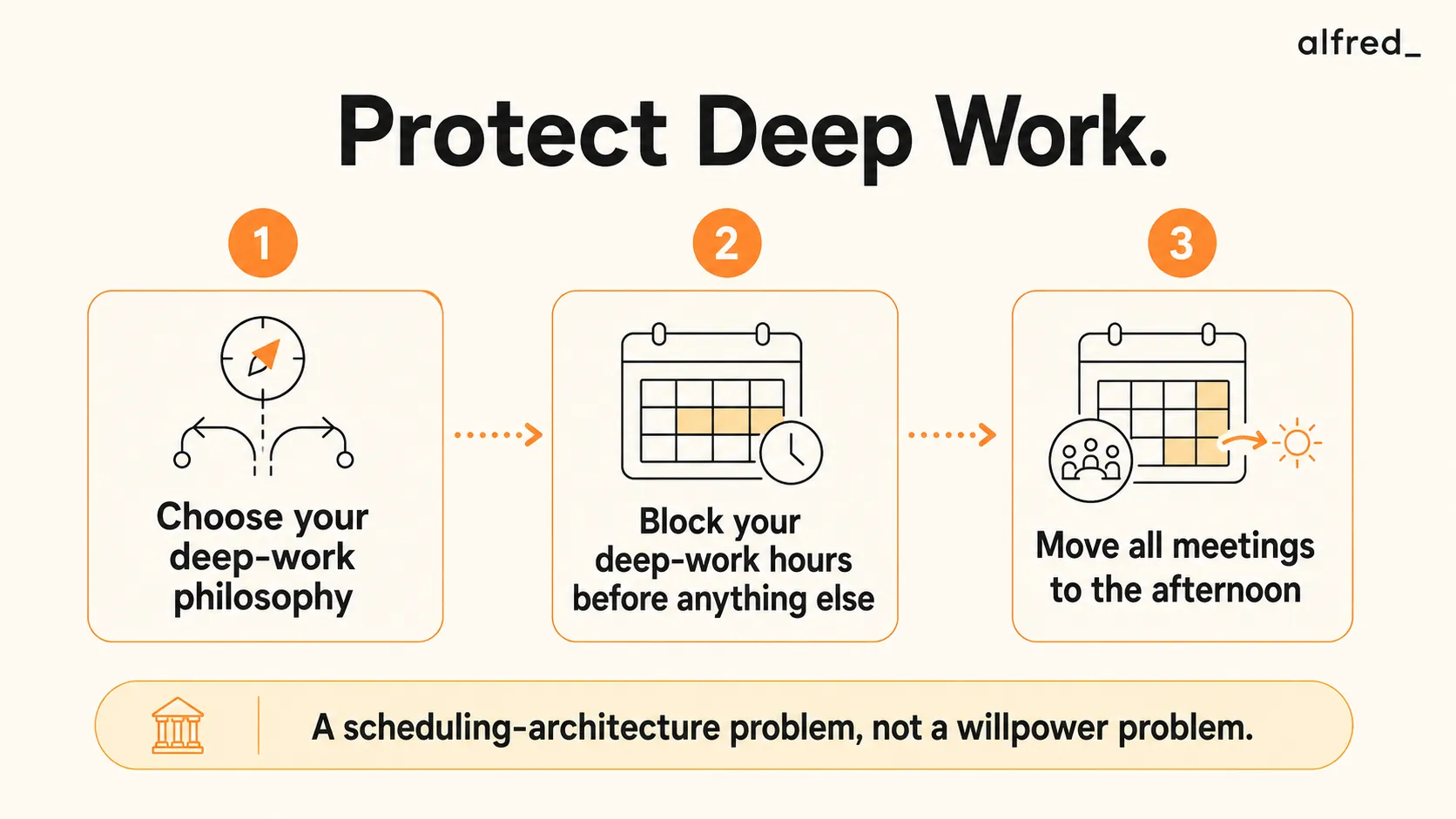
1. Choose Your Deep Work Philosophy
Start with Rhythmic. Identify your peak cognitive hours, usually the first 2-3 hours of the workday before the world’s demands begin. Commit to protecting those same hours every day. Don’t try to be clever about it; the value of Rhythmic is in the removal of choice. Same hours, every day, no negotiations with yourself.
2. Block Your Deep Work Hours Before Anything Else
Open your calendar now and block your deep work hours for the next four weeks. Make them recurring. Label them clearly (“Deep Work” or “Focus Block”) so that anyone with calendar visibility understands they’re intentional, not empty. Set them as busy. Show unavailability in your scheduling tool during those hours. What isn’t blocked will be filled.
3. Move All Meetings to the Afternoon
Graham’s office hours principle in practice: audit your existing recurring meetings and move every one that can be moved to afternoon slots. Update your scheduling link to show availability only from 1 PM or 2 PM onward. For the first week, expect pushback from colleagues accustomed to your morning availability. Hold the line. It takes one week to recalibrate expectations.
4. Time-Block Every Remaining Minute
Newport’s time-blocking practice: assign every working hour a named job. The hours not yet deep work or meetings become email processing windows, administrative tasks, creative incubation, or reading. Hours with names are defended hours. Hours without names are targets. They fill with whatever anyone asks of you. Ten minutes the night before to plan the next day’s time blocks is enough.
5. Let alfred_ Handle Email During Deep Work
Don’t check email during your deep work block. alfred_ triages your inbox continuously, reading, categorizing, and prioritizing every incoming message while you focus. At the end of your deep work session, check your morning brief: you see only what genuinely requires your attention. The newsletters, notifications, and non-urgent messages are already handled. The cognitive tax of email during deep work is eliminated.
Collins’s 20 Mile March for Deep Work
Jim Collins’s 20 Mile March concept from Great by Choice applies directly to deep work habit-building. The 20 Mile March means committing to consistent output regardless of conditions: a performance floor you hit every day, a ceiling you don’t exceed even when conditions are favorable. Collins: “The march imposes order amidst disorder, discipline amidst chaos, and consistency amidst uncertainty.”
Apply this to deep work: define your daily floor (e.g., 90 minutes of deep work). Hit it every day, including the days when you’re travelling, when something urgent has come up, when the morning feels wrong. Don’t exceed your ceiling on good days either. The goal is the flywheel: each consistent session makes the next one easier to start and harder to derail.
The failure mode of most deep work attempts is inconsistency: brilliant weeks followed by chaotic weeks where deep work disappears entirely. Collins’s insight is that the brilliant weeks don’t compensate for the chaotic ones. You fall behind and have to rebuild the habit from scratch. The 20 Mile March prevents this by making consistency the explicit goal, not maximum output.
4 hrs
the daily ceiling on deep work even for the most experienced practitioners. Most knowledge workers, buried in email and meetings, manage far less
What to Do About Email During Deep Work
The single most common deep work failure mode is email. Not because email is inherently destructive, but because the habit of checking it has become reflexive. Most professionals check email without deciding to, as a form of attention relief when the deep work gets hard.
Newport is unambiguous: don’t check it during deep work. The cost isn’t the twenty seconds it takes to look. It’s the attention residue that follows: the partial occupation of working memory by whatever the inbox contained, degrading the quality of the work you return to.
alfred_’s role in this system is structural, not motivational. It removes the legitimate reason to check email during deep work by handling triage continuously. Anything genuinely urgent gets flagged in the morning brief at the end of your deep work block. Everything else is already categorized and handled. You’re not ignoring your inbox. It’s being managed. The anxiety that drives email-checking during deep work evaporates when you trust that nothing important is slipping through.