

The virtual assistant pitch is seductive: hand off everything you should not be doing yourself, free up 10-20 hours a week, focus on high-value work. And it can work exactly like that, some of the most successful executives and entrepreneurs credit their VA as one of their best investments.
But the pitch skips over the hard parts. The 3-6 months of training before your VA is truly useful. The hours you spend creating documentation and processes. The turnover that means starting over every 12-18 months. The cost that ranges from “manageable” to “I’m basically paying a salary.”
Whether a VA is worth it depends on what you need done, how much you can afford, and whether you have the patience for the investment curve.
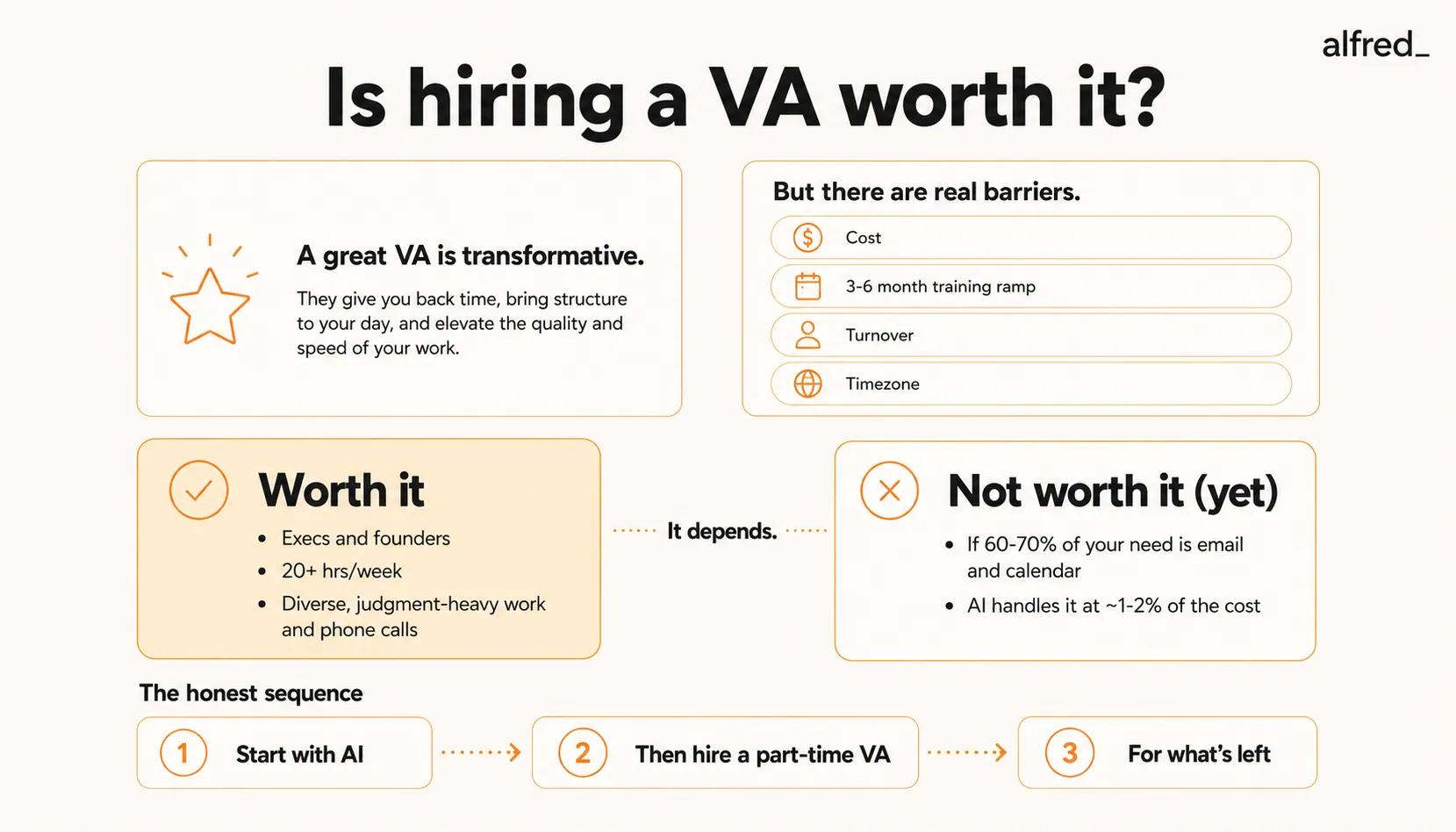
What a Good VA Does Well
A great VA becomes an extension of your brain. After 6-12 months, a well-trained VA understands your preferences, anticipates your needs, and makes decisions you would make. They book the hotel you would have chosen. They respond to routine emails in your voice. They know which meetings you will want to reschedule and which you will not. This level of contextual understanding is genuinely transformative.
VAs handle the full spectrum of admin work. Email management, calendar scheduling, travel booking, expense reports, meeting coordination, vendor communication, research, data entry, gift purchasing, appointment scheduling, invoice processing, a VA can handle all of it. This breadth is unmatched by any single software tool. One person covers what would otherwise require five different apps.
Human judgment on ambiguous tasks. When a request is unusual, nuanced, or requires reading between the lines, a human VA can figure it out. “Find me a restaurant near the office that would be good for a client lunch, nothing too loud, they mentioned they’re vegetarian”, a VA handles this naturally. Software struggles with this kind of open-ended, judgment-rich task.
VAs can make phone calls and handle real-world interactions. Calling your insurance company, coordinating with building management, negotiating with a vendor, following up with someone who has not responded to three emails. These require a human on the other end of the line. No software tool can do this.
The relationship compounds over time. The longer a VA works with you, the less management they require. After a year, a good VA operates with minimal oversight. They are not just completing tasks. They are managing workflows, catching things you missed, and proactively handling issues before you know about them.
The Hidden Costs and Challenges
The Money
The sticker price for a VA is just the beginning.
Direct cost: $800-5,000+ per month depending on location, experience, and hours. A reliable, English-fluent, experienced VA from a reputable agency typically costs $1,500-3,000/month for full-time work.
Your time investment: You will spend 5-10 hours per week managing your VA during the first three months. Creating documentation, providing feedback, answering questions, reviewing work. This is time you are not saving. It is time you are investing against future returns.
Tools and access: Your VA needs software licenses, email access, calendar access, and possibly a company phone number or credit card. These are real costs that add up.
Agency markup: If you hire through a managed service (Belay, Time Etc, Wishup), expect a 30-50% markup over what the VA earns. You pay $25/hour; the VA might receive $12-15/hour. The agency provides recruitment, backup coverage, and management, but the cost adds up.
Effective hourly rate: When you factor in your management time during the ramp-up period, the effective cost per productive hour is often 2-3x the sticker rate for the first six months.
The Training Curve
A new VA knows nothing about you. They do not know your email preferences, your calendar priorities, your communication style, your key contacts, or your decision-making patterns. Everything must be taught explicitly.
Month 1: You spend more time delegating than you save. The VA handles simple, clearly defined tasks. You review everything.
Months 2-3: The VA handles routine tasks independently. You still review most work. They start to learn patterns but still ask frequent questions.
Months 4-6: Real productivity gains emerge. The VA handles most routine work independently and starts making judgment calls. Your management time drops significantly.
Months 6-12: The VA is fully productive. They anticipate needs, make independent decisions, and manage workflows proactively. This is where the investment pays off.
The problem: you invest 3-6 months of time and patience before reaching the payoff. Many professionals give up during the investment period because the short-term return is negative.
The Turnover Problem
This is the challenge nobody talks about enough. In the offshore VA industry, turnover is a persistent challenge. Even with US-based VAs, turnover is a reality.
When your VA leaves, you lose everything you invested. The context they built, the preferences they learned, the judgment they developed. It all walks out the door. You start over with someone new. Another 3-6 months of training. Another period of negative returns.
Over a five-year period, you might train 3-4 VAs. Each time, you repeat the investment curve. The cumulative cost of turnover, in your time, in lost productivity during transitions, in the emotional friction of starting over, is enormous.
Timezone and Availability
If you hire offshore to save money, you deal with timezone differences. A VA in the Philippines is 12-13 hours ahead of US Eastern time. “Can you call the restaurant and change our reservation tonight?” does not work at 3am their time.
Some agencies offer overlapping hours, and some VAs work US hours. But this often comes at a premium, partially negating the cost savings of hiring offshore.
Context Limitations
No matter how good your VA is, they cannot read your mind. They do not see your private thoughts about a difficult client relationship. They do not know that you are stressed about a board meeting unless you tell them. They work from the information you share, which is always a subset of the information you have. This asymmetry means some decisions and tasks will always require your direct involvement, even after your VA is fully trained.
Who Should Hire a Virtual Assistant
Executives and founders earning $200K+ who need 20+ hours/week of diverse admin support. At this income level, your time is worth $100-200/hour. A VA at $15-30/hour is a clear positive ROI, even after accounting for the ramp-up period. The breadth of tasks (email, calendar, travel, vendor management, research, personal errands) justifies a human generalist.
People who already know what they want to delegate. If you have a clear list of tasks, documented processes, and the discipline to delegate consistently, a VA will be productive faster. The worst VA engagements are ones where the employer hires a VA hoping the VA will figure out how to help. You need to know what you need before you hire.
Professionals who need phone calls and real-world interactions managed. If a significant portion of your admin work involves calling people, coordinating logistics, or handling tasks that require a human presence, software cannot replace a VA. Insurance calls, vendor negotiations, appointment scheduling with offices that do not use online booking. These need a person.
People with the patience for the investment curve. If you can commit to 3-6 months of active management and training without expecting immediate returns, a VA can become one of your best investments. But you need the patience and the management skills to get there.
Who Should Not Hire a VA (Yet)
Anyone whose primary problem is email and calendar management. This is the big one. When most professionals describe what they want a VA to do, 60-70% of the list is email triage, calendar management, meeting scheduling, and follow-up tracking. These are the exact tasks that AI handles better than humans in 2026, faster, cheaper, available 24/7, and with no training period.
If email and calendar are 70% of your need, you are paying $1,500-3,000/month for a human to do what AI does for $25/month. The math does not work.
People who cannot clearly define what they want delegated. If you hire a VA hoping they will “figure out how to help,” you will waste months and thousands of dollars. VAs need clear instructions, defined processes, and consistent delegation. If you do not have these, invest the time in defining your needs before hiring.
Professionals earning under $100K. The ROI math is harder at lower income levels. A VA at $1,500/month is $18,000/year. If your time is worth $50/hour, the VA needs to save you 30 hours/month to break even, and that is before accounting for your management time. AI tools at $25-50/month are a better first step.
Anyone who has been burned by VA turnover. If you have already hired and trained 2-3 VAs who left, the pattern will likely continue. The problem is structural (industry turnover rates), not personal. Consider whether AI can handle the core tasks, with a part-time VA for the genuinely human-required work.
Where alfred_ Fits
alfred_ is not a virtual assistant replacement for everything. But it is a replacement for the 60-70% of VA work that involves email and calendar management.
Here is what alfred_ handles that people typically hire VAs for:
- Email triage: alfred_ reads your inbox, identifies what matters, and filters the noise, 24/7, with no training period.
- Draft replies: Routine emails get draft responses prepared automatically, in your voice, with context from the thread.
- Daily briefing: Every morning, you get a summary of what happened and what needs your attention. No VA delivers this as consistently.
- Follow-up tracking: alfred_ finds who has not replied when you ask, or every Monday with the Chase what I’m owed routine. No forgotten follow-ups.
- Calendar awareness: Your email triage is informed by your calendar. The email from your board member gets prioritized on the morning of the board meeting.
What alfred_ does not do (where a VA is still valuable):
- Make phone calls
- Book travel with complex preferences
- Run physical errands
- Handle multi-step research requiring judgment
- Manage vendor relationships
- Process expenses
The cost comparison is stark: alfred_ at $29.99/month vs. a VA at $1,500-3,000/month. That is 1-2% of the cost for 60-70% of the functionality. And alfred_ never quits, never needs training, never takes sick days, and works in every timezone simultaneously.
The practical recommendation for most professionals: start with alfred_ for email and calendar management. See how much of your administrative burden it handles. If you still need help with the tasks AI cannot do, the phone calls, the travel, the research, hire a part-time VA for those specific tasks. You will spend $500-800/month on a part-time VA instead of $2,000-3,000/month on a full-time one, because alfred_ handles the bulk of the work.
The Verdict
A great virtual assistant is one of the best investments a busy professional can make. Full stop. The right VA, well-trained, becomes a force multiplier that gives you back hours every day.
But the barriers to getting there are real: $1,200-5,000/month in cost, 3-6 months of training, significant management time, and the ever-present risk of turnover wiping out your investment. Most professionals who hire VAs are disappointed in the first six months, and many give up before reaching the payoff.
The honest recommendation in 2026:
-
Start with AI. Use alfred_ for email and calendar management. This is immediate, requires no training, and handles the majority of what people hire VAs for.
-
Evaluate what remains. After a month with AI handling your communication management, assess what is left. If you still have 15+ hours/week of tasks that require a human, hire a VA.
-
Hire a VA for the right reasons. Phone calls, complex travel, vendor management, research, personal errands. These are genuine VA tasks. Hire for these, not for email triage.
-
Consider part-time. With AI handling communication management, most professionals need 10-15 hours/week of human help, not 40. A part-time VA at $600-1,200/month plus alfred_ at $25/month is often better than a full-time VA at $2,000-3,000/month.
The old model of hiring a full-time VA to manage your email, calendar, and admin work made sense when the alternative was doing it yourself. In 2026, the alternative is AI that costs 1% as much and handles the communication layer better than most humans. Hire a VA for the tasks that genuinely need a human. Let AI handle the rest.