


You are 20 minutes into lunch. Real lunch, away from your desk, at an actual restaurant, with an actual person. The food is good. The conversation is good. And then the thought arrives:
What if something came in?
Not a specific email. Not a particular crisis. Just the general, nagging sense that something, somewheremight be happening without you. A client might have replied. A fire might have started. A decision might be getting made in a thread you are not watching.
You do not check your phone. Not yet. But the thought is there now. It sits behind the conversation like a subtitle you cannot turn off. You nod at the right times. You laugh at the right moments. But 20% of your brain is somewhere else, scanning the horizon for a threat you cannot see because you are not looking.
“I can’t take lunch without my phone. Not because I want to check. Because I can’t not check.”
This is work FOMO. And it does not just happen at lunch. It happens during every meeting that runs long. Every weekend afternoon. Every vacation. Every single moment you are not actively monitoring your communication channels, a quiet voice asks: what are you missing?
The Fear Is Not Irrational
Here is the part that makes work FOMO different from social FOMO: it is grounded in experience.
Most workers have missed important messages because there were too many to track. Not hypothetically. Actually missed them. A client email that sat unanswered for three days. A deadline that slipped because the notification was buried. A decision that was made without them because they were not in the channel when it happened.
You have experienced this. Maybe not catastrophically. But enough times that your brain has filed it under “verified threat.” The fear of missing something important when you step away is not paranoia. It is pattern recognition.
Research published in Computers in Human Behavior found that workplace FOMO is associated with increased communication checking, higher stress levels, and lower job satisfaction. A study from the University of British Columbia found that people who limited email checking to three times per day reported significantly lower daily stress, though separate research on notification-free periods shows that completely eliminating notifications can increase anxiety about what is being missed.
That word again: trust. Without it, every gap in monitoring is a gap where something could fall through. And when you have experience with things actually falling through, the gap is not theoretical. It is a known risk.
The Lunch Break You Cannot Take
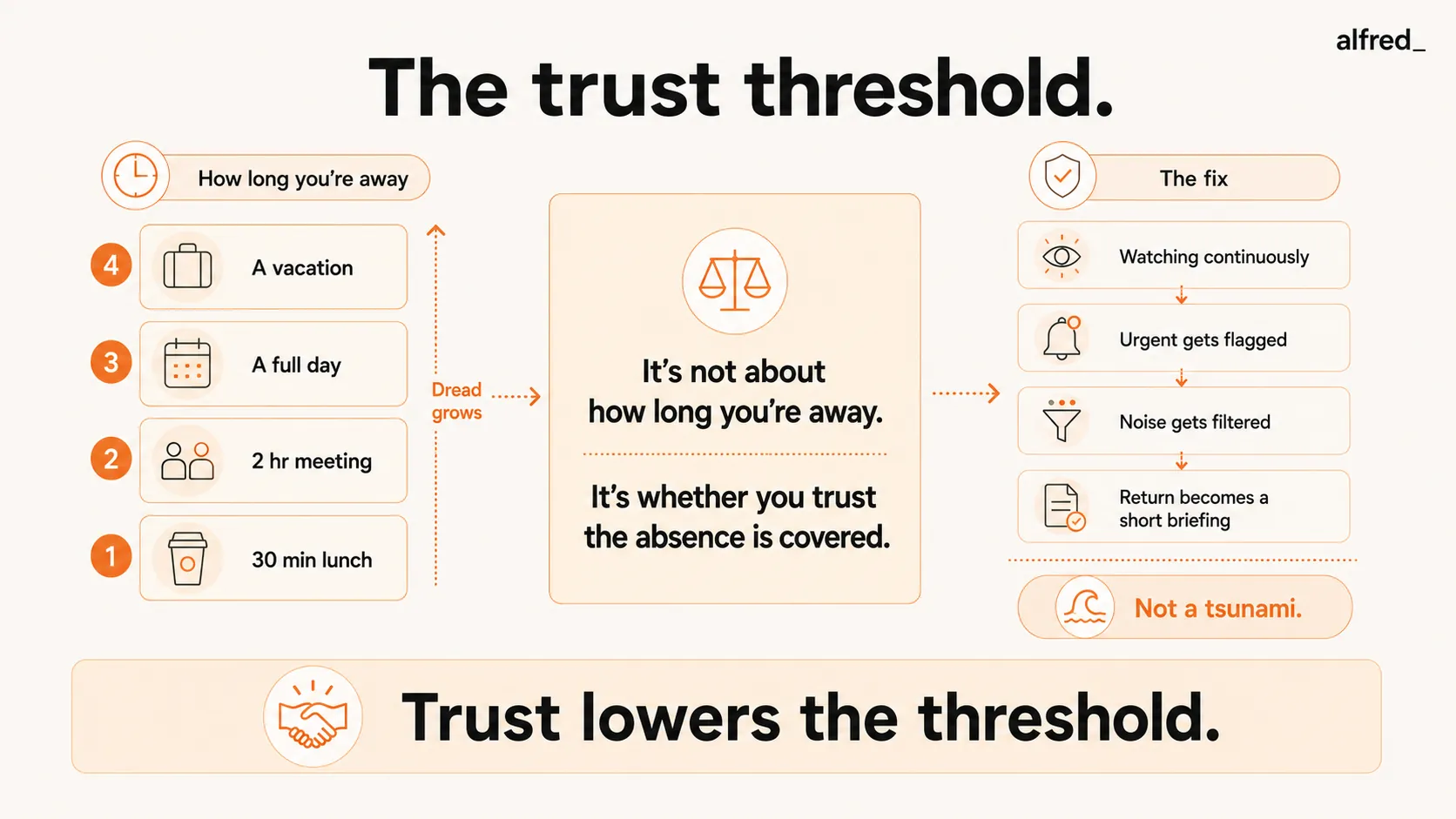
There is a specific hierarchy of work FOMO. It starts small and escalates:
30 minutes away (lunch, a meeting): I should check when I get back. Low-level awareness. Manageable. You can mostly focus on the meal or the conversation, though there is a half-thought running underneath.
2 hours away (a long meeting, an offsite): What if something came in that needed me? The awareness sharpens. You start doing mental math about the likelihood of an urgent email arriving during a two-hour window. The probability is not zero. It is almost never zero.
A full day away (sick day, personal day): I’ll just check once. Just to see. The anxiety has crossed a threshold. You are not in a position to respond even if something urgent has arrived, which makes it worse. You can see the fire but you cannot put it out. Or you do respond, while sick, from your phone, and the personal day becomes a partial work day.
A vacation (multiple days): This is going to be so much to come back to. The FOMO is no longer about specific items. It is about the aggregate, the wall of unread that grows every day you are away. Each day of vacation adds another layer of dread about the return. By day three, you are checking “just to keep the pile manageable.” By day five, you are working for an hour each morning from the hotel, calling it “just staying on top of things.”
“I haven’t taken a real vacation in three years. Not because I don’t have PTO. Because the anxiety of what I’ll come back to makes the vacation worse than just working.”
A survey by Glassdoor found that 61% of Americans who receive paid vacation check in with work while on it. The American Psychological Association found that more than 4 in 10 workers (44% of working adults) check work messages while on vacation, and 53% check at least once a day over the weekend.
These people are not workaholics. They are people who cannot tolerate the uncertainty. The vacation is supposed to be rest, but the uncertainty makes it work, cognitive work, emotional work, the work of wondering and worrying and half-monitoring.
The Return Tsunami
For many people, the worst part of work FOMO is not the anxiety during the absence. It is the return.
You come back from a three-day weekend. Your inbox has 187 new messages. Slack has a red badge that just says “99+”. There are 4 meeting invites for things that already happened while you were out. A thread in Teams has 47 replies and you are mentioned in reply 12 and reply 38.
You spend the entire first day back just getting current. Not working, triaging. Reading. Catching up. Figuring out what happened, what was decided, what still needs you, and what has already been resolved without you (which creates its own anxiety: was I not needed? Or did something get decided wrong because I was not there?).
By the second day back, you are finally able to start working again. But you are already behind because the first day was consumed by catch-up. The catch-up creates new open loops, things you learned during the triage that now need your attention. You are more behind after the vacation than you were before it.
“Every time I take a day off, it costs me two days to catch up. So mathematically, days off have a negative return.”
This calculus, the cost of returning exceeding the benefit of leaving, is why people stop taking time off. Not because they love work. Because the cost structure of disconnecting is broken.
What Delegation Does Not Fix
The standard advice for vacation anxiety is: delegate. Tell your team what to watch for. Set an out-of-office. Identify a backup.
This helps. But it introduces new vectors of anxiety:
Delegation anxiety: Did they handle the client email the way you would have? Did they catch the nuance in the vendor’s message? Are they following up on the things you would have followed up on? You delegated the tasks but not the context. The person covering for you has 20% of the information you have.
Out-of-office false security: Your OOO reply tells people you are away and provides an alternative contact. But you know, from experience. That many people ignore the OOO and just wait. Their email sits in your inbox, marinating, growing staler by the hour. The OOO does not process the message. It just delays it.
The coverage gap: Even with a backup, there are things only you know. Client relationships, ongoing negotiations, implicit commitments you made verbally that are not written down anywhere. Your backup does not know about these. Nobody does. These are the things that keep you checking on vacation, the threads that only you can see, that only you can catch.
| Approach | What It Covers | What It Misses |
|---|---|---|
| Out-of-office reply | Notifies senders you are away | Does not process or triage incoming messages |
| Delegate to colleague | Handles known, documented items | Misses implicit commitments, client context, nuance |
| "Just check once a day" | Keeps the pile manageable | Turns vacation into part-time work; rumination fills the rest |
| Complete disconnect | Maximum rest potential | Maximum return anxiety; nothing is handled |
| alfred_ | Continuously triages all incoming; surfaces urgency; drafts replies | Nothing is missed; complete briefing on return |
The Trust Threshold
Here is the core insight. Work FOMO is not about how long you are away. It is about whether you trust that the absence is covered.
If you trusted, genuinely trusted. That every email arriving during your lunch, your weekend, your vacation was being read, understood, triaged, and handled appropriately, the FOMO would dissolve. You would not need to check because there would be nothing to check for. The monitoring function in your brain would stand down because the monitoring is covered.
This is why a great executive assistant eliminates FOMO for the people who have them. It is not that the EA answers every email. It is that the EA sees every email. Nothing is unmonitored. Nothing is sitting in an inbox, unseen and accumulating. The executive can disconnect because they trust that the monitoring function is covered.
You do not have an executive assistant. Most people do not. So you are the EA and the executive, monitoring everything yourself, processing everything yourself, and never able to step away from either role because both require constant attention.
What It Looks Like When the Cracks Are Covered
Imagine this. It is Tuesday. You have an offsite from 9 AM to 4 PM. No phone, no laptop. Full attention on the people in the room.
In the old world, you would check during every break. You would step out for “a bathroom trip” that was actually a 7-minute email scan. You would spend the afternoon session half-present because by 2 PM the anxiety of accumulated unread would be screaming.
With alfred_, you walk into the offsite and you stay in the offsite. Because you know: alfred_ is watching your inbox. A client email arrived at 10:30 AM. It was urgent, so alfred_ flagged it and drafted a response based on the context of your previous conversation. A vendor sent a follow-up, routine, so it was categorized for later review. A meeting invite arrived for tomorrow. It conflicts with your focus block, and alfred_ noted the conflict for you to resolve later.
At 4 PM, you emerge from the offsite. You open your briefing. Seven lines. Three items need your attention. Two have drafts ready. The rest is handled.
No tsunami. No 187-message triage. No lost day of catch-up. You were away for 7 hours and you missed nothing, because nothing was missed.
“I went on vacation for the first time in two years without checking email. Not because I was being strong. Because I genuinely didn’t need to.”
Now scale that to a vacation. Five days away. alfred_ watches continuously. Each day, it handles the routine, flags the urgent, drafts replies, tracks follow-ups. When you return, instead of 500+ messages and a full day of triage, you have a briefing: here is what happened, here is what needs you, here is what was handled. You start working on day one. Not catching up. Working.
The vacation was actually rest. Not because you had discipline. Because the cracks were covered.
The Math of Letting Go
Work FOMO costs you in ways that are hard to quantify but easy to feel:
- Lunches eaten at your desk because stepping away feels risky
- Weekends shadowed by the awareness that Monday’s inbox is building
- Vacations that are not vacations, just changes of scenery with the same anxiety
- Relationships eroded by half-presence, the “you’re not really here” that your partner has stopped saying because they are tired of saying it
- Sleep disrupted by the last-thing-before-bed check that turns into a 30-minute scroll
Research on psychological detachment from work consistently finds that it predicts better recovery, lower burnout, higher life satisfaction, and, criticallybetter work performance. You do not just feel better when you disconnect. You perform better when you come back. The fear that disconnecting will make you worse at your job has it exactly backwards.
alfred_ does not teach you to disconnect. It does not lecture you about work-life balance. It makes disconnecting safe. It covers the cracks that your brain is terrified of. It watches while you are away and briefes you when you return. Nothing falls through. Nothing is missed. Nothing is buried.
You can take lunch. You can take the weekend. You can take the vacation. Not because you have learned to be brave about stepping away. Because stepping away no longer requires bravery.
The FOMO ends when the cracks are covered. alfred_ covers them.