

You know you need to follow up. You have known for five days.
The email is right there. You have looked at it every morning this week. You have opened the thread, read the last message, considered what to write, and closed it. Five times. Five mornings. Five moments where you could have sent three sentences and moved on with your life.
You did not send them. And now it has been long enough that the follow-up itself has become the problem. It is no longer a simple “hey, checking in on this.” It is a thing that requires an explanation. An acknowledgment of the delay. A careful calibration of tone that says “I’m on top of things” while the delay itself proves you are not.
“I told myself I’d follow up and I didn’t and now the moment has passed.”
Except the moment has not quite passed. Not yet. You could still send it. Right now. Open the thread, write three sentences, hit send. It would take four minutes. You have had four minutes available every day this week. You have not used them.
The question is not whether you will follow up. The question is why you cannot.
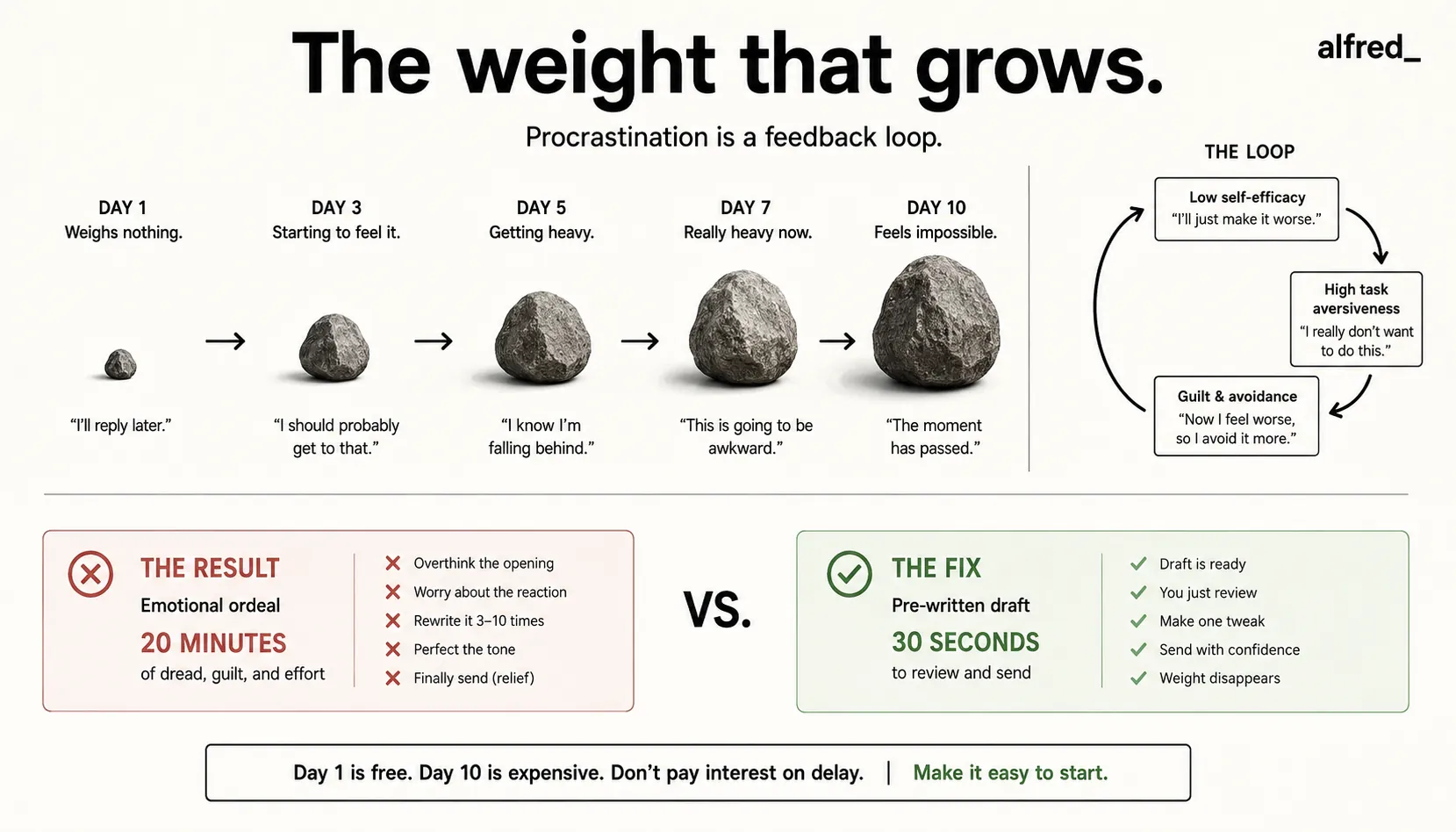
The Weight That Grows
Day one, the follow-up weighs nothing. “I’ll send that tomorrow.” Perfectly reasonable. No guilt. No friction. The thread sits in your inbox, and you know exactly what to say.
Day three, the follow-up weighs something. You open the thread and hesitate. “It’s been a few days, should I acknowledge that? Or just respond normally?” The calculus has started. The message that would have taken 30 seconds on day one now requires 3 minutes of tone-setting.
Day five, the follow-up weighs a lot. The delay is now the subtext of any message you send. You cannot write “just checking in on this” because it has been five days and “just” implies casualness that does not match the timeline. You need to acknowledge the gap. But how? “Sorry for the slow response”, too apologetic? “Wanted to make sure this didn’t slip through”, ironic, since it clearly slipped through. Every opening line you draft feels wrong.
Day seven, the follow-up weighs more than the task it represents. The original request, maybe it was reviewing a document, or providing feedback, or confirming a meeting, would take five minutes. But the follow-up email, which is just the wrapper around that five-minute task, has become a 20-minute emotional obstacle course. You are not avoiding the work. You are avoiding the awkwardness of doing the work late.
Day ten, you have entered the dread zone. The thread is a weight in your inbox. You see it every morning and feel a specific, targeted shame. You know you should send it. You know the longer you wait the worse it gets. You know this. And still, you open the thread, stare at the blank reply box, close it, and tell yourself tomorrow.
This is not laziness. This is not carelessness. This is a well-documented psychological phenomenon, and it has a name.
The Procrastination Feedback Loop
Dr. Piers Steel at the University of Calgary conducted a meta-analysis of procrastination research synthesizing 691 correlations from the research literature (Steel, 2007). His findings describe the exact mechanism that traps you:
Procrastination increases as perceived self-efficacy decreases. When you are confident you can do a task well, you are less likely to defer it. Follow-ups that are overdue lower your self-efficacy. You are no longer sure you can write the message without it sounding awkward. The delay itself undermines your confidence in handling the delay.
Procrastination increases as task aversiveness increases. A task that feels unpleasant gets deferred. Follow-ups become more aversive with each passing day because the delay adds emotional complexity, guilt, shame, anxiety about the other person’s perception. The task that was neutral on day one is actively unpleasant by day seven.
The feedback loop. Low self-efficacy and high aversiveness create delay. The delay increases both factors. Which creates more delay. Which increases them further. This is the guilt-avoidance spiral: feeling guilty about not following up makes the follow-up feel harder, which increases avoidance, which increases guilt.
Research by Gropel and Steel (2008), studying over 9,000 participants, found that procrastination correlates at r=0.60 with energy level, when energy is low, procrastination spikes. Follow-up emails live in the worst possible category for this effect: they are important enough to weigh on you but not urgent enough to force action. They drain energy by existing in your mental queue, and the energy drain makes you less likely to address them.
The follow-up you have been putting off is not just a task. It is a tiny engine of anxiety that runs in the background of your day, consuming mental resources while producing nothing.
The Things You Tell Yourself
You have a library of justifications, and you cycle through them:
“They’re probably busy too.” Maybe. But that does not change the fact that you committed to following up and have not.
“If it were really urgent, they would have followed up with me.” Possibly. But the absence of their follow-up is not evidence that the task is unimportant. It is evidence that they are also juggling 40 things and assumed you would handle it.
“I’ll do it when I have more energy.” You have been saying this for five days. The energy has not appeared. It will not appear. The follow-up will still be there tomorrow morning, slightly heavier than it is today.
“The moment has passed.” This is the final justification, the one that ends the spiral not with action but with surrender. You decide it has been too long. Following up now would be more awkward than not following up at all. You archive the thread or let it sink. The guilt fades to a dull hum. Until the next one.
But here is the thing about “the moment has passed”. It is almost always wrong. The other person is not sitting at their desk thinking about your delayed follow-up. They are managing their own overloaded inbox, their own dropped balls, their own deferred tasks. A late follow-up is infinitely better than no follow-up. The deal that might be salvageable goes to zero when you stop reaching out entirely. The relationship that might absorb a late response certainly does not survive silence.
What People Try (and Where It Breaks)
Boomerang ($4.98-49.98/month). You snooze the email to reappear tomorrow at 9 AM. Tomorrow at 9 AM, the email appears. You open it. You stare at the blank reply box. You think about what to write. The delay is now six days instead of five. The tone calibration is even harder. You snooze it again. The email has been snoozed three times. The problem was never the reminder.
Superhuman ($30-40/month). Faster email processing. Keyboard shortcuts. Split inbox. You can get through your email faster, which means you encounter the deferred follow-up faster, fail to write it faster, and move on to the next email faster. The speed does not address the emotional barrier.
Setting a deadline. “I will follow up by end of day Friday.” Friday arrives. You are tired. The follow-up feels harder on a Friday afternoon than it did on Monday morning. You move the deadline to Monday. Monday you are busy. Tuesday is “too close to Monday to follow up on something from last week.” Wednesday you realize it has been two weeks.
Writing the draft and not sending it. This is a fascinating workaround that many people discover independently. You write the follow-up. You read it. You do not send it. You save it as a draft. The draft sits there for three days. The next time you open it, you revise it. You still do not send it. The draft becomes its own object of procrastination.
The common thread: every approach still requires you to write the message. The writing is the barrier. The blank reply box is the barrier. Not the reminder. Not the interface. Not the deadline. The words.
How alfred_ Writes What You Cannot
alfred_ removes the blank reply box.
Follow-up identification. alfred_ finds threads that need follow-up when you ask, or every Monday with the Chase what I’m owed routine, without you flagging them. The email you have been staring at for five days? alfred_ recognized it as needing a response on day two. By day three, a draft was ready.
Drafted in your voice. Not a template. Not “Hi [Name], just following up on my previous email.” A contextual draft that references the specific conversation, uses your writing style, and, critically, handles the delay naturally. If it has been five days, the draft might read: “Hey, wanted to circle back on this. Still interested in connecting on the Q2 numbers if the timing works on your end.” Brief. Specific. No over-apologizing. No pretending the delay did not happen.
The activation energy drops to near zero. The barrier to sending a follow-up is not the send button. It is everything that comes before: opening the thread, re-reading the context, choosing the tone, composing the message, second-guessing the wording, and deciding whether to acknowledge the delay. alfred_ handles all of it. What remains is a 30-second review. Read the draft. Change a word if needed. Send.
The guilt-avoidance spiral breaks. The spiral depends on the follow-up remaining unwritten. As long as the blank reply box is blank, the avoidance compounds. Once the draft exists, once the words are on the screen and you can see that the message is fine, the tone is right, and sending it will take five seconds, the spiral loses its power. The task shrinks from “20-minute emotional ordeal” to “30-second review.”
Appropriate timing. alfred_ drafts follow-ups at natural intervals. Not immediately. That can feel aggressive. Not after two weeks. That is too late for most conversations. The draft appears at the inflection point: early enough that the follow-up feels timely, late enough that the other person has had a chance to respond on their own.
Less than one hour of the mental energy you spend each week thinking about follow-ups you have not sent. Immeasurably less than the accumulated cost of conversations that died because you could not bring yourself to write three sentences.
The Moment Has Not Passed
The email you have been avoiding for five days? The follow-up you keep telling yourself you will send tomorrow? The thread that makes your stomach dip every time you scroll past it?
It is not too late. The other person has not moved on. The opportunity has not evaporated. The relationship has not ended. You are telling yourself a story about irreversibility because irreversibility is easier to accept than action. If the moment has passed, you are off the hook. If the moment is still here, you have to do something.
The moment is still here.
And the something you have to do, the three sentences, the brief acknowledgment, the “hey, circling back”, is already drafted. alfred_ wrote it while you were staring at the blank reply box. The tone is right. The context is there. The wording handles the delay without making it the focus.
All you have to do is review it and hit send.
The follow-up you have been putting off for five days takes 30 seconds when the draft is already written. The guilt-avoidance spiral that felt like a personality flaw dissolves into a quick scan and a click. The moment you thought had passed turns out to be right now.
Send it. Then close the thread. The weight lifts immediately.